Richibi’s Weblog

Just another WordPress.com weblog

Category: concerts to ponder

sonatas, continued (Rachmannov – “Rhapsody on a Theme of Paganini”)

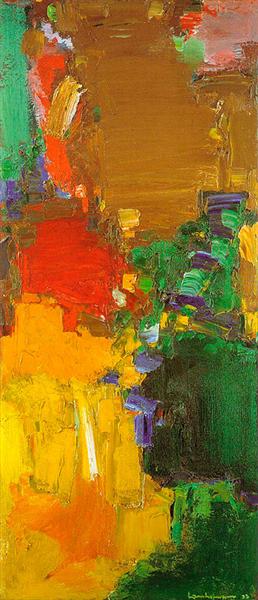
Rhapsody, 1958 - Hans Hofmann

    Rhapsody (1958) 


       Hans Hofmann

 
           ________
           

before putting variations aside, if only 

for the moment, let me explain why 

this piece, an essential component

in the history of the form in our 

Western Classical musical culture, 

is not called variations


let me get into it


Rachmaninov’s Rhapsody on a 

Theme of Paganini is, essentially, 

a set of variations, but even more 

so, it’s a concerto, for piano and 

orchestra 


what’s a concerto, a concerto is a 

sonata, a piece of music consisting 

of more than one segment, movement,   

but written for a full orchestra, and one 

central soloist


Rachmaninov has therefore combined

two musical forms, variations and the

concerto, but eliminated the pauses 

between the movements, thereby 

blocking his path to calling his work  

a concerto, which requires identifiable

separate movements


with variations, Rachmaninov asserts 

the significance of repetition in our 

Western Classical musical structure,

each variation returns us to its source,

making manifest repetition, tradition,

ritual, as primary, as essential to 

community, to one-on-one trust


but each variation allows also for a

difference in tempo, another essential

element of the Classical architecture, 

these two aspects are therefore in

something of a conflict


tonality, the third essential component

of Classical music, remains essentially

untouched, there are no discordant

episodes 


this will happen, but only later


meanwhile, listen


R ! chard

November / Month of the Sonata – 14

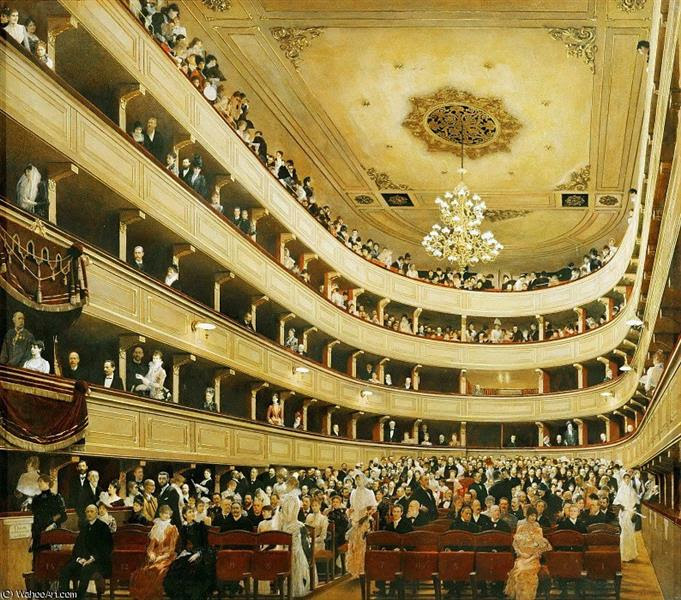
The Old Burgtheater, 1888 - 1889 - Gustav Klimt

     “The Old Burgtheater (1888 – 1889)  


              Gustav Klimt


                  _______


cause most composers, including the great 

ones, didn’t write many sonatas, or not many

to equal their greatest compositions, I’ll skip

directly from Bach to Beethoven, who first

gave sonatas their commanding position 

on the cultural map


he wrote 32, the early ones competent, 

even admirable, others inspiring, several

completely transcendental


of the 32, here’s the first of my favourites,

his 15th, in E major, Opus 28, the 

“Pastorale”, German spelling, of 1801


you might wonder about all the letters and

numbers in the naming of early music, much

of it compiled by later musicologists, cause

titles hadn’t been given to musical pieces,

even Beethoven’s “Pastorale” had been 

later provided by his publisher


music before the late Classical Period 

might’ve been written down, but not 

widely distributed, there wasn’t a 

market for it until the advent of the 

Middle Class, who now wanted 

access to what the aristocracy had


earlier, what compositions existed

would’ve been the property not of

the composer, but of the duke, 

baron, or prince who’d hired him 

for his court, see Haydn here, for 

instance, and the Estherházys


when greater demand grew for music 

manuscripts, titles little by little became 

a manner of increasing marketing,

scores found their way throughout 

Europe to supply the many amateurs

who’d gather and play before we had

television


some of these amateurs became 

noteworthy performers, who also 

began to proliferate, to fill the

burgeoning concert halls, 

see above


incidentally, there’s also a “Pastorale”

Symphony of Beethoven, in F major,

Opus 68, you might want to listen to  

and compare


enjoy


R ! chard

how to listen to music if you don’t know your Beethoven from your Bach, XVI – on Chopin

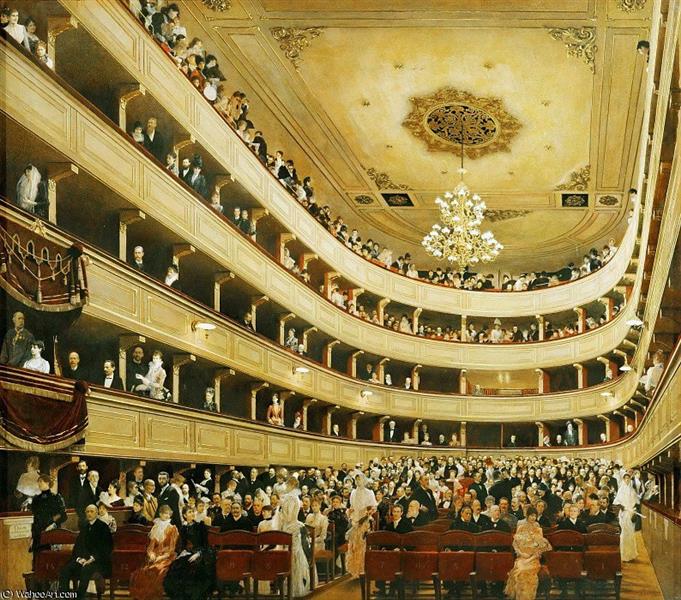
The Old Burgtheater, 1888 - 1889 - Gustav Klimt

       The Old Burgtheater (1888 – 1889)  

                  Gustav Klimt

                        _______


having brought up nocturnes and ballades

in my last instalment, however peripherally, 

I’ll dig into these deeper, to illustrate the 

impact Romanticism had on music, on 

fine arts as well, and literature, in the 

West, as it highlighted emotions as a 

requirement of the audiences that 

funded them


the French Revolution had happened,

the idea of individual rights, liberty,

equality, fraternity, spread across 

even autocracies, czars, kaisers, 

kings were threatened


theatres were becoming, because of 

the growth of the Middle Class, what 

had been the salons of the aristocrats,

people were paying for what the nobility

had been seeing, in concert halls, see

above


but the audience wanted their money’s 

worth, both in spectacle, and personal

contact, easy ingenuity was out, they

had to be impacted, get them howling,

whooping, just like today


but to return to ballades and nocturnes,

they were the answer, plangent appeals

to the heart, which had not been a 

concern of the earlier Classical Period,

where prestidigitation, technical

wizardry, had been the requirement

of the courtly courts  


ballades, nocturnes, preludes, didn’t 

exist before the Romantic Period, 

essentially, music that hadn’t a 

formal structure, hadn’t a set of 

compositional rules, but spoke, 

rather, from a place of intimacy,

unconstrainedly


here’s a balladefor instance, here’s 

a nocturne, both of Chopin, as 

identifiable as Shakespeare, van 

Gogh, in each their own particular 

vocabulary, wearing his heart on

his sleeve, and always absolutely 

extraordinary 


enjoy


R ! chard

how to listen to music if you don’t know your Beethoven from your Bach, XV – what’s a rhapsody

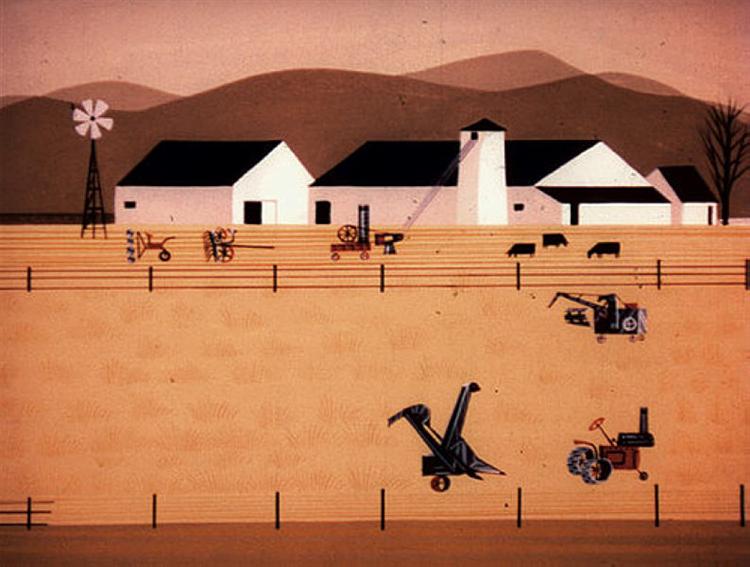
Rhapsody of Steel, 1959 - Eyvind Earle

        Rhapsody of Steel (1959)

                   Eyvind Earle

                       ________

so what’s a rhapsody

if you’ve been following at all my 

musical adventure, you’ll have 

heard by now several rhapsodies 


at first, I suggested that the rhapsody

was an evolution from the fantasia,

a piece of music in one movement

that allowed for any internal 

construction, but that, after the

Classical Period, became imbued  

with Romanticism, passion became 

a condition of music, mere technical

ability was no longer enough  


note that the audience was different,

rather than nobles who commissioned

artists to decorate their salons, the

burgeoning Middle Class was hungry 

for them to entertain, performers were

becoming the main attraction, not just

the background, see, for instance, 

Beethoven


but not only did rhapsodies spread 

from just one player to an entire

orchestra – see Brahms, then 

see Gershwin – but its essential 

structure, one movement, was 

challenged, see Ravel here, or 

Rachmaninov, whose rhapsodies 

are both composed of distinct 

movements, Rachmaninov even 

further refining his movements 

into variations, for years, I 

referred to his Rhapsody on a 

Theme of Paganini as his 

Variations


all this to say that a rhapsody is 

turning out to be not identified 

by its structure, its technical

parts, but rather by its intention,

a rhapsody is in the eye of its 

composer, like a nocturne, or 

a ballade


I’d thought that rhapsodies had 

been relegated to the Romantic 

Era, with the occasional later 

tribute


who, I wondered, could be

writing rhapsodies anymore


but here’s something, however

unexpectedly, you’ll be familiar

with, from 1975, Queen’s Bohemian

Rhapsodyin several movements 

– intro, ballad, opera, hard rock, 

outro – and including in all of them,

note, voice


all of which speaks of tradition

being a lot closer than one would 

think, ancestral, residual, but

defining, traces, like genes, 

however updated, however

posthumously interpreted,

pervade, infiltrate, pursue,

inexorably


rhapsodies are in our DNA, it

would appear, for better or for 

worse, ever


here’s to them


R ! chard


how to listen to music if you don’t know your Beethoven from your Bach, XIII – Antonin Dvořák

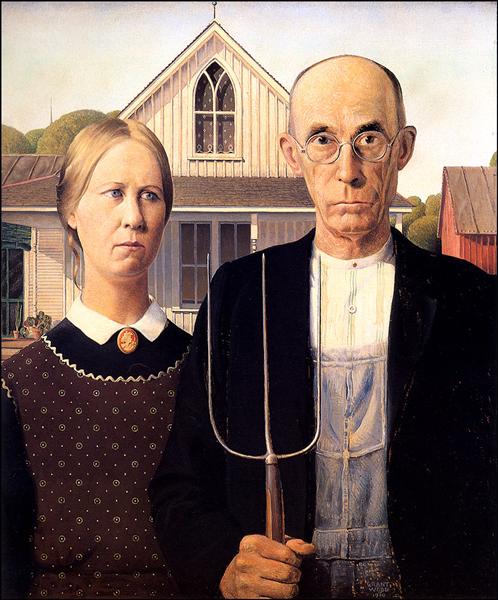
American Gothic, 1930 - Grant Wood

    “American Gothic (1930) 


                Grant Wood        


                      ______


if you were able to hear the difference

in my last communication between

Vienna and New York in the two

rhapsodies I compared, contemporaries,

incidentally, you might be interested in

European composer, highly

underestimated in my opinion, who

bridges both cultures by composing a

tribute to the country that receives him,

gloriously, for a couple of years, before

he returns, homesick, to his beloved

Bohemia, which is to say, Prague,

Antonín Dvořák, don’t ask, 1841 – 1904


here’s his 12th String Quartetnicknamed

the “American”, listen, you’ll understand

why


here’s his New World Symphonyagain

you’ll understand why


fun facts, Neil Armstrong brought a

recording of it, the New World

Symphonywith him to the moon

during the first manned landing,

back in 1969, can you get more

cool than that


also, this particular version is from

Pyongyang, which is to say, North

Korea, which is to say, the audience

here is nearly as interesting as the

symphony itself, do they even

speak the language, if they grew

up on Chinese opera


do you


R ! chard

how to listen to music if you don’t know your Beethoven from your Bach, XII – on rhapsodies 

Rhapsody, 1958 - Hans Hofmann

   Rhapsody (1958) 

           Hans Hofman 

                       _____


if, in my last instalment, I compared iconic

funeral marches, let me do the same for

a couple of iconic rhapsodies, another 

musical form that came and went, that’s

come and gone, but not forgotten

what’s a rhapsody

as far as I can make out, it’s much the 

same as a fantasia, if you can remember 

what a fantasia is, a free form composition, 

but with a Romantic, which is to say a 

heartfelt, twist, more pathos, less 

technical wizardry


Gershwin wrote his Rhapsody in Blue 

in 1924, you can hear New York, Times 

Square, Broadway, from the first wail 

of the languid horn


Rachmaninov’s Rhapsody on a Theme

of Paganini, written in 1934, ten years 

later, gives you, however, Vienna, its 

Romantic Period, the traditions of, 

a century earlier, Beethoven, Schubert 


Rachmaninov is personal, introspective,

tragic, Gershwin is extroverted, social, 

fun


Rachmaninov looked back to his 

European, Old World, traditions, 

Gershwin augurs an entirely new 

voice 


listen, you can hear it 

enjoy


R ! chard   

how to listen to music if you don’t know your Beethoven from your Bach, IX

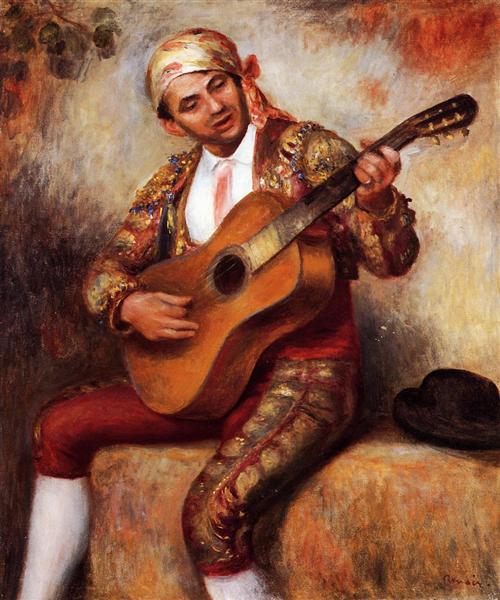
The Spanish Guitarist, 1897 - Pierre-Auguste Renoir

          The Spanish Guitarist” (1897)


                  Pierre-Auguste Renoir


                            ____________


just as I was about to relegate the trill

to Mozart and the Classical Period, I

inadvertently came upon something

wonderful by Joaquín Rodrigo, a

Spanish composer, 1901 – 1999, a

concerto for guitar


the trill had been decorative, meant to

appeal to aristocrats frequenting

salons


then the French Revolution happened,

and the growth of the Middle Class,

and consequently popular avenues

of entertainment for the liberated,

concert halls, for instance, looked

for a more emotionally powerful

experience, arpeggios took care of

that


the trill died


but in 1939, nearly two centuries

later, Rodrigo wrote his Concierto

de Aranjueza descendent pays

homage to an elder, trills abound


it should be stated that a guitar can

play only one note at a time, it might

be that trills lend themselves better

to such an instrument than an

arpeggio would


then again, I’ve found that Spanish

music, the tango, the tarantella, for 

instance, see above, has held more

rigidly to the imperatives of Western 

music I’ve spoken of here before,

tempo, tonality, repetition, it is not 

Debussy, Ravel, it is not even

Chopin, it is peripheral, maybe, to

the cultural establishment, but

potent, steeped in blood and

tradition


here’s Rodrigo giving you Mozart


enjoy


R ! chard

how to listen to music if you don’t know your Beethoven from your Bach, V

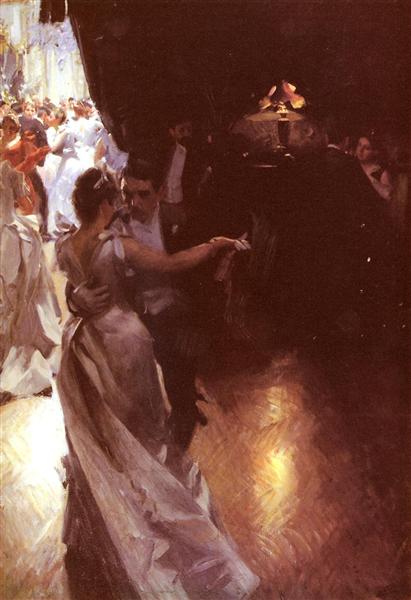
Waltz, 1891 - Anders Zorn


       Waltz” (1891)


        Anders Zorn


           ________


having brought up the idea of

longevity in my last communication,

the fantasiaa musical form that

lasted about 150 years, with hats

off nevertheless to the later Disney

classic, Fantasiaa tribute, which,

full of Classical music references,

followed in its spiritual mode, and,

after introducing Chopin, perhaps

the very representation of the

Romantic Era, that we carry, or

intuit, in our very bones, I thought

I’d talk about the waltz, a Chopin

specialty, where he created,

incontrovertibly, utter magic


who hears of the waltz anymore, an

antiquated curiosity, though even in

our not so distant blood we feel the

reverberations of its memory, the

throb of its still vibrant cultural

intensity, relevance, rhythm


tangos, incidentally followed, and

other intimate interactions, which

had been earlier frowned upon


the waltz had been the minuet,

the difference was the physical

contact, young nobles left their

aristocratic salons, however

discreetly, to frequent the

more liberal, if disreputable,

establishments – like to

speakeasies during Prohibition

– where they could explore the

new, licentious venues, as

young nobles, ever, would, for

the lure of intimate connection

with the partner


the waltz was thereby born,

couples touched, breast upon

breast, composers followed


Chopin was metaphysical, you

didn’t dance to his waltzes, you

experienced them, here’s his

Minute Waltz, Opus 64, no 1,

here’s his equally delightful

Opus 64, no 2, its companion


but Strauss ll, Johann l‘s son,

got all of Vienna to dance his, 

and everywhere else after, until  

the waltz fell out of favour 

somewhere in the 1950s, leaving

only its memories behind,  here’s          

his incandescent By the Beautiful

Blue Danubemakes you wish

you’d been there


in the one case, the waltz is

idealized, in the other, it’s the

waltz in action, listen, you can

tell the difference, you won’t 

want to dance, for instance, to 

Chopinthough you might give

it an ineffectual try, to Strauss

you’ll careen


R ! chard

Piano Concerto no 20, K.466 – Mozart (Uchida)

mozart-2015.jpg!Large

  Mozart (2015)


       Bernd Luz


          ______


having been immersed recently, indeed 

consumed by, Ovid, his Metamorphoses, 

for four months now, according to a 

friend, since, however improbably, April, 

and we’re now in mid-August, I’ve been 

redirected recently, not only for

metaphysical breath, but by friends 

who’ve brought up other ideological 

realities


I watched a concert on TV yesterday, 

my mother said this morning when I 

went over for coffee, she lives, 

providentially, to my mind, only a few 

blocks away, we touch bases regularly


great, I reacted, I’ve got it on tape, I 

was meaning to watch it later


the pianist, she marvelled, also

conducted, I’ve never seen that


I cheered her on, and couldn’t wait to 

see for myself when I got home


but couldn’t watch more than a few 

moments, the pianist / conductor, 

famous in his day, had become 

crotchety, decrepit, the piece was 

Mozart, you can’t play Mozart with 

arthritic fingers


which had me finding the mistress of 

Mozart on the internet, unmatched at 

Mozart to this day, Mitsuko Uchida, 

watch her transform Mozart’s flights 

of lyrical fantasy into utter, and 

irrepressible, magic, sent it to my

mom for incontrovertible 

corroboration


his 20th Piano Concerto, K.466


watch, marvel   


R ! chard


Chopin Piano Concerto no. 1

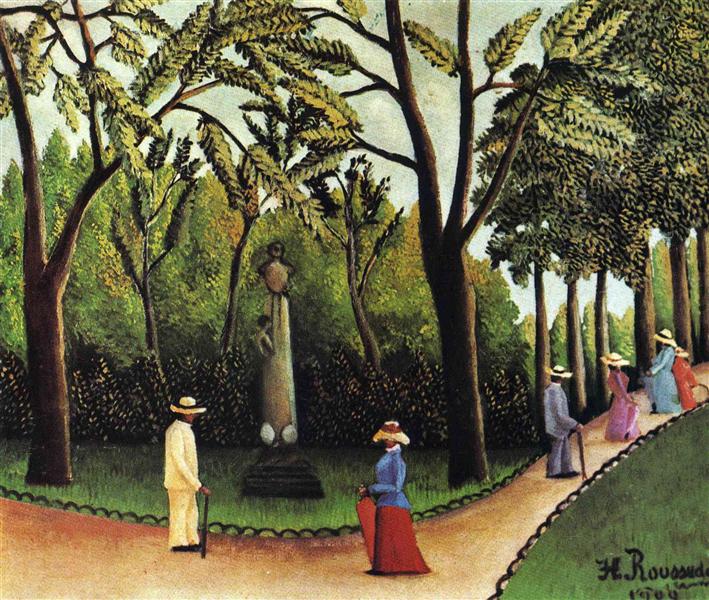
the-monument-to-chopin-in-the-luxembourg-gardens-1909.jpg!Large

   “The Monument to Chopin in the Luxembourg Gardens (1909) 


             Henri Rousseau


                   ________


                                               for Joselyn, thanks for the tip


one good Chopin Piano Concerto deserves

another, especially if it is, to my mind, superior,

however ever be these things entirely subjective, 

you decide 


here’s his First, listen, be mesmerized


R ! chard