nocturnes / scherzos, Chopin
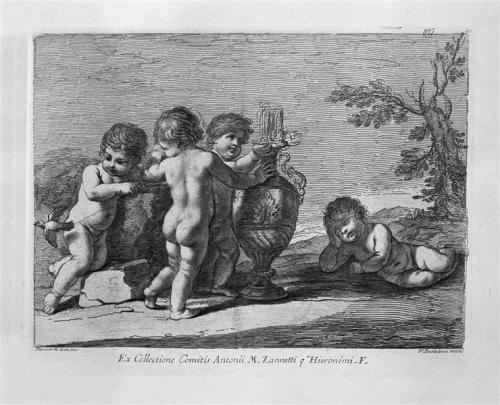
“Scherzo di putti“
Giovanni Battista Piranesi
______________
two, a scherzo
you tell me
both by Chopin
two, a scherzo
you tell me
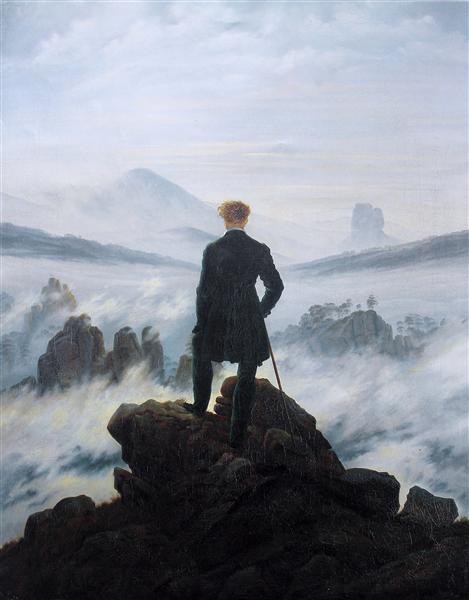
“The Wanderer above the Sea of Fog“ (1818)
_____________
if Beethoven built the Church, along
with Goethe maybe, of Romanticism,
and be assured Romanticism is an
ideology, a moral outlook, a
motivational perspective, much like
the economy is nowadays,
supplanting any more humanistic
imperatives, Brahms put up one of its
Cathedrals, just listen, the First Piano
Concerto is a monument, as mighty
as the Cologne Cathedral musically,
right next to Bonn, incidentally,
Brahms‘ birthplace
with the disintegration of the
supremacy of the Catholic deity
at the onset of the Protestant
Reformation, Luther, Calvin,
Henry Vlll and all that, bolstered
by new discoveries in scientific
speculation, that the earth wasn’t
flat, for instance, that it revolved
around the sun rather than the
other way around, contradictory,
though convincing, voices began
to abound, excite question
in the 18th Century, the Age of
Reason, the Christian Deity fell,
never effectively to be put back
together again, see for Its final
sundering, Nietzsche
in France, after the Revolution,
the Church was officially removed
from political consideration,
countermanding its centuries of
morally heinous depredations,
the United States had already at
its own Revolution separated it
from State
Romanticism was an answer to
a world wherein there might not
be a God, a world with, however,
a spiritual dimension, to respond
to the clockwork universe
envisioned by the earlier epoch,
the Enlightenment, a world where
everything could be categorized,
analyzed, predicted
Romanticism called for the
inclusion of inspiration in the mix,
there are more things in heaven
and earth, Horatio, than are
dreamt of in your philosophy,
as Shakespeare would, for
instance, have it – “Hamlet”,
1.5.167-8
poets became prophets thereby,
if they could manage it, very
oracles, the world was blessed
with, at that very moment,
Beethoven, far outstripping the
likes of, later, for example, Billy
Graham, or other such, however
galvanizing, proselytizers,
whose messages would’ve been
too, to my mind, literal
for music cannot lie, obfuscate,
prevaricate, music cannot be
fake
and then there was Schubert,
and Chopin, Tolstoy, Dickens,
Elizabeth Barrett Browning,
Robert, her husband,
Tchaikovsky, Caspar David
Friedrich, the Johann Strausses,
Byron, Shelley, Keats, whose
artworks, all, are as profoundly
in our blood, our cultural system,
as, if not more so than, our
present information about the
details of our Christian myths,
despite a superfluity of them
even, throughout the long
indeed Middle Ages, and right
up to, and including, the still
fervent then Renaissance, for
better or for worse still, for us
what Romanticism did, and
specifically through the work
of these seminal artists, was
give each of us a chance,
show us how to come
through trial and tribulation,
what a faith does, any faith
it said, here, this is my dilemma,
and this is how I deal with it
for me, Beethoven’s 32nd
Piano Sonata is, soundly, the
epitome of that, but listen to
Brahms put a stamp on it
with undaunted authority
we might be ultimately of no
consequence in an indifferent
universe, they say, but, hey,
this is what we can do, and
do gloriously, while we are
at it
Woody Allen picks up the
purpose in our own recent
20th Century, following in
the earnest footsteps of his
Existential mentor, the much
too dour, I think, Ingmar
Bergman
but that’s another story
entirely
meanwhile, listen
also watch, the conductor here,
a complete delight, is right out
of “Alice in Wonderland“, I
promise you’ll love it
R ! chard
______________
if I’m including Tchaikovsky’s Third,
and last, Piano Concerto in my survey,
it’s not because of its excellence, it is,
indeed, severely flawed, but because
I am a completist – if I’m visiting the
Cologne Cathedral, ergo, for instance,
I’ll make my way to the very top,
however treacherous might be the
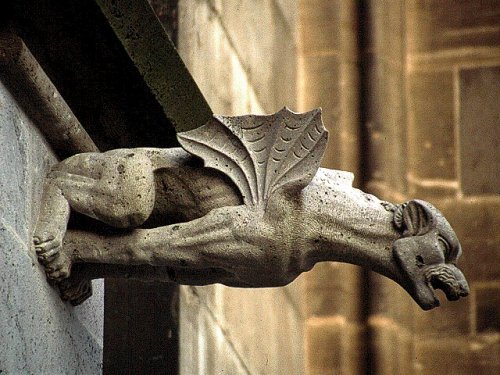
stairs, the gargoyles being worth it,
not to mention the view
first of all, it’s incomplete, Tchaikovsky
died before finishing it, you can’t blame
him for that, though he was, curiously,
complicit in his own demise, but I don’t
believe this composition and his death
are that intimately interrelated
it has only one movement, but has
nevertheless been termed a concerto
on the, debatably unsound, strength
of its intention
briefly, and this is my opinion, the
movement has no lyrical moment,
no melting melody to float you out
of the recital hall as you exit,
nothing to hum, nor to whistle as
you wistfully wend your way back
home, nothing to remember but
flash, braggadocio, bombast,
expert fingers strutting their
dazzling, even, stuff, style over
substance, I venture, won’t be
enough to whisk you into the
following centuries
Chopin, the other towering Romantic
figure standing between the spiritual
bookends of Beethoven and Brahms,
wrote two piano concertos, of which
his Second suffers from, essentially,
not being his First, however mighty
his Second here, for instance,
proves to be in this utterly convincing
performance, watch, wow
Beethoven, in other words, wrote the
book, two works, Tchaikovsky’s First
and Chopin’s First, tower above his
in the public imagination during the
ensuing High Romantic Period, after
which Brahms closes the door on the
era with his two powerful masterpieces
for piano and orchestra
of which more later
there are other piano concertos
along the way, but Beethoven’s
five, Tchaikovsky’s and Chopin’s
one each, and Brahms two are
the basics – but let me add, upon
further consideration, and for a
a perfect ten options, Liszt, his
own, of two, First Piano Concerto –
what you need to consider yourself
comfortably aware of the essentials
of music in the 19th Century, the
culture’s predominant voice then,
until art, painting, took over as the
Zeitgeist‘s most expressive medium
with Impressionism
of which more later
R ! chard

“The Birth of Venus” (1485)
___________
if there’s a piano concerto that dominates
the 19th Century, it’s Tchaikovsky’s First
Piano Concerto, not even Beethoven’s
Fifth, to my mind, matches its celebrity,
one thinks Romantic Period, one thinks
this iconic masterpiece
Tchaikovsky had the advantage of
absorbing not only Beethoven by this
point in history, but also Chopin, the
narrative power of the former, with
the mesmerizing textures of the latter,
what could go wrong but insufficient
genius
of which Tchaikovsky manifestly had
more than plenty, enough to verily
stop your breath
many towering performers have
challenged this concerto‘s peaks,
some even historically, you’ve
heard them, I won’t reiterate
but listen to what Yuja Wang does with
this challenge, and you tell me if she
doesn’t conquer its tribulations,
despite, or abetted by, her
controversial dress
she is a vixen, manifestly, at least in,
admittedly, her attire, but should a
vixen play as brilliantly, what does
one have to counter her provocative
presentation but her innate femininity,
her, too often castigated, female pulse,
something the world could do with a
lot more of
Venus, with all her allure, was goddess
for centuries before women were
obliterated from the dominant Christian
pantheon, the Father, the Son, the Holy,
I ask you, Ghost, with no equal female
foundational representative
Yuja Wang, a modern day Venus abetted
by her evident attendant muses, the
symbolic, here, orchestra, see above,
could play nude, as far as I’m concerned,
she’d still be transcendent, and I’m not
even heterosexual
girlfriend, I say, however proper, modest,
blushing, get a grip
not to mention that Tchaikovsky is also,
in this outing, once again, astounding
R ! chard
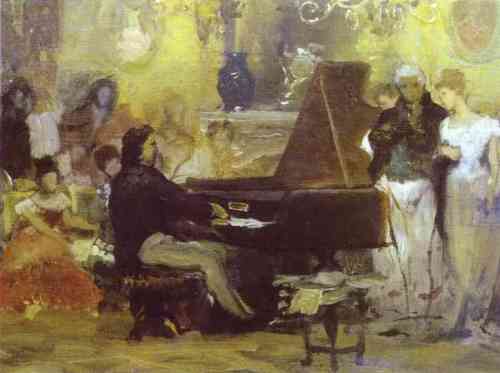
“Chopin Performing in the Guest-Hall of Anton Radziville in Berlin in 1829”
(1887)
________
Chopin’s Piano Concerto no 1, written
in 1830, is in the same mold as both
the Beethoven Violin Concerto, 1806,
and Paganini’s 5th, a synchronous
1830, three movements, fast, slow,
fast, a long symphonic introduction,
followed by miracles of articulation
by the virtuosic soloist, with, however,
differing degrees of emotional impact
Beethoven is evidently the source,
and model, for both later compositions
having clearly preceded them by a
number of years, but neither Chopin
nor Paganini have the chops to match
his magisterial orchestration
Chopin, like Paganini, was confined to
essentially one instrument, of which,
however, both were utter masters, and
manifestly and profoundly there inspired,
but in either, once the solo part takes
flight, the symphony is merely
packaging, no longer an equal partner
Beethoven has parts for all his players,
his is a conversation, not a declamation
but Chopin, 1830, had learned by then,
and integrated from Beethoven the
lesson of how to incorporate drama
into his high wire act, the constant
repetition of a melting air, a musical
motive, which Paganini hadn’t, Chopin
not only could fly, but also knew how
to dress for it, to become a virtual
angel of mercy and compassion up
there under the biggest of tops, his
immortality
don’t take my word for it, though,
you’ve probably heard already Chopin‘s
work, a very emblem of 19th Century
Romanticism, somewhere in your
subconscious you know this melody,
heard it before, it’s part of our Western
culture
not so the Paganini
what’s kicked
see above
you’ll hear your senses talking, the
language of music and art, more
accurate eventually than any of my,
however erudite, however informed,
but merely ruminative, words, art
being, once again, in the eye, the
ear, in this case, of the beholder,
or here, the be-hearer
listen
R ! chard
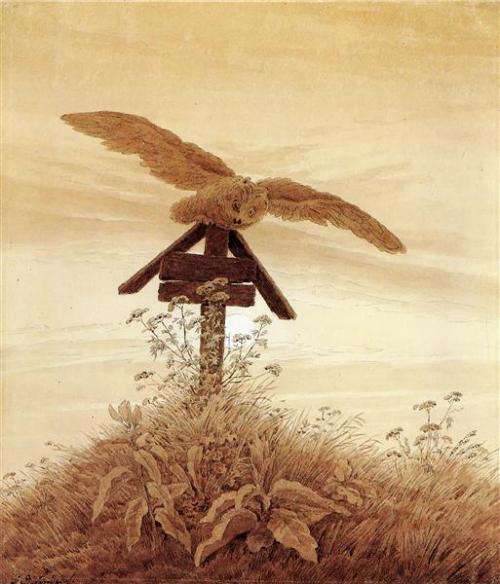
“Owl on a Grave” / “Eule am Grab“ (c.1836 – c.1837)
_______
following my nose rather than
my intellect in my exploration
of musical treasures, like a very
Aladdin uncovering at the click
of my password a cave full of
priceless wonders, I might find
stuff out of sequence, but gems
nevertheless, and I can’t just
whisk by without acknowledging
them, however peripheral to my
main task
it’s like heading towards the Eiffel
Tower in Paris, and not stopping
at the Arche de Triomphe
though I’d debated so soon
presenting these two pieces,
not because of their chronology
especially, though also that, but
mostly because of their dour
content, I’ll point out that the
move from Classicism to
Romanticism is the transition
from dance music, delightful
music, to drama, passion,
powerful emotions, dirges,
therefore, are not out of place,
however mournful
thus the two most famous
funeral marches, Beethoven’s,
Chopin’s, the third movement
in either of their home sonatas
the clincher for me was the
immaculate performance of
the Chopin here, a revelatory
moment, though the Beethoven,
significantly earlier, the tune,
1801, 1837, is nevertheless
unimpeachable, however still
underdeveloped – four variations
only in the first movement, for
instance, and all of them
elementary – the caterpillar had
not yet become the butterfly, the
apple blossom the apple
note that each movement in the
Chopin, apart from the last, has
two distinct tempi, executed
effortlessly and nearly
imperceptibly, a total of six, you
can’t see, you can’t hear, the
seams as you listen, which, with
its virtual therefore episodes,
conflicting and tortuous
emotions, constitute collectively
a drama, a narrative, music has
become literature
the last movement of the Chopin
moves beyond even tempo –
Beethoven’s also, incidentally,
nearly – creating therefore a
very challenge to it, both trying
to transcend tempi, an area to
closely watch
Beethoven’s Piano Sonata no 12
take your pick
both are supremely, mark,
instructive
R ! chard
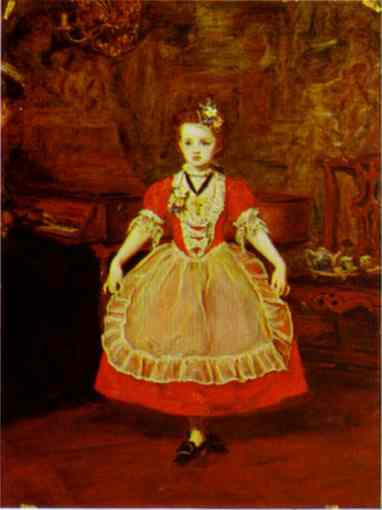
“The Minuet“ (1866)
_________
having pointed out that the minuet
and the waltz were historically
related, let me somewhat
extrapolate
they are both in 3/4 time, which is
to say, three quarter-notes to the
bar, which means that when
you’re dancing, your beat is one,
two, three, one two three, with
the accent, usually, on the first
note
so what happened, how could two
identical frameworks turn out so
differently
here’s Bach, 1725, his Minuet in G
the first thing you’ll think is, o, so
that’s what that is, it is an iconic
number written on our collective
consciousness
the second thing you’ll notice is
that it is choppy, however delightful,
that it is written for a harpsichord,
and that it’s probably not ready,
despite it’s 3/4 time, to be a waltz,
too many curtsies
here’s Mozart, 1762, his Minuet in G
though you might not want to admit
it, I suspect this number is much
more present in your subconscious
than you’d think, see if you don’t
find yourself later on humming it
but it’s still way too polite to be a
waltz, you can easily imagine the
partners, hands held high together
around their imaginary maypole,
courting, but there’s a touch more
fluidity in the progression of the
notes, it is written for a fortepiano,
an instrument that has added the
hold, or the sustain, pedal to the
harpsichord to increase a note’s
resonance, a loosening of the
earlier constraints of that
quintessentially Baroque
instrument, a cannily apt
metaphor, take into account, for
the unfolding cultural r/evolution
here’s Beethoven, 1796, his Minuet
in G, you’ve heard this one too
the Revolution has taken place,
but entrenched in the music of an
earlier era, the beat remains the
same, this is not a waltz, despite
it’s 3/4 progression
you’ll note, however, more spin
to the cadences, more give, more
elasticity, much of this has to do
with the development of the
central instrument, which was
about to become a pianoforte,
instead of a fortepiano, but
‘nough said about that, I’ll let
you feel it
here’s Chopin, 1833, his Grande
valse brillante, Opus 18, written
for itself, the piano, it is indeed
a waltz, the difference is in the
piano’s ever evolving flexibility,
again a metaphorical expression
of, or an avatar for, the unleashing
of personal freedom, an idea spun
ineradicably from the lessons of
the French, and the, incidentally,
nearly simultaneous, 1776, 1789,
American Revolutions
for better or for worse
R ! chard
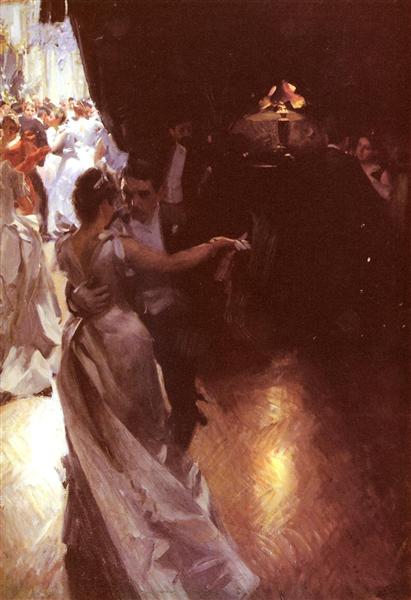
“Waltz“ (1891)
________
inadvertently, during my last comments,
I let slip, perhaps, prematurely – cause I
thought I’d explore earlier Romantic
pieces first, more Beethoven, more
Paganini – the word waltz, when I
referenced the “Minute Waltz”, a dance
which expressed a sea change in
Western cultural history made
manifest through music
though the waltz was already the rage
in lowlier social circles in the late
1700’s, the minuet still held sway in
the more aristocratic salons, whose
young swains nevertheless would
skip out to ferret out the servants’
quarters, as young swains do
slowly the dance, for its more
informal aspects, not to mention
its sensuous intimacy, became so
astonishingly mainstream as to
define pretty well the very century,
Chopin and the Strausses, Father
and Son, would take care of that,
the last two making a carnival out
of very Vienna
but until the late 1820’s, not much
was heard of the waltz in the
musical curriculum, at which
point it’ll come in with a vengeance
not much from Beethoven, who, in
his fifties, was probably about as ,
interested in waltzes as I am in hip
hop, a ditty only, a trifle, this one,
1824, one of only two waltzes
from him
here’s Johann Strauss l, however,
his “Carnival in Venice“, 1828, is a
waltz in “Carnival“ clothing, like
cadenzas, for instance, in the
guise of Paganini “Caprices”
here’s Johann Strauss ll, the son,
with his “Wiener Blut“, “The Spirit
of Vienna“, electrifying, 1873, the
late already 19th Century
but here’s Chopin doing his stuff,
1847, right in the middle of both,
from far away Paris, which was
going through its list of Empire
changes right about then, his
Waltz in C-sharp minor
Chopin’s waltz is a more decorous
composition, more courtly, more
also introspective, contemplative,
private, indeed Romantic
note how strongly the Classical
unities still apply here, tempo,
tonality and repetition, even more
markedly than in Beethoven, Chopin
is Mozart, but with more sentiment,
and perhaps more rubato, stretching
the rhythm in composition to
accommodate a dancer’s presumed
dip, in his otherwise meditational
compositions
the waltz will undergo trials and
tribulations later, as the world
turns, but I’ll keep those
reflections for later
meanwhile, choose your partner
R ! chard
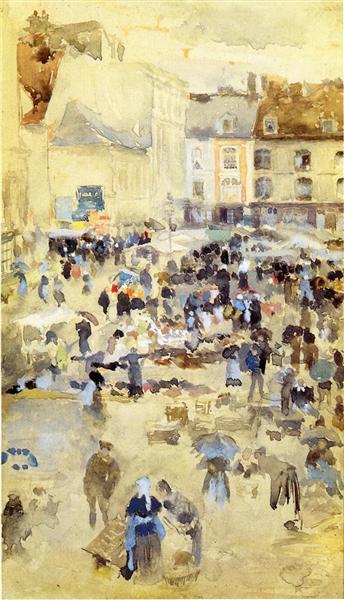
“Variations in Violet and Grey – Market Place“ (1885)
___________
strolling through my virtual musical park
today, in, indeed, the very merry month
of May, I was taken by surprise by, nearly
tripped over, in fact, a Beethoven work,
written in the very year, 1806, of the
“Razumovsky”s
I’d overlooked it cause it is without an
opus number, is listed, therefore, as
WoO.80, and is, consequently, easily
lost in the wealth of Beethoven’s
more prominently identified pieces,
but it is utterly miraculous, I think,
and entirely indispensable
I’d said something about it in an earlier
text, back when I was somewhat more
of a nerd, it would appear, perhaps even
a little inscrutable, though it’s
nevertheless, I think, not uninformative,
you might want to check it out, despite
its platform difficulties
the 32 Variations in C Minor are shorter,
at an average of 11 minutes, than Chopin’s
“Minute Waltz”, relatively, a variation every
half minute, where Chopin’s nevertheless
magical invention takes twice that to
complete its proposition
but in this brief span of time, this more
or less 11 minutes, Beethoven takes
you to the moon and back
a few things I could add to my earlier
evaluation, could even be reiterating,
Beethoven in his variations explores a
musical idea, turns it in every which
direction, not much different from what
he does in the individual movements of
his string quartets, his trios, his
symphonies, concertos and sonatas,
with their essential themes, motives,
they’re all – if you’ll permit an idea I got
from Paganini’s “Caprices” – cadenzas,
individual musings inspirationally
extrapolated, which, be they for
technical brilliance, or for a yearning
for a more spiritual legacy, set the
stage for a promise of forthcoming
excellence
this dichotomy will define the
essential bifurcated paths of the
musical industry, during, incidentally,
the very Industrial Revolution, their
mutual history, confrontation, for the
centuries to follow, which is to say,
their balance between form and
function, style versus substance,
Glenn Gould versus Liberace, say,
or Chopin, Liszt
before this, it’d been the more
sedate, less assertive evenings at
the Esterházys, to give you some
perspective, mass markets were
about to come up, not least in the
matter of entertainment
Beethoven was, as it were, already
putting on a show
R ! chard
psst: these alternate “Variations” put you in
the driver’s seat, a pilot explains the
procedures, it’s completely absorbing,
insightful, listen
 Richibi's Weblog