“Années de pèlerinage”, 2nd Year – Liszt

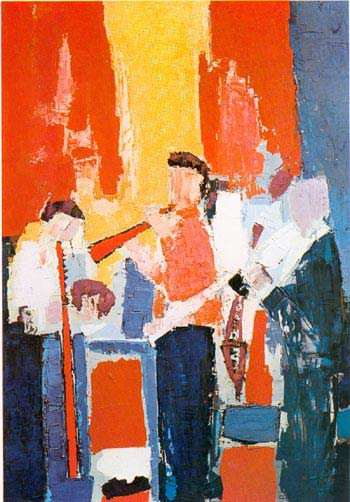
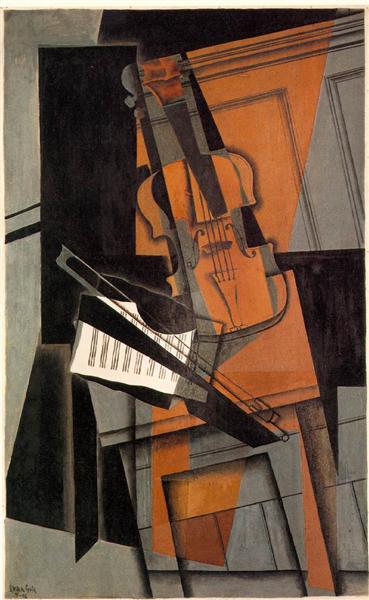
“The Violin“ (1916)
_____
if I was able to bring up a list of
ten top Romantic piano concertos
throughout the 19th Century earlier,
I can number of violin concertos
only three essential ones, with,
however, two other significant
such compositions, which remain,
for one reason or another,
peripheral, secondary
more about which later
but the exalted three are situated
conveniently, the first, at the very
beginning of the Romantic Era,
Beethoven’s magisterial, even
extraordinary, Opus 61 in D major,
1806, and close doubly with the
two others, Tchaikovsky’s
resplendent work, words cannot
do it justice, and Brahms’ no less
transcendental one, at its very end,
1878, none are negligible, it’d be
like missing the Eiffel Tower while
in Paris, skipping the pyramids
along the Nile, they are part of our
cultural consciousness, it would
be an utter shame to pass them
by, they are our glory, our
magnificent heritage
it should be noted that the
concerto, be it for violin, piano,
cello, what have you, a soloist
in concert with an array of
instruments, is the perfect allegory
for the Romantic Era, an individual
in contention with a community,
under the influence of a conductor,
a mayor, a mentor, a polity, the
individuality afforded by the
proclamation of human rights in
the aftermath of the French
Revolution, and its social
consequences, musically
manifested
the match might be fraught,
should be, though with
compromise, considerate
accommodation, fruitful,
hopefully even transcendental,
if not at least entertaining,
cooperation, music seems to
infer eventual concord,
congress, harmony, a way out
of, even dire, distress, or at
least point the way toward it
concertos die out, incidentally, in
the 20th Century, you don’t hear
of very many, if any at all, after
Rachmaninoff, they are gone,
much like later, in the 1950s, the
waltz, forever, with the wind
may they rest in peace
R ! chard
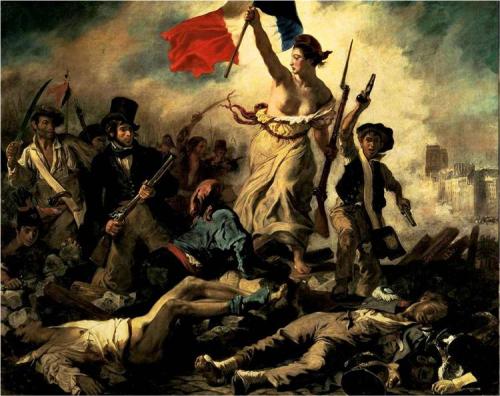
“Liberty Leading the People“ (1830)
_________
for everyone, with great gratitude,
who reads me, I mean only to
bring poetry, which is to say,
light
though I’d considered leaving the
Romantic Piano Concertos behind
to explore other areas of the period
in this survey, it seemed unfair,
indeed remiss of me, not to include
the three among my top ten that I
haven’t yet highlighted, Beethoven’s
2nd, 3rd, and 4th Piano Concertos,
Opuses 19, 37, and 58 respectively,
after all, these are where the spirit
of the age, the Zeitgeist, was
constructed, like a building, with
walls, windows, a hearth, all of
which would become a church,
then a Church, and by the time of
Brahms, a very Romantic Cathedral
the foundation had already been laid
by Mozart with his 27, but music had
not yet become anything other than
an entertainment by then, or
alternatively, an accessory to
ceremonial pomp and circumstance,
see Handel and England for this, or
liturgical stuff, see, among many
others here, Bach
but with the turn towards
independence of thought as the
Enlightenment progressed, cultural
power devolved from the prelates,
and their reverent representations,
to the nobles, who wanted their own
art, music, which is to say, something
secular, therefore the Classical
Period, 1750 – 1800, in round figures
then in the middle of all that, 1789,
the French Revolution happened,
and the field was ripe for prophets,
anyone with a message of hope,
and a metaphysical direction, midst
all the existential disarray – the Age
of Reason had set the way,
theoretically, for the possibility of a
world without God, something, or
Something, was needed to replace
the The Trinity, the Father, the Son,
and the Holy Ghost, Who had been
seeing Their supremacy contested
since already the Reformation
Beethoven turned out to be just
our man, don’t take my, but history‘s
authentification of it, see the very
Romantic Period for corroboration
in a word, Beethoven established a
Faith, a Vision, not to mention the
appropriate tools to instal this new
perspective, a sound, however
inherited, musical structure – his
Piano Concertos Two, Three, and
Four, for instance, are paramount
amongst a host of others of his
transcendental revelations
briefly, the initial voice, I am here, in
the first movement, is declamatory,
even imperious, but ever
compositionally solid, and proven,
tempo, tonality, recapitulation, the
materials haven’t changed from the
earlier Classical epoch, just the
design, the interior, the
metaphysical conception
his construction is masterfully
direct, the line of music is
throughout ever clear and concise,
despite flights of, often, ethereal,
even magical, speculation, you
don’t feel the music in your body
as you would in a dance, as in the
earlier era, of minuets, but follow
it, rather, with your intellect, you,
nearly irresistibly, read it
but the adagio, the slow movement,
the middle one Classically, is always,
for me, the clincher, the movement
that delivers the incontrovertible
humanity that gave power to the
Romantic poet, who touched you
where you live
Beethoven says life is difficult, and
eventually, at the end of his Early,
Middle and Late Periods, life may
even have no meaning
but should there be someone, he
says, who is listening, Someone –
though implicit is that one may be
speaking to merely the wind – this
is what I can do, this is who I am
and while I am here, however
briefly, I am not insignificant, I
can be worthy, even glorious,
even beautiful, I am no less
consequential, thus, nor
precious, than a flower
for better, of course, or for worse
R ! chard
_____________
if Brahms’ 2nd Piano Concerto is, to my
mind, the last one of the Romantic Period,
Beethoven’s First is, accordingly, the first
I thought it, therefore, instructive to pair
them
Beethoven, impelled by ideological
speculations, built not only a variation
on what had come before, music as
entertainment, a reason to dance, but
gave it a greater, which is to say,
philosophical, dimension
by extending the reach of the cadence
beyond the usual metered rhythm,
sending the melodic statement
beyond an otherwise constricting bar
line, Beethoven turned a lilt into a
sentence, a ditty into a paragraph
Shakespeare does the same thing to
poetry, for instance, with iambic
pentameter devoid of rhyme
“But, soft! what light through yonder window breaks?
It is the east, and Juliet is the sun.
Arise, fair sun, and kill the envious moon,
Who is already sick and pale with grief,
That thou her maid art far more fair than she”
and with this newfound oratory,
peremptory, insistent, imbued,
however, with utterly convincing
honesty, unfettered emotion,
which is to say, humanity,
Beethoven establishes the
sensibility of a very era, listen
that era, up to, eventually, Brahms,
elaborates on that ethos, adding
texture and enhanced authority
to the original concept, setting
the moral agenda for that, and
other generations, to follow
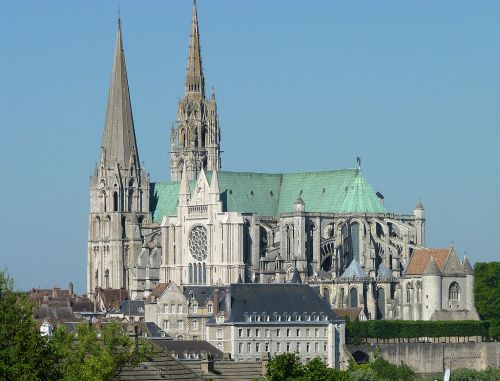
Brahms is more ponderous, mighty,
a cathedral instead of a church, a
commandment instead of an
aspirational, merely, thrust, he
adds even a fourth movement to
an already magnificent structure,
an extra steeple to a towering
edifice, a subliminally received
reference to Beethoven‘s already
inspired, but tripartite only,
architecture
see Chartres for a comparable
ecclesiastical counterpart
R ! chard
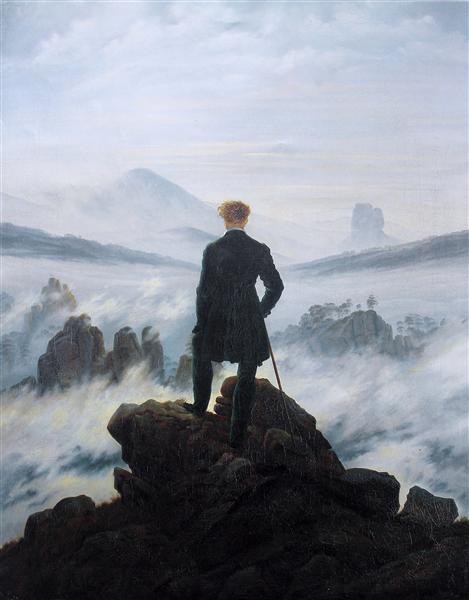
“The Wanderer above the Sea of Fog“ (1818)
_____________
if Beethoven built the Church, along
with Goethe maybe, of Romanticism,
and be assured Romanticism is an
ideology, a moral outlook, a
motivational perspective, much like
the economy is nowadays,
supplanting any more humanistic
imperatives, Brahms put up one of its
Cathedrals, just listen, the First Piano
Concerto is a monument, as mighty
as the Cologne Cathedral musically,
right next to Bonn, incidentally,
Brahms‘ birthplace
with the disintegration of the
supremacy of the Catholic deity
at the onset of the Protestant
Reformation, Luther, Calvin,
Henry Vlll and all that, bolstered
by new discoveries in scientific
speculation, that the earth wasn’t
flat, for instance, that it revolved
around the sun rather than the
other way around, contradictory,
though convincing, voices began
to abound, excite question
in the 18th Century, the Age of
Reason, the Christian Deity fell,
never effectively to be put back
together again, see for Its final
sundering, Nietzsche
in France, after the Revolution,
the Church was officially removed
from political consideration,
countermanding its centuries of
morally heinous depredations,
the United States had already at
its own Revolution separated it
from State
Romanticism was an answer to
a world wherein there might not
be a God, a world with, however,
a spiritual dimension, to respond
to the clockwork universe
envisioned by the earlier epoch,
the Enlightenment, a world where
everything could be categorized,
analyzed, predicted
Romanticism called for the
inclusion of inspiration in the mix,
there are more things in heaven
and earth, Horatio, than are
dreamt of in your philosophy,
as Shakespeare would, for
instance, have it – “Hamlet”,
1.5.167-8
poets became prophets thereby,
if they could manage it, very
oracles, the world was blessed
with, at that very moment,
Beethoven, far outstripping the
likes of, later, for example, Billy
Graham, or other such, however
galvanizing, proselytizers,
whose messages would’ve been
too, to my mind, literal
for music cannot lie, obfuscate,
prevaricate, music cannot be
fake
and then there was Schubert,
and Chopin, Tolstoy, Dickens,
Elizabeth Barrett Browning,
Robert, her husband,
Tchaikovsky, Caspar David
Friedrich, the Johann Strausses,
Byron, Shelley, Keats, whose
artworks, all, are as profoundly
in our blood, our cultural system,
as, if not more so than, our
present information about the
details of our Christian myths,
despite a superfluity of them
even, throughout the long
indeed Middle Ages, and right
up to, and including, the still
fervent then Renaissance, for
better or for worse still, for us
what Romanticism did, and
specifically through the work
of these seminal artists, was
give each of us a chance,
show us how to come
through trial and tribulation,
what a faith does, any faith
it said, here, this is my dilemma,
and this is how I deal with it
for me, Beethoven’s 32nd
Piano Sonata is, soundly, the
epitome of that, but listen to
Brahms put a stamp on it
with undaunted authority
we might be ultimately of no
consequence in an indifferent
universe, they say, but, hey,
this is what we can do, and
do gloriously, while we are
at it
Woody Allen picks up the
purpose in our own recent
20th Century, following in
the earnest footsteps of his
Existential mentor, the much
too dour, I think, Ingmar
Bergman
but that’s another story
entirely
meanwhile, listen
also watch, the conductor here,
a complete delight, is right out
of “Alice in Wonderland“, I
promise you’ll love it
R ! chard
______________
if I’m including Tchaikovsky’s Third,
and last, Piano Concerto in my survey,
it’s not because of its excellence, it is,
indeed, severely flawed, but because
I am a completist – if I’m visiting the
Cologne Cathedral, ergo, for instance,
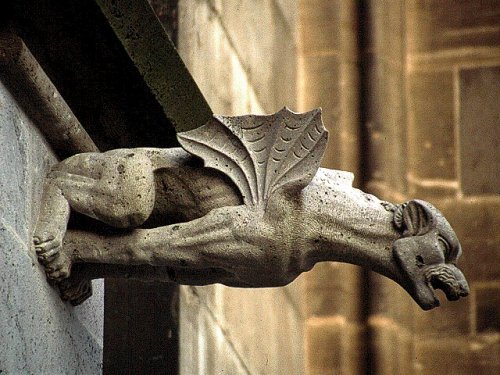
I’ll make my way to the very top,
however treacherous might be the
stairs, the gargoyles being worth it,
not to mention the view
first of all, it’s incomplete, Tchaikovsky
died before finishing it, you can’t blame
him for that, though he was, curiously,
complicit in his own demise, but I don’t
believe this composition and his death
are that intimately interrelated
it has only one movement, but has
nevertheless been termed a concerto
on the, debatably unsound, strength
of its intention
briefly, and this is my opinion, the
movement has no lyrical moment,
no melting melody to float you out
of the recital hall as you exit,
nothing to hum, nor to whistle as
you wistfully wend your way back
home, nothing to remember but
flash, braggadocio, bombast,
expert fingers strutting their
dazzling, even, stuff, style over
substance, I venture, won’t be
enough to whisk you into the
following centuries
Chopin, the other towering Romantic
figure standing between the spiritual
bookends of Beethoven and Brahms,
wrote two piano concertos, of which
his Second suffers from, essentially,
not being his First, however mighty
his Second here, for instance,
proves to be in this utterly convincing
performance, watch, wow
Beethoven, in other words, wrote the
book, two works, Tchaikovsky’s First
and Chopin’s First, tower above his
in the public imagination during the
ensuing High Romantic Period, after
which Brahms closes the door on the
era with his two powerful masterpieces
for piano and orchestra
of which more later
there are other piano concertos
along the way, but Beethoven’s
five, Tchaikovsky’s and Chopin’s
one each, and Brahms two are
the basics – but let me add, upon
further consideration, and for a
a perfect ten options, Liszt, his
own, of two, First Piano Concerto –
what you need to consider yourself
comfortably aware of the essentials
of music in the 19th Century, the
culture’s predominant voice then,
until art, painting, took over as the
Zeitgeist‘s most expressive medium
with Impressionism
of which more later
R ! chard

“The Birth of Venus” (1485)
___________
if there’s a piano concerto that dominates
the 19th Century, it’s Tchaikovsky’s First
Piano Concerto, not even Beethoven’s
Fifth, to my mind, matches its celebrity,
one thinks Romantic Period, one thinks
this iconic masterpiece
Tchaikovsky had the advantage of
absorbing not only Beethoven by this
point in history, but also Chopin, the
narrative power of the former, with
the mesmerizing textures of the latter,
what could go wrong but insufficient
genius
of which Tchaikovsky manifestly had
more than plenty, enough to verily
stop your breath
many towering performers have
challenged this concerto‘s peaks,
some even historically, you’ve
heard them, I won’t reiterate
but listen to what Yuja Wang does with
this challenge, and you tell me if she
doesn’t conquer its tribulations,
despite, or abetted by, her
controversial dress
she is a vixen, manifestly, at least in,
admittedly, her attire, but should a
vixen play as brilliantly, what does
one have to counter her provocative
presentation but her innate femininity,
her, too often castigated, female pulse,
something the world could do with a
lot more of
Venus, with all her allure, was goddess
for centuries before women were
obliterated from the dominant Christian
pantheon, the Father, the Son, the Holy,
I ask you, Ghost, with no equal female
foundational representative
Yuja Wang, a modern day Venus abetted
by her evident attendant muses, the
symbolic, here, orchestra, see above,
could play nude, as far as I’m concerned,
she’d still be transcendent, and I’m not
even heterosexual
girlfriend, I say, however proper, modest,
blushing, get a grip
not to mention that Tchaikovsky is also,
in this outing, once again, astounding
R ! chard
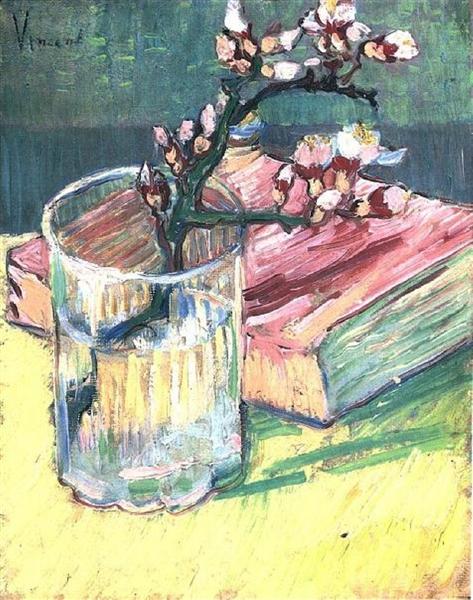
“Blossoming Almond Branch in a Glass with a Book“ (1888)
__________
if Tchaikovsky’s 2nd Piano Sonata hasn’t
remained in the canon, if it isn’t one of
the pieces you’ve heard if only through
the grapevine, it’s, I suspect, cause it’s
essentially not an advance on other more
prescient works in the form, other more
oracular compositions
Beethoven had paved the way for the
Romantic Period, nearly invented it,
established incontrovertibly the
dimensions of the sonata, notably its
purpose, its structure, Schubert had,
however belatedly, confirmed it, with
works equal to his, and even, here
and there, superior, listen
but having reached the summit of
what a sonata could say, the form
little by little withered in its several
Romantic permutations, Tchaikovsky
here, for example, and became mere
elaborations upon a waning theme
rather than exciting, and revelatory,
productions
the sonata would survive, but
transformed by another era,
Impressionism, Tchaikovsky would
as well, of course, but not through
his sonatas
his Second, however, is not not
worth a listen, would you pass,
for instance, on a less celebrated,
perhaps, van Gogh, see above
Tchaikovsky’s, therefore, Second
R ! chard
___________
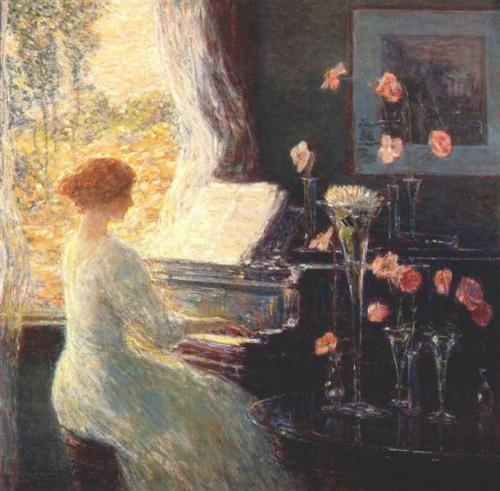
for Sarah and Rachel, the daughters
of the son of a dear cousin, after a
belated lunch recently, two young
girls, 14, 16, in bloom, as Proust
would say, who speak not only
music, but French and English,
fluently, I checked – perhaps
even German, their Oma
lives with them – they also
play the flute, the piano,
and sing, what could be
I ask you, more beautiful,
two young girls in bloom,
indeed in very blossom
or am I being too French
the form of the sonata had been established
decisively during the Classical Period, out
of the rudiments of Bach’s own such pieces,
Mozart and Haydn had given the concept its
final shape, its structure, three or four
contrasting movements, by definition all
entertainments
Beethoven kicked the entertainment part
right out of the ball park, made his show
into a veritable transcendental meditation,
rather than to merely applaud, audiences
gasped, were meant to be awed, as I still
ever am by his musical speculations
but by definition as well, a sonata is a
piece for a single instrument, therefore
inherently introspective, whether the
player has an audience or not, soloists,
note, play easily on their own
even an accompanied sonata, as violin
sonatas often are, for instance, or this
one for two pianos, would lose the
intimacy of a solo piece, for having
someone playing, however compatibly,
over one’s shoulder
in other words, a piano sonata is, by
definition, a monologue, a soliloquy,
where notes tell the story that words
would intimately, even confessionally,
in poetry, convey
the emotions that are elicited from
a piece are as real as they would
be from any literary alternative,
except that they’re quickened, like
aromas, through the senses, rather
than through divisive, by definition
confrontational, logic
rosemary reminds me always, for
instance, of one of my departed
aunts, like the taste of a madeleine
dipped in tea opened the door for
Proust to an entire earlier epoch,
the seed, the subject, of his
disquisition on Time, “À la
recherche du temps perdu“, “An
Exploration into Elapsed Time“,
my own translation, none of the
published proffered titles
having rendered the subtlety
of the shimmering original
rosemary, in other words, speaks,
if even only to me
listen to Tchaikovsky’s First Piano
Sonata, in C# minor, opus 80, one
of only two of his, what do you
hear, think, feel
R ! chard
 Richibi's Weblog
