Richibi’s Weblog

Just another WordPress.com weblog

Category: Beethoven

Beethoven‏’s “Pathétique Sonata”, no 8 in C minor, opus 13

the very first chord of Beethoven’s Pathétique Sonata,
no 8 in C minor, opus 13, does the same for the
Romantic Era as Descartes’ “I think, therefore I am”
and Shakespeare’s “To be, or not to be” did for the
Age of Reason, it defined its parameters, and set it
on its path, I can think of no other literary equivalent
with anywhere near the same power, the same clarity
and precision as that bold, peremptory statement for
that burgeoning period
 
Delacroix, too nationalistic, the Romantic poets too
introspective, Beethoven perfect, blending the political
with the personal, the personal with the philosophical,
the philosophical with the transcendental, and the
transcendental finally with the sublime, you come out
of a Beethoven composition not only entertained but
informed, inspired, transformed, he takes you there 
 
 
though unknown, to me at least, not yet among the
immortals, Daphne Honma acquits herself quite well
here in Beethoven’s masterpiece, perhaps a little too
plodding at the beginning, I thought, for my taste,
stretching nearly embarrassingly her sforzandos,
those initial arresting statements, Beethoven would
never ‘ve called for that, too much melodramatic
excess would only blur, he knew, the sheen of
unadulterated oracles 
 
but all is soon set aright, indeed redeemed by what
comes next, Daphne Honma deserves much more
applause than is here her portion
 
 
one of Beethoven’s early works, it’s 1798, Beethoven
is 27
 
 
Richard
 
psst: an “unadulterated oracle” 


from Haydn to Beethoven‏

in my pantheon of pianists Sviatoslav Richter, 1915-1997, 
is a paragon, if you’ll pardon that parade of p’s, here he
plays two not especially eminent Classical masterworks, 
though neither not uninteresting nor unimportant
 
 
Haydn, along with other composers of his time, wrote
sonatas mostly for their students, young ladies frequently
looking for marriageable advantage, he saved the cream
therefore of his art for his more public pieces, symphonies,
oratorios, string quartets, these last, to my mind, his most 
impressive vehicle
 
you’ll nevertheless be delighted by this effervescent musical
 
Richter plays it in the dark, in his later years a personal 
idiosyncracy
 
it’s 1984
  
 
you’ll note in a Classical musical composition even the
adagio, the slow movement, will be wistful, never even
melancholy, never ever forlorn, considered impudent, 
impertinent, by a genteel aristocracy, their code of
noblesse oblige would’ve frowned on emotional excess, 
considering it undignified, common 
 
Beethoven’s fire bursts through these Classical strictures
already in his very first piano sonata, opus 2, no 1
adhering to the Classical sonata form, even its intention,
but he’s revealed unequivocally by his passion and fury 
 
his adagio here might be lilting but it’s unmistakably
at the very least emotionally compromised, beyond
wistful, though Beethoven at this point, is giving it an
honest try, the movements are in traditional order
despite an extra fourth instalment, and of course any
extra length, as I’ve earlier pointed out, always means
more substance, gravitas, already something of an 
impertinence to the traditional, more unbending
contemporary social cast
 
by the prestissimo, the last and appropriately most
explosive of the movements, he is anything but courtly,
his music already, three years before the Revolution in
Francewill no longer submit to imperious aristocracies
flexing no longer tolerable muscle, he cannot, in his very
bones, be confined to merely niceties, and you can hear it
 
Beethoven can no longer be Mozart, Haydn, though he
has studied profoundly at their schools, his are 
tempestuous seeds in that fertile, their Classical, soil, of,
just round the corner, its flower, the more unruly but
profoundly introspective Romantic Movement, the
exploration, the prioritization, of the human soul,
the burgeoning era of human rights 
 
Beethoven will define it, set it firmly on its path, give it
an anthem, a credo, a forthright example, a solid ground
to build a new world on
 
   
the piano sonata, opus 2, no 1, of three in his second
opus, is Beethoven’s very first piano sonata, it’s 1795   
 
stick around, this is just the start
 
 
Richard   


* Anthony van Hoboken, 1887-1983, rather than
   chronologically like Köchel Mozart, organized Haydn’s
   work according to its musical form, l for symphonies for
   instance, lll for string quartets, XVl for piano sonatas,
   of which this is the 24th, therefore Hob. XVI 24van
   first published in 1957
 
   an alternate method, published in 1963, from Christa    
   Landon, is arranged chronologically, where this is
   Haydn’s piano sonata no 39, incidentally, of 1773
 
   confusing maybe, but kind of like the EEU being
   referred to just as often as Europe, same place, 
   different organizational catalogue, not so tough


Beethoven’s Symphony no 6, in F major, opus 68, “Pastoral”‏

symphonies are not my preferred musical form, they are
generally too broad, grand, impersonal, they are nevertheless
the other most impactful order of presentation among musical
instruments, along with the concerto
 
a symphony is a concerto without a soloist, or it might be more
appropriate to say that a concerto is a symphony accommodating
a soloist, or soloists, in either case the musical elements remain
the same, you don’t have a symphony without movements   
 
a symphony is also of course another name for that very orchestra,
just to confuse you
 
 
despite my indifference to that particular form of entertainment 
some symphonies are nevertheless still for me impressive, some
even meaningful, poignant, several of Beethoven’s, most of the
works of the transcendental Bruckner, Brahms’ magnificent Fourth,
most others you can keep, as far as I’m concerned, I need a firm
anchoring principle, not the amorphous peregrinations of an
unbridled, often cacophonous crowd 
 
 
those that I love however have touched me deeply, Beethoven’s 
Sixth for instance, wherein through its second movement a loved
one spoke to me unmistakably from heaven, there and then made
me believe in an afterlife and angels, I remember the day clearly
and cherish still that powerful metaphysical moment  
 
 
in the “Pastoral” Beethoven apotheosizes nature, the movements
themselves, of which there are an unconventional five, are named
after rural settings, like paintings
 
     
I imagine Beethoven channeling the idyllic Classical Fragonard, or
prefiguring the bucolic and more Romantic Constable, Beethoven
straddles triumphally both epochs 
 
you will hear the birds sing, the rippling of the brook, it is as fresh
as ever springtime, as profound and expansive as itself time
 
Beethoven here speaks as clearly as actual language, and thereby
suggests that music is indeed itself an expressive tongue, earlier
it had been, though moving and undeniably evocative, essentially
an entertainment, a courtly device, though often enough sublime,
see Haydn, Mozart
 
Beethoven is not courtly, he is bold, assured, and mighty, of a new
breed of colonizers of the new and exhilarating democracy, the
French Revolution had just happened and their aristocracy was
dead and gone, indeed guillotined, a new day had dawned for
the common people, the idea of human rights
 
Beethoven spoke to these as a prophet, Moses at a secular Mount,
declaring the ideals of the Age of Reason, of which we still carry
the torch, to the multitudes and to their ensuing spawn
 
 
Klemperer at first seemed slow to me, nearly tired, but little by
little established a mesmerizing solemnity
 
by the end of the piece I’d again been touched by heaven 
 
 
Richard


some Joshua Bell

in my search for another violin concerto to follow up
on my suggested commitment for a while to that
instrument, to point out that concertos can go further
afield of course than the piano, and notably have, I
was able to find an Aladdin’s cave of musical wonders
but none to fit that specific bill

these other options however have been overwhelming,
once again for me irresistible, I’m a sucker, I’m afraid,
for excellence

for instance this astounding performance I’d temporarily
put aside for being a repetition, another interpretation
of Beethoven’s Violin Concerto in D major, done already
superbly here by the resplendent Anne-Sophie Mutter
with her inimitable mentor, Herbert von Karajan, no
less, among my previous recommendations

but this rendition by Joshua Bell, an American, who’d ‘a’
thunk it midst the profusion of Asian superstars, totally
transcends, he is precise, impassioned, is carried away
incandescently by his muse

we are too

Anne-Sophie Mutter who, we wonder, though only for a
moment, she is reliably transcendent, incandescent ever
too

his glissandos made me shiver, his rallentandos hold my
breath, his cadenzas, well, gasp in veritable wonder

a cadenza is what seems like an extended solo part near
the end of a movement where the soloist gets to strut
his, her stuff, it is often enough composed independently
of the composer, but I can only suppose that’s indeed the
case here for this cadenza not sounding especially
contemporary with Beethoven, for instance the strident
atonalities, long stresses on individual notes, defying
the usually strict conditions of that master’s nearly
religious adherence to tempo, rhythm

but it magisterially works, and therefore who cares

whether by Beethoven, Joshua Bell, or anyone else, I
don’t know, and am content to leave behind here such
esoterica

there is a bit of another cadenza near the end also of
the third movement

slow movements are not likely to have one for being
inappropriate, it would be bad form to show off at a
dirge

also von Karajan is not replaced, a conductor is simply
not there, and Joshua Bell seems an unlikely stand-in
for one here since he doesn’t even often look at the
orchestra, also he looks busy enough doing, wouldn’t
you think, other things

since the timpanist, the drummer, at the outset
gives the cue, a lovely of course Asian girl, she could
conceivably be setting the beat at least for her orchestra,
though often the first violin will take up the conductor’s
cause, when not the soloist, why else would one take a
bow, as they always do at concerts, but this one appears
unsubjected to so commanding a role

they open with some recalcitrance at first, as though
not quite sure of the engine, but soon things are humming,
the orchestra is in full swing, stunning, committed, soaring,
through giddy, infinitely miraculous, air

soon enough they also transcend

Joshua Bell earns himself meanwhile for his inspired part
in this splendid presentation an estimable place in my lofty
heaven, among the other poets, painters, asteroids and
stars shining there

Richard

Beethoven piano concertos, complete‏

so that you may enjoy these masterpieces at your leisure, I’ve
compiled, for an online musical library you might easily store
among your “Folders”, the best I could find of Beethoven’s five
piano concertos on the Internet, all of them of course complete,
which is to say with all of their unabridged individual sections,
for what is a concerto by definition without its integral
movements, its parts, in Beethoven these fast, slow, fast, in
that order, fast first to draw in your attention, slow then to
signal the composer’s, the interpreters’ varied musical abilities,
versatility, then last fast again to send you off on your merry
way a happy, even exhilarated, camper, these are the
traditional, Classical, structural arrangements, this will change

there are better performances than the clutch of five here first
presented, a collaboration several years ago between a somewhat
celebrated, though inpressively able, performer, Krystian
Zimmerman – an especially European fame, which is of course not
surprising it being their very own music, which resounds for
them more than for us culturally, who only sporadically retained
some vestiges of it generally in our psyches across the pond,
we were busy building countries – and the illustrious, legendary
Leonard Bernstein, who died before finishing this august project
so that Zimerman had to continue on his own, he conducts from the
bench the 1, and the 2, having, I think, channeled his eminent
master for his conducting work sounds magnificently similar

there are better performances, I say, but there are also much,
much worse, and both Bernstein and Zimerman are entirely
worth the price of admission, only your time

the 1, in C major, opus 15 (1796/7)

the 2, in B flat major, opus 19 (1787/9)

the 3, in C minor, opus 37 (1800)

the 4, in G major, opus 58 (1805/6)

and the 5, in E flat major, the mighty, the “Emperor”, opus 73 (1809/11)

I couldn’t help adding to this compendium an alternate 2 of
great energy and enthusiasm, with younger and less austere
celebrants, Paul Lewis plays the piano with Andris Nelsons
conducting the City of Birmingham Symphony Orchestra
at
the Royal Albert Hall, London, July 29, 2010

what the old lack in dexterity, agility, they make up for in
tenderness, Alfred Brendel, another titan, sent shivers up my
spine early with the very first quiet notes he spun, delicately,
exquisitely, then intermittently again thrillingly throughout
so that I often swooned, flushed, he is led by Claudio Abbado,
whose silken sounds are never in the shadow of the great
pianist, the other equal part of that bilateral heaven

Claudio Abbado replaced Herbert von Karajan, that illustrious
luminary, at the head of the Berlin Philharmonic, with the Vienna
Philharmonic perhaps the two best orchestras then in the world,
when von Karajan died, 1989, this incidentally just after women
were being allowed in those orchestras, 1982 in Berlin, Karajan
was not amused, 1997 in Vienna, a contentious development still
over there, Vienna has only one yet, the harpist

they do a sublime, ravishing, utterly captivating Third, they are
at the Lucerne Festival with the Lucerne Festival Orchestra,
August 10, 2005

George Li is 15, Mark Churchill conducts the Symphony ProMusica,
somewhere, January 30, 2011, an intriguing curiosity, they do the
4, the enchanting unexpected encore is a piano transcription from
a flute obbligato, a required flute solo, from Glück’s wonderful
opera, “Orphée et Eurydice“, stick around

Beethoven transcends age incidentally, as well as cultures, races,
one might note, in that last production, the work, the sine qua
no
n indeed, the otherwise-there-is-none, of art

do not try to do all this at once, this is entirely for your delectation,
and further reference

Richard

psst: for the Beethoven, take out your metronome, or just
tap the beat, or nod to it, note again the rigidity of
the beat in Beethoven, you can even get up and
marvel, dance

Beethoven: piano concerto no 5, in E flat major, opus 73‏

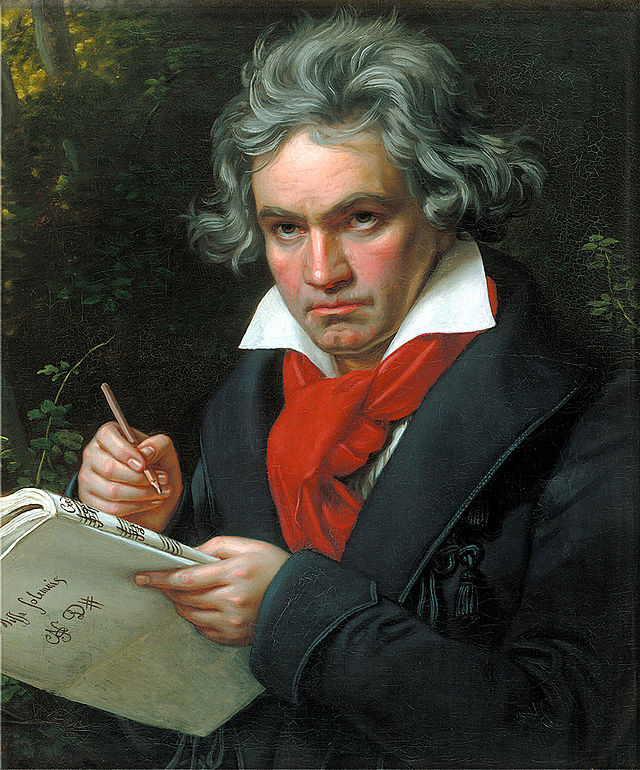
"Beethoven" - Joseph Karl Stieler

A portrait of Ludwig van Beethoven (1820)

Joseph Karl Stieler

_____________

you might say a triumvirate of piano concertos dominate
our Western musical culture, a veritable trinity of pianistic
masterworks that tower over, and have ruled, our musical
consciousness throughout the modern epoch, the
Rachmaninoff 3 has been one of them, but the 5th of
Beethove
n is surely the granddaddy, the “Guppa” as a
favourite grandchild I know would say, the Olympian
Zeus, the Christian God the Father, of them all, in majesty
and authority, others quake in its overwhelming aura, it is
the sun to all the other stars

Glenn Gould is the standard still by which it should be
played, none yet, to my mind, has surpassed him

Karel Ancerl conducts the Toronto Symphony Orchestra,
a competent orchestration, overshadowed inevitably by
this prodigy, who nevertheless doesn’t ever flaunt his
finger play but remains faithful throughout to the
dictates, the tonal balances, of the music, it is 1972

I had mentioned “variations in volume, tempo, tonality,
the play of harmonization and discords” in Rachmaninoff
,
note the strict adherence to tempo here, even the fastest
runs of notes are grounded in beat, more solid, less elusive
than the iridescent Rachmaninoffian allusions to Debussy,
you could set a metronome to the appropriate tempo of
each individual movement in Beethoven, it would remain
constant, apart from a few restrained ritardandos near
the end of some musical elaborations, until its very final
apotheosis, beat was ever an anchor for the fulgurating
Beethoven, an article of faith from which he strayed only
with great circumspection

note the language is not emotional, passionate and ardent,
but philosophical, metaphysical, Beethoven is confronting
cosmological considerations, existential realities, not the
more emotional concerns that confound us every day, it’s
God he’s talking to, eternity, not the incarnate tendrils
of the moment, not the poignant stuff even of soon
through Schubert a Chopin, Beethoven was at the start
of that Romantic Movement, indeed its very first
proponent, but not quite ready to wear his heart itself
on his sleeve, but a more spiritual, probing reason, whose
ardent metaphysical ratiocinations would set all the others
on fire, setting the stage for all the other stars

later, if you haven’t guessed what it’ll be already, I’ll
supply you with the third concerto, the Holy Ghost, of
the trinity, the Apollo, god of music and the sun, among
our concert greats

Richard

Rachmaninoff: Piano Concerto no 3, in D minor, opus 30

fully 150 years after Mozart the concerto was still a thriving
musical form though it had undergone some modifications,
you’ll hear a more passionate account in Rachmaninoff than
the more lyrical, less emotionally overt compositions of
Mozart, the variations in volume, tempo, tonality, the play
of harmonization and discords, all incidentally within a single
movement, show the passage of time, of Beethoven, of Chopin,
of Debussy between Mozart and the more Romantic, Impressionistic
Rachmaninoff, note the sweeping ritardandos, where the beat is
drawn out, stretched for pathos, a Chopinesque insinuation into
music not found in earlier stuff, one imagines torrid expressions
of fervent sentiment, note the evanescent flurry of notes passing
by like the fleeting glitter of stars, the ephemerality of an
incorporeal idea that Debussy originated and brought to music,
and of course note the irrepressibility, the authority, the masculinity
of a volcanic Beethoven underpinning the lot, you can hear them all

the Vladimir Horowitz Piano Concerto no 3 of Rachmaninoff at
Carnegie Hall, January 8, 1978, with Eugene Ormandy leading the
New York Philharmonic Orchestra is, after Van Cliburn’s historic
1950s account, May 19, 1958, again at Carnegie Hall but under Kiril
Kondrashin this time, and the now defunct Symphony of the Air,
don’t ask, the one I then grew up with, it was riveting even without
the pictures

with pictures here he is again a few months later at Avery Fisher
Hall in New York, September 24, 1978, under Zubin Mehta with
again the New York Philharmonic, so good you’ll even forgive
Mehta his usual sentimental excesses

incidentally Horowitz was 74 at this concert, he is astounding

Vladimir Horowitz, colossus and legend, 1903 -1989

enjoy, be transported, be transfixed, you have been warned

Richard

Beethoven, Triple Concerto in C major, op. 56

recently trying to familiarize a friend of mine with the idea
of the concerto, something I’d been working at with him for
quite some time, along with the related concepts of the
sonata, the trio, the quartet, quintet, sextet, and, following
those numerical indices, the symphony, when to count the
multiplicity of instruments involved would be asinine, I
asked, what do you think you’d hear if I said a triple concerto

after some polite leeway I answered for him, you’d need
a symphony of course, another word for an orchestra but
perhaps with some pedantry, showcasing in this case not
one, not two, but three soloists in conversation with
the band, another word again for orchestra, this time
connoting perhaps less pedantry, calibrating prestige
as it moves from the bar to the nightclub, to the more
rarefied air of the concert hall

most often a concerto will spotlight one only performer, one
must consider temperaments, finances, compositional ability,
three musical variables instead of the usual, and less demanding
but still impressive, hypothetically virtuosic, one

and indeed I knew of only one triple concerto then, Beethoven’s,
though I’ve since learned of another by Mozart, but that’s another
story

not only was this a triple concerto, I exhilarated, but one by
Beethoven, Nietzsche’s very superman, an entity of supreme
musical authority

and in my collection I had it performed by Yo-Yo Ma, the superstar
cellist, who needs no other introduction, Emanuel Ax at the piano,
whom I’ve admired for many years, dominating some of the most
difficult piano pieces in the catalogue with elegance and majesty,
often accompanying Ma, and Gil Shaham, an internationally famous
violin virtuoso of the very highest order

I trembled at the very thought, and hoped my friend would also thrill
at the opportunity

we watched

Ma, Ax, and Shaham did their usual unforgettable stuff

Alan Gilbert conducts the New York Philharmonic, another word for
symphony, that one, with perhaps a nod to a congruence of many
harmonies instead of merely an assemblage of sounds, both here
striving equally however for the undifferentiated sublime

my friend later found me the corresponding online video

watch

Richard