Richibi’s Weblog

Just another WordPress.com weblog

Category: Beethoven

Liszt – piano concerto no 2 in A major‏

since discovering Tamás Érdi, feral hands,
uncommonly hirsute, but uncovering the
soul of a poet, an angel in wolf’s clothing,
a satyr, without a flute but, at the piano,
I’ve been hooked, combined with Liszt he
is again irresistible, not to mention totally
transcendental

you’ll find Liszt quite a bit like Beethoven,
but more bombastic than philosophical,
style trumps substance, Liszt was a
show-off, a pianistic Paganini

stylistic flourishes abound in the hands
of a deft, however uninformed might he
or she be, technical wizard, it doesn’t
take an Einstein, in other words, to be
a Puccini

and Liszt is a Puccini, who delivers
likewise, and for the very ages

note the same intensity as Beethoven
in Liszt, much of the same musical
idiosyncrasies, but with more dramatic,
late Romantic, alterations of tempo, he’ll
milk a phrase before returning to a more
Classical, which is to say, less elastic
beat

his extemporisations are also less
ruminative, more serendipitously
motivated, like jazz, Liszt wants
primarily to dazzle, kick around,
not instruct

and he does, masterfully, just that

here’s Alfred Brendel doing an alternate,
wholly incandescent version
I couldn’t
at all leave out

here’s Julie Andrews giving her take on
the history of jazz

Richard

Beethoven Strinq Quartet no 14, opus 131‏

if Beethoven had written merely one transcendental
work we would still have been beholden, but that he
wrote neither two, nor three, but several immutable
pieces is extraordinary, super-, apparently, human,
though, of course, manifestly not, unless you want
to bring Jesus into the picture as such a dual being,
then we’ll talk, but Beethoven is a staunchly secular
voice, devoid of the spiritual considerations of a
Bach, for instance, Beethoven speaks for humanity,
its longings, consternations, aspirations, its essence,
no longer the discredited primacy of the Cross and
Its imperial derivatives, Human Rights have trumped
God

what Beethoven maintains however is the reverence,
his later pieces – you’ve heard the Hammerklavier“,
already, the 32nd piano sonata – are manifestly
spiritual experiences, as opposed to religious

the 14th String Quartet will do the same

if the Hammerklavier is akin to Moses delivering
his peremptory tablets, the 14th String Quartet is
the Sermon on the Mount, in the history of music
they have so great an impact

briefly, as briefly as I can, I’ll say a few introductory
words, then let your soul and the music do the rest,
see what happens to your karma

there are seven movements in the 14th, uninterrupted,
no pauses between the movements, though each is
easily identifiable, tempo therefore becomes incidental
instead of Classically ordered, the first movement, for
instance, is an adagio, a Classically improbable spot

the sections therefore play much as chapters in a
novel, advancing according to the logic and emotions
of the moment, always, as in all of Beethoven, moving
inexorably forward despite the intricacies of the, not at
all predictable, plot, as had been the case in the more
regimented Classical model, Beethoven takes you,
instead of around the corner, into the clouds, into a
spiritualized heaven, a place of profound existential
introspection

try listening to the 14th String Quartet attentively
without thinking about your soul, its existence,
its mission, in the very face of its ineradicable,
and fateful, actuality, the human conundrum,
Beethoven lets us know we’re not alone

some mountaintop Sermon indeed, watch what
happens to your sensibility, your very sacred
self, or maybe I should say, listen

may your path be decked meanwhile with laurels,
and your days be blessed with grace, be it ever
so merely, maybe, human

who knows

sincerely

Richard

psst: if you’ll allow me to pursue my series of
similarities you’ll imagine piano sonata
no 32
as Beethoven’s “Last Supper”,
this one in particular five luminous stars

Schubert – Piano Sonata D959‏

to my utter surprise when I checked I’d never
but only once in the many months I haven’t
been able to shut up since I started spouting
my bristling endorsements, like a very rushing
river gushing with the overflowing bounty of
an inveterate spring, mentioned Schubert, an
incandescent voice from surely heaven

it was about his String Quartet in C major, the
D956, not surprisingly, it is utterly enchanting,
D for Otto Erich Deutsch still, incidentally

here’s an alternate version of it, an utterly
inspired one

but if I’ve reintroduced Schubert it’s specifically
this time to compare him with Beethoven, they’re
easily confounded, I even did it once myself, to
my crushing embarrassment, in erudite and
unflinching company, oof, I cringe to even
remember it

the D959, moments only after the 956 of course,
has all the idioms of a Beethoven, and exercises
them as expertly, the beat, however, is always
on, unlike Beethoven, whose beat is always off,
contrary, rebellious, against the prevailing
order

though this variance might seem slight, one
senses already in the younger and later
Schubert a return to form, elegance, and civility,
the First Empire had indeed taken hold during
the transformation of Napoleon from hero of
the Revolution to a different incarnation of
Emperor, Chopin as well would be beholden
to later similarly reinstated French courts

so seemingly trivial an alteration speaks
volumes when one attentively listens, one
must do this with one’s heart

such a return to aristocratic principles is not
uncommon, incidentally, we seem, indeed, to
thirst for dynasties, if you’ll note the return of
late, of the Bushes, the Clintons, and most
recently the Canadian Trudeaux

Putin is another, though arguably somewhat
less democratic, version of that principle

Beethoven is off the beat then, Schubert on, you
won’t find much else that’s different upon first
listening, you’ll note only that their music is very
much the same, rigorous beat, tonal, essentially,
harmonics, and the return eventually of the
melodies, Classical imperatives, but with the
distinction of the new Romantic,
transformational however, sensibilities

Schubert might’ve even outpaced Beethoven
had he survived, I think, but he didn’t, he died
much too young, at the most tender age of
only 31, younger even than the more
celebrated Mozart, famous for succumbing
prematurely at the still early age of 36

may they rest, may they all rest, Schubert,
Mozart, and the somewhat longer-lived
Beethoven, still early deceased at 56, in
eternal peace, for they have brought us
but wonders

Richard

psst: here’s a movie to go with the earlier
Schubert
, The Company of Strangers“,
the very best film Canada has ever had
to offer, bar none, a gaggle of old women
are stranded in the Laurentians after their
tour bus breaks down, Schubert would’ve
loved it

and been honoured

Beethoven’s piano sonata no 29, “Hammerklavier”, revisited, as promised

upon listening to Beethoven’s 29th sonata
one doesn’t imagine its originality, having
been showered for centuries now with its
miracles and majesties, nothing would’ve
been heard like it before, so great a project,
a work of not only temporal magnitude, an
astonishing fifty minutes, but evidently of
more than just mere entertainment, a work
of philosophical, even, amplitude

Beethoven is not just trying to delight, he’s
trying to engage here, bring together, stir,
more profound human responses, evoke
thought, responsibility, compassion, a
spiritual complicity in the new
post-Revolutionary secular order, he is
establishing new metaphysical ground

the subject is existential, the audience
no longer merely aristocratic, masses
now were talking, an affluent bourgeoisie,
artists were responding to a new Romantic
Age, about rights, and what it means to be
human, both men and women, incidentally
– and I stress that newly pertinent at the time
conjunction – above and beyond those of
God, for each couldn’t both hold the
supreme, the earlier Classical, pinnacle,
the rights of Gods and, by extension,
Kings, Queens if you lived in England,
Russia

secularism was needing new oracles

see Elizabeth Barrett Browning, for
instance, for the emergence of
women

see also, of course, otherwise,
Beethoven

the difference with Beethoven is that
he achieved, ultimately, profound
wisdom, I can think of no other
comparable poet, save, of course,
Marcel Proust, both of whom proved
to be, in the same breath, philosophers,
able to stake that exalted claim, certainly
no painter, a difficult medium through
which to philosophize admittedly, to
bring logical and existential constructions
together to enunciate a transcendental
vision

then again, before Proust and Beethoven,
who’d ‘a’ thunk one could’ve transformed
words or music into very grace, mystically
transubstantiated gold, notwithstanding
the misguided alchemists

Pink Floyd did some of that in the Seventies
but retreated into historic and more personal,
less oracular, reminiscences, philosophizing
isn’t easy, see the punishment of Prometheus,
or, for that matter, John Lennon

Beethoven was completely deaf by the time
he composed the Hammerklavier“, lost in
his own isolation, like Homer, blind to,
though obviously not unaware of, his art

not lost, not unaware either, more like
having been given extrasensory, outright
extraordinary, manifestly, perception

to our utter and everlasting, both of them,
benefit

Richard

Beethoven piano sonata no 29, the “Hammerklavier”

take a few minutes, well, nearly an hour,
to watch, imbibe, incorporate, integrate,
this video, to smell this miraculous
flower, Beethoven’s piano sonata no 29,
the monumental Hammerklavier“, the
equivalent, to my mind, of the Eiffel
Tower, the Coliseum, the Parthenon,
Homer’s Iliad“, I promise it will
transform you

I’ll talk about it later, I also promise

Richard

psst: you might need some Kleenex

Beethoven piano sonata no 28 in A major, opus 101

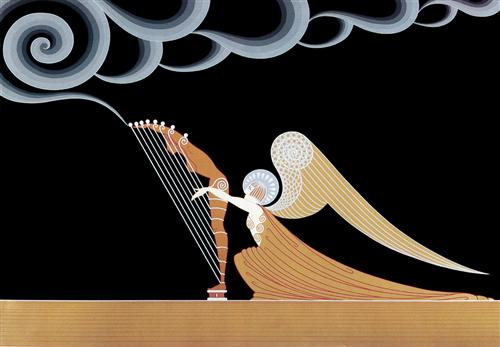
Erte - "The Angel"

The Angel

Erte

___

Beethoven’s piano sonata no 28, opus 101,
in A major
, is the first of what is considered
to be his late piano sonatas, as opposed to
early and middle, three entirely distinct
periods that are easily recognizable upon
closer listening, the early ones are bold,
even headstrong, with Beethoven’s ever
characteristic vigor and Promethean authority,
the length themselves of his early works are
a testament to his sense of his own great
personal validity, the first four, to my mind,
go on much longer than often enough they
should, a typically youthful presumption on
his part, and are musically at best trite, I find,
after their first expositions, the repeats come
as redundant, and tolerable merely, surprises,
even the famous 8th, the Pathétique“, opus 13,
is, I think, too brash and impudent, however in
this manner, nevertheless admittedly, entirely
effective, listen

the Pastorale“, of the middle period, opus 28,
no 15
, is where I deem the music to become
henceforward sublime, it has a settled
confidence that brims with not only technical
wizardry but with also positively enchanting
and entrancing musical ideas, bursting like
very flowers in springtime, with colour and
inspired, effervescent, imagination

the late period is where Beethoven becomes,
however, a sage, a prophet, and indeed a
hierarch in the new secular order of a
reconstituted Heaven, after all, someone
had to take the place of the now discredited
angels, Nietzsche called them Übermenschen,
Supermen

the 28th sonata starts out slowly, or rather,
more slowly than the earlier forthright ones,
already a sign of less physical, more
measured and considered reponses, my
impression here is of a grandfather visiting
his granchildren, jovial but not too disportive,
merely jaunty, always cheery but for a moment
of haunting melancholy, at the adagio, before
becoming congenial and avuncular again,
with then a big, boastful ending, snapping
staunchly his patriarchal suspenders,
getting the last, and traditional, word, with
a firm, which is to say, a foursquare-major-
chord, finish, the aural equivalent of turning
out the lights

musically, however, the progressions are
exploratory, incremental, more and more
layered with possible, and often apparently
rejected outcomes, in order to try out
something more fitting, maybe, more
accurate, a deconstruction, in other words,
of musical ideas, an investigation, in search
of a viable musically cohesive path

in the 28th sonata Beethoven, I think, is
doodling, however, coming up with the
methods of his great addresses, the
language here is not yet philosophically
precise, a smattering merely of pianistically
plausible ideas, musical sketches, the first
stirrings here, you’ll gather, of formal jazz

in the next sonata, the 29th, the still
unsurpassed “Hammerklavier”, he writes
the definitive book, speaking for music in
the forthcoming history of the world, and
determining its future path, we are still
moving along on his transcendent carpet,
no one ‘s come along still to give us a
more assured ride, kind of like Homer,
some would say Shakespeare, others
Albert Einstein, other, incidentally,
post-Christian, post Revolutionary
Supermen

who do you presently pray to, who are
your angels, who your Superwomen,
-men,
towards what do you aspire,
towards whom

Superwomen, -men, incidentally,
cultivate their own efflorescence,
manifest their own, I think, destinies,
or, if you like, their own Heaven

much as I believe angels also do

Mozart’s Fantasy in C minor on the
same program
shows him in a nearly
Beethovenian mode atavistically, much
more somber than he usually is, but he’s
nevertheless easily distinguished by
his much less intricate musical
accompaniment and his much more
rigorous melodic line, you’re more
likely to hum it

Mozart also composes from the nursery,
I find, the exhilaration of playful discovery,
you can see the toy soldiers, the golden
tresses on little milkmaids in dirndls with
red circles for cheeks

Mozart’s pieces are like nursery rhymes

Beethoven progresses to literature

before you judge me too harsh on Mozart,
by the way, consider that my favourite
piece of the two in this program is the
Mozart, it’s like comparing apples and
oranges, though, it depends on your
mood that day which you’ll favour

cheers

Richard

psst: just in case you missed it, this version
of the Pathétique is the best I’ve ever
heard, indeed, of all the pieces here
the most extraordinary, don’t miss it
Beethoven piano sonata no 32, opus 111‏


when I was a young boy my sister returned
from school with a catechism the nuns had
given her, if there’s anything you’d like to
know, she said, the answer will be in here,
touting it triumphantly

we all laughed at her of course, being a
family of sceptics

but in the following sonata, Beethoven’s
transcendent no 32, opus 111, I believe
that’s exactly what you get, that catechism,
something with all the answers

there are only two movements in the 32nd,
an oddity to say the least, it will end not on
a joyous note, as was the traditional manner,
but on a much more contemplative one

midway I never manage not to break down

the first movement is fast, chaotic, succinct,
the following one tentative, orderly, expansive,
exploratory as opposed to rash, humble as
opposed to demanding

dichotomies, in other words, abound the
more profoundly you let the pattern sink
into you, the more you spend time with
the music

for me it is man, woman, it is chaos, grace,
right, wrong, evil, good, sin, retribution,
war, peace, intolerance, mercy, love

it is also the very steps of our passage
through those life choices

when life has been for me too much of a
struggle this sonata has come along, in
those most private and most vulnerable
moments, invariably to hold my hand,
thanks be duly to Beethoven, philosopher,
poet, mystic, guardian angel, sage

if there’s anything you’d like to know, I
affectionately quote, and presently
ardently remind you, the answer will
be in this cathechism

if you can keep your eye off the pianist,
who is evidently, and indeed enviably,
in its throes

we’ll want to see more of Yeol Eum Son

Richard

Nemo – “Ennead I” by Plotinus (12)‏


Date: Wed, 13 Mar 2013 16:50:52 +0000
To: Richibi’s Weblog
From: comment-reply@wordpress.com
Subject: [New comment] “Ennead I” by Plotinus.
 

Richard,

I like your comment, “I won’t try to impose my perspective, I can only tell what I see”, which reminded me of a sentimental story that I had heard a long time ago. The story was in first-person narrative and went like this:

I [an art merchant] traveled to a far country on a business trip, and found lodging in a small family inn owned by an blind old man and his daughter. During an after-dinner conversation, I learned that the old man was actually a connoisseur of art with many famous paintings in his collection. Naturally I was delighted when he offered to show me the paintings. But his daughter was visibly distressed and signaled me to follow her.as she went to fetch the paintings. She explained to me that they had fallen on hard times and she had no choice but to sell the paintings to survive, in spite of the old man’s firm instructions that the paintings must not be sold, because they were his life. He had become blind due to sickness so he didn’t know that the paintings were all gone. When the daughter brought the blank frames to the old man, he proudly presented them to me, naming them one by one, while caressing them gently with his withered hands. Staring at the blank frames, I listened in silence and shock. Suddenly, the old man stopped, he sensed that something was missing, something didn’t feel quite right. What happened to his beloved painting? The daughter looked to me in desperation for help. I hesitated but finally mustered enough courage to speak. I picked up where the old man had left off, and, recalling from memory, I described the details of the paintings and complimented the old man’s taste. He beamed with pride and delight.
….
There are many ways to interpret the story, one of which is this: if the “paintings” were all in the old man’s mind, and “I” had not seen them nor anybody else, it would be impossible to carry out the conversation, and there would be no sharing, nor inspiration, nor delight.

This is the armchair Platonist’s answer to the demented Nietzsche: we are able to share our thoughts and feelings with one another, because we both behold the same underlying intelligible reality, both within ourselves and without. If we are only conscious of ourselves and nothing else, conversation would be impossible and pointless. Even Nietzsche, before he fell to dementia, couldn’t resist the desire for conversation since he published his works– as you say say rightly, philosophy is conversation. Otherwise, he could have kept all to himself, in his private notebook

 
your question is probing, Nemo, I’m not sure
that even Plato would have come to such
corollary conclusions as what you seem to
be suggesting, which is to say that Plato’s
absolutes, distant and distinct from us, as I
understand them, as God, yet received by
us a priori, or, inherently, at birth, as you
would have it, suggest the underlying 
existential commonality of our experience
 
you forget the pivotal factor of birth here,
Nemo, I think, incarnation, spirit, or
something, made matter, like buds in
spring, bursting with each its own
unpredictable, and wondrous, existence
  
my experience is that I cannot know even
dimensions before I formally deduce them,
before I enter this world, though the
dimensions themselves may indeed be there 
 
who knew love, Nemo, before experiencing
it, the thing that more than anything else
moves our world, remember the adolescent
who had to put it all together piece by
disconcerting piece, we had to learn it all
at the movies to finally make any kind of
sense of it, playing out our battles in water
too deep for most of us most of the time,
and ultimately too treacherous for many  
 
there is mathematics, there are probably
even dimensions, Nemo, but I don’t know
about any other merely abstract world
beyond this one, for better or for worse    
 
therefore Proust
 
and therefore Beethoven  
 
 
Richard
 
psst: your parable is delightful, even
           unforgettable, and it merely
           bolsters my recommended
           literary and musical advice


Beethoven piano sonata no 23, opus 57, “Appassionata”‏

despite its apparently appropriate appearance
Beethoven’s “Appassionata” once again was
not so titled by Beethoven, but posthumously
even only, by an otherwise inconsequential
publisher with respect to our story, it is filled
with brilliance and verve, as had been
Beethoven’s wont, but a new spirit has
invaded this work, to my mind, which
hadn’t been evident in his earlier, even
more recent sonatas  
 
Beethoven has ceded to contemplation,
no longer merely the bravura that bristled
thrillingly when his fingers flew across a
dazzled, surely, keyboard, dashing off
feats of musical dexterity, indeed of
outright improbable prestidigitation, the
inspired and omnipotent fury of a youth
in all his promise and pulsating
exhilaration
 
here, in the second movement mostly,
the very heart of the piece, his quest is
philosophical, this is no longer merely
a musical air, but a striving for meaning
 
from here on Beethoven, where earlier
he’d been an adventurer, a Johnny
Appleseed, if you’ll remember my calling
him that, in his idyllic Pastorale“, full of
determination and fire, still impervious 
to any danger, now has suffered doubt,
and begins here, at the height of his
compositional powers to display it 
 
this is no longer entertainment, this is
conversation, it’s like going from the
Beatles’ I Want to Hold Your Hand to
John Lennon’s Imagine having been
through the intermediate Sergeant
Pepper“, the later works meant to
actually change the world, not only
just to regale it 
 
this is also only the start, Beethoven
will become extraordinary, a sage, 
music’s highest priest, and prophet  
 
watch, listen, wonder
 
 
Richard


“Thirty Two Short Films About Glenn Gould”‏

to my mind, one of the best films Canada has
had to offer, a study of the musical giant which
is probing, perceptive, and profoundly revealing,
and the impersonator, Colm Feore, is impeccable,
superlative, rendering the mystery of flights of
inspiration vivid and comprehensible, he is,
seamlessly and completely convincingly,
Glenn Gould     
 
Glenn Gould is of course identified with his
book-end interpretations, his first release and
the interval of not quite thirty years for him to
further appraise these epic pieces, both issues
are considered monumental, defining cultural
moments, both eclipse, have eclipsed, any
other, even celebrated, performance
 
the reference in the film’s title is to these  
Goldberg Variations, of course, composed
of thirty variations on an opening “aria”,
which is repeated as a “coda”, an ending,
a musical last word, for a total of 32
segments
 
but I submit that the place of Beethoven’s own
could not possibly have been overlooked in
the movie’s title, considering especially the
inclusion of that specific number, despite,
incidentally, the missing hyphen, an infelicitous,
I think, literary licence 
 
the Thirty Two Short Films are themselves,
not incidentally, a set of 32 filmic, note, 
variations, on the subject, in this instance, 
of the player himself, Glenn Gould
 
may his star shine bright forever    
 
 
Richard