Richibi’s Weblog

Just another WordPress.com weblog

Category: Beethoven

on odes

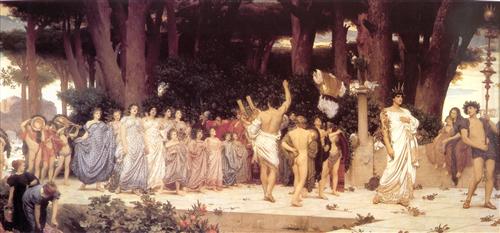
                          "The Daphnephoria" - Frederic Leighton

The Daphnephoria (c. 1875)

Frederic Leighton

________________

odes, with their suggestion of music
– despite a history of merely words
spoken in the intervening interim,
counting on meaning and rhythm
without music’s attendant tonality –
go back to the Greeks, the Seventh
Century, BCE, Sappho, for instance,
one of history’s most honoured
women poets, surely quite an
achievement for her in an age of
predominant, indeed
disenfranchising, masculinity

the ode was meant to accompany
tributes to people, events, things,
thereby acquiring an element of
acclamation and praise within its
dimensions, Pindar, ca 552 – 442
BCE, wrote odes for heroes of the
original Greek Olympics, for
instance

by the time of Horace, 65 – 8 BCE,
odes had become stylized,
independent of music, here’s one,
not inappropriately in this season’s
vernal context, to spring

odes remained spoken throughout
their resurrection in the wake of the
rediscovery of the Ancient World
during the Renaissance, onwards
through some famous Romantic
ones, Shelley, for instance, Keats,
up to even this one, by Stanislaw
Barańczak
, which I found in the
New Yorker
, April 20th, a gem, I
think, and in the very spirit of our
Age of Irony

Plywood

O plywood, second best to the real stuff,
believe me, one day I will say “Enough”

to my stooping shoulders, my slouched spine;
my sloped shape and your stiff boards will align,

and you’ll see how my backbone will unbend
and I’ll be standing straight until the end

of my makeshift but rectilinear
prayer, one stiff-backed as a chest of drawers

when we shove heavy furniture around;
I will rise from the dead, though on what ground

and which I, I don’t know; I’ll stand erect,
though my vertebrae’s hierarchic sect

won’t outlive plywood, no, it just can’t win
against that vertical eternity, so thin

and yet so sturdy in its ersatz pride;
as if the moon had shown me its dark side,

I lean, my ear glued to a cupboard’s back,
and I can hear its hollow and exact

hymn to its own cheap immortality;
no, wait, I still can straighten, still can be

square with this upright world (you knew I could),
just as plumb as four planks of real wood.

Stanisław Barańczak

(Translated, from the Polish,
by Clare Cavanagh and the author.)

__________

though you mightn’t’ve caught an “Ode”
in the title, the clue to its essence is in
the initial “O”, an acclamation

and yes, “O, Canada” is therefore also
an ode, as would be most anthems

incidentally Beethoven put the music
back into the form with his incendiary
use of Schiller’s poem for his vocal
triumph in his ninth Symphony, An
die Freude
“,
the Ode to Joy,
incomparable in this rendering for
an improbable 10,000
, yes 10,000, just
click

Richard
Beethoven’s tribute to spring

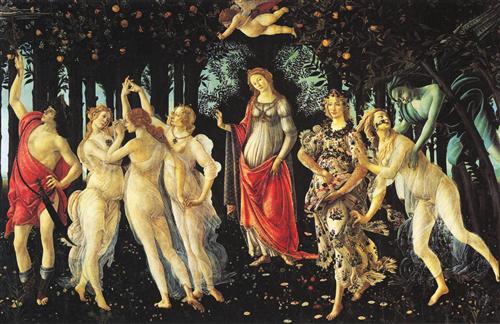
Sandro Botticelli - "Primavera"

Primavera (1478)

Sandro Botticelli

_________

if there’s a musical work to perform for
spring what Botticelli‘s Primavera
does with painting, celebrate it, that is,
for the ages, it must be Beethoven’s
“Pastorale”, German for “Pastoral”,
Symphony, usually referred to thus,
with the accent on the last “a”

the composition is expressly narrative,
Beethoven even sets the scene for every
movement, five of them

1 Awakening of cheerful feelings upon arrival in the countryside
2 Scene by the brook
3 Merry gathering of country folk
4 Thunderstorm
5 Shepherd’s song; cheerful and thankful feelings after the storm

he is manifestly using music as language,
descriptive language, you can nearly hear
the flowers grow, you can most definitely
imagine them, you bristle at the crack of
thunder

the subject isn’t specifically spring, but
the spirit is undeniably so, the spring of,
indeed also, the spirit, the buoyancy of
youth

it’s 1808, Beethoven is at the height of
his euphoria, his admiration, and
celebration, of physical nature, he’s
sowing his wild oats

later he’ll address the metaphysical,
but for now he’s still bursting with
unmitigated life, his spring

Richard

psst: see also his “Spring” Sonata, opus 24,
for still more, though less familiar,
vernal, purportedly, magic, Beethoven
didn’t name the sonata, his publisher
did, which is why the “Pastorale”
Symphony
sounds more springlike
than this other more direct, apparently,
offering

which had never been there, essentially,
Beethoven’s primary, anyway, intention,
however lovely the eponymous, the
titular, work
might have in comparison
proven to be

you be the judge, listen

R

Beethoven Cello Sonata no 1, opus 5, no 1‏

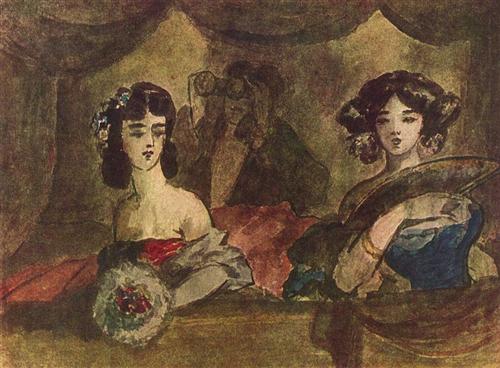
"La loge de l'opéra"-  Constantin Guys

La loge de l’opéra

Constantin Guys

__________

through the good graces of a friend
of mine, a musicologist, who writes
the programmes for the chamber
music presentations put on by our
city’s recital society, pithy, pungent
pieces to prepare the patrons for
their palpitating performances, I had
the not only unfettered privilege but
also the undiluted glee, yes, glee, of
seeing, hearing, two internationally
acclaimed artists deliver works for
piano and cello of Beethoven, one
of them one of my very favourite
compositions, the opus 5, no 1

unable to find anything by these two
of anything of Beethoven’s, I struck
upon, instead, these two others,
titans in their field, the very two who
defined for me this exuberant sonata
in the eighties, wherein Beethoven
was finding, to my mind, his chops,
nothing before this, of his nevertheless
extraordinary output, had inspired me,
the early piano sonatas still sound to
my ear didactic, like someone putting
together academic theory, where here
Beethoven lets his spirit fly, let’s the
music running through him deliver,
carry unimpeded the fire, the charge
is electric

eccentricities abound, there are only
two movements, the first sports two
tempi, an introductory, hesitant,
segment giving way to the second
unfettered one, the contrast a move
in the direction of drama, I think,
highlighting context, narrative, an
aesthetic inspired, I’m sure, by
opera, and its combative
peregrinations

Beethoven wrote one opera, not at all
the equal of his other productions,
words were to get in the way of his
instrumental, it appears, music, his
more direct, ultimately,
communication

though you’ll not want to miss, from
Fidelio“, his Mir ist so wunderbar,
a vocal quartet of the very highest
order

mir ist, you’ll say, so wunderbar,
indeed

Richard

psst: click everything, there are wonders
beneath the above links

Beethoven Cello Sonata no 3, opus 69 – Gould/Rose‏

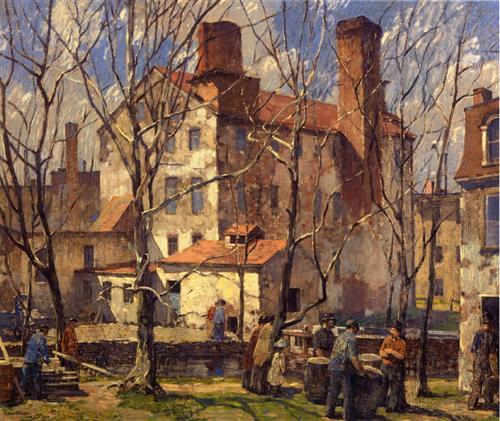
 "A Day in March" - Robert Spencer

A Day in March(1918)

Robert Spencer

_________

hot upon having seen a tremendous recital
by two internationally renowned interpreters
of the cello sonatas of Beethoven, neither
could I find their own renditions on the
Internet but their individual performances
only of works by other composers, some
astounding, others not, nor performances
by other artists of the same works I could
wholeheartedly recommend, even the big
ones, sometimes they have an off night

but with Beethoven, Glenn Gould never
lets you down, he is, quite simply, ever
transcendent, watch his Cello Sonata
no 3 of Beethoven, opus 69
, with cellist
Leonard Rose, up as well to so august
a challenge, be unequivocally
transported, don’t not watch, just click,
wow

Richard

Paganini’s First Violin Concerto – Akiko Suwanai‏

Jean Auguste Dominique Ingres - "Niccolo Paganini" (c.1819)

Niccolo Paganini (c.1819)

Jean Auguste Dominique Ingres

_____________

for Apollo, who alerted me to my error

having egregiously misspelled “Akiko”
in my recent commentaries about Ms
Suwanai, since, however, corrected, I
can only heap upon her greater praise
now for again an immaculate
performance of, this time, Paganini’s
First Violin Concerto
, itself an event,
as atonement

not only does she play this thrilling
masterpiece
with precision and
consummate artistry, this is the
performance with which she wins
the Tchaikovsky Competition, the
one Van Cliburn had secured so
illustriously back in the late Fifties,
at the height of Soviet Communism,
she in 1990, moments only after its
fall, a full, now, 25 years ago

it astounds me that such a talent
would’ve taken so long to reach my
ears, which have been attuned to
Classical music and its
peregrinations for as long as I can
remember

then again there was no ticker tape
parade for Ms Suwanai when she
triumphed
, the world has changed,
it seems such excellence is no longer
so universally paraded, not even
much advertised

the Paganini Violin Concerto was
composed around 1818, late
Beethoven, early Chopin, Paganini
defines for the violin the Romantic
Period, what Chopin did for the piano,
Beethoven had given them the push

if you can get past your astonishment
you’ll note that the foundation of the
piece
is Classical, tight tempi, tonality,
no discordant notes, and repetition
always of the themes, still the triple
pillars of our understanding of music,
its Trinity, despite some strong forays
into their deconstructions, see, for
instance, the haunting George Crumb

what Paganini adds to Classicism is
personality, Romanticism, same as
Beethoven did, and at about the
same time

aristocratic formality was giving way
to the voices of the crowd, some highly
articulate, representative, formidable,
as the shackles of servitude fell with
the French Revolution and human
rights became central, and
indomitable

Richard

Alban Berg Violin Concerto‏

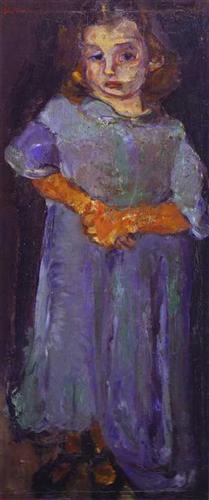
"Little Girl in Blue," - Chaim Soutine

Little Girl in Blue (c.1934-c.1935)

Chaim Soutine

________

though Apollo had offered the two
complimentary symphony tickets
he’d scored to my sister and my
mom, my mom bowed out and
suggested I, an adept, should
instead go along, though I needed
to know more about the content,
who and what would be on, no
one knew

meanwhile my sister, preferring not
to leave her husband alone, opted
to cede her ticket to Apollo so he
could accompany me

after some research, when I gushed
that Akiko Suwanai would be playing
Beethoven’s Violin Concerto in D
minor – his only one, I cried – Apollo
reconsidered, would, he said, come
along, my enthusiasm having struck
apparently a reverberant chord, a key,
maybe his D minor

once at the concert, to our surprise
and delight, my sister and her
husband, under the spell also of that
maybe bewitching key, had got rush
tickets for essentially, as it were,
a song, so that serendipitously we
all attended the superb performance
together

Dad does concert tickets too, my
sister exulted

Suwanai was transcendent, lifted me
from my seat at the very first touch of
her exquisite bow, I floated, though it
might’ve been also the magic chocolate
I’d bought at the corner, this is Vancouver
after all, known also, not inappropriately,
as Vansterdam

you’ve heard rapturous versions of
Beethoven’s Violin Concerto on at
least one of my earlier blogs,
Anne-Sophie Mutter’s there, Joshua
Bell’s
, but I couldn’t get any of Akiko
Suwanai’s renditions on the Internet

found instead for you this wonderful
Berg
, also his only violin concerto

Berg is of the Second Viennese
School, along with Schoenberg and
Webern, this is no longer Beethoven,
the advent of the First World War in
the Western world had fundamentally
altered everything, the arts were
reflecting this transformation, idioms
were abandoned in every creative field,
as well as in borders and forms of
government, rudiments were being
questioned, tested, see what Soutine
does, for instance, to traditional
representation above, to perspective,
colour, proportions

you’ll note that Berg’s Concerto
doesn’t stipulate a key, part of the
disintegration musical theory was
undergoing, twelve-tone music,
rather than the traditional eight,
was eliminating the subordination
of sharps and flats within scales,
atonality became dominant,
sounding a lot like the cacophony,
I think, of Twentieth-Century traffic

you won’t mistake however the
utterly Romantic sensibility beating
through Berg’s composition, midst
all the discord and the dissonance
you can’t miss his pulsing and
ardent heart, his wistful, dare I say,
heartstrings

there are two movements to the
concerto, the first representing life,
the second death and transfiguration,
Berg had written this, his last work,
for Alma Mahler’s daughter, Manon,
after she died of polio at the age of
18, Alma Mahler had been Gustav
Mahler’s wife, a musical giant, Berg
dedicated the piece, he wrote,
“to the memory of an angel”

Berg died later that same year,
Christmas Eve, 1935, he was 50

Richard

psst: the first part of the programme
had been a bust except for a
lovely piece for violin and koto

what’s a koto, I asked Apollo

it’s what you wear when you’re
coldo, he replied

a koto is a bit like a xylophone,
but with strings instead of
wooden bars, the performer
had dressed in traditional
Japanese garb for the special
Japanese occasion

Freedom

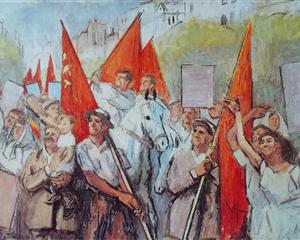
Alexandru Ciucurencu - "May Day in Freedom" (1958)

May Day in Freedom (1958)

Alexandru Ciucurencu

__________

two events took place after the fall
of the Berlin Wall, which have
remained cultural landmarks since,
nothing much comes close to their
historical significance, music to
declare a new world order

on December 25, 1989, Leonard
Bernstein conducts Beethoven’s
Ninth Symphony at the
Schauspielhaus in the former
East Berlin, it is remembered as
the “Freedom Concert” for having
replaced the word “Joy” in
Schiller’s poem during the “Ode
to Joy”,
the vocal novelty of the
Ninth, also its triumph, with the
word “Freedom”, a whim of the
conductor, not inappropriately

on July 21, 1990, Roger Waters
puts on The Wall“, Pink Floyd’s
20th-Century counterpart for the
Beethoven, the clarion call to do
away with barriers, fences, it’s
hard to dismiss its prescience
when the piece had been written
eight years earlier, seven years
before the fall of the Wall, as
though Pink Floyd had been
prophetic

like Beethoven had been, not
at all coincidentally here
, in
his own day

both concerts are beyond
description, extraordinary

just click

watch for unexpected guest
appearances in either of,
everywhere, the very highest
quality

Richard


“How I Didn’t Get Myself to a Nunnery” – Suzanne Lummis‏

"Ophelia" - Arthur Hughes

Ophelia (1852)

Arthur Hughes

_________

according to Suzanne Lummis Ophelia
“g[o]t outta town”

Suzanne Lummis is Ophelia here, this
is a dramatic monologue, I can’t tell you
how much I find that exciting

you’ll want to run to the source, of course,
to find pertinent references, so I’ve linked
a few for you from the text below to their
counterparts in Hamlet“, if it’s coloured,
just click, otherwise a couple of asterisks
explain two probably too obvious items,
in which case you’ll forgive me my
infelicitous impertinence, my unintended
and hapless presumption

thanks

How I Didn’t Get Myself to a Nunnery

That girl they found ensconced in mud and loam,
she wasn’t me. Small wonder, though, they jumped.
To a conclusion. Water puffs you up,
and we pale Slavic girls looked much alike—
back then. Deprivation smooths you out.
Yes, that was the season of self-drowned maids,
heart-to-hearts with skulls, great minds overthrown.
And minds that could be great if they could just
come up for air. Not in that town. Something stank. *

But me, I drifted on. I like rivers.
And I’m all right with flowers. I floated
on a bed of roses—well, O.K., rue
and columbine
. It bore me up not down.
That night I made a circle with my thumb
and finger, like a lens, and peered through it
at the moon—mine, all mine. My kissed-white moon.
“Moon River wider than a . . .” Mancini/
Mercer wrote that, sure, but I wrote it first.

You wonder where I’m going with all this?
Where water goes. It empties into sea.
Sold! I’d take it—the sea or a fresh life.
Some other life. A good man—good enough,
fair—fished me out. He’d come to quench his thirst.
No sun-god prince,* of course, like him I’d loved,
still loved. (Some loves don’t die; not even murder
kills them.) I married his thatched hut, hatched chicks—
kids running underfoot. Don’t cry for me,

Denmark. I’d learned the art of compromise
back there, in the black castle—then came blood,
ghosts. Something in me burst. If not lover,
father, king, ** then whom can you trust? Alone,
I took up some playing cards. I played them
into skinny air. A voice said, Swim or drown.
It said: Your house caught fire, flood, caught fear—
it’s coming down. No one loves you now, here.
By land or water, girl, get outta town.

Suzanne Lummis

* i.e. Hamlet, of course, prince of Denmark
** Hamlet, Polonius, Claudius

our debt to Shakespeare in literature
is enormous, after even 400 years –
“Hamlet” was written in 1602 – his
literary form, his countless neologisms,
his stories, his blueprints, transformed
into ballets, paintings as above, operas,
have become our myths, our moral and
philosophical standard, our modern
Olympus, the measure of our time,
our epoch, Shakespeare is our Iliad

only Beethoven in music has ever
matched this, in the visual arts, no
one

you’ll notice that the poem itself is a
monologue, in answer, in homage, to
Shakespeare, it’s in iambic pentameter,
also his wont

mine too, incidentally

Richard


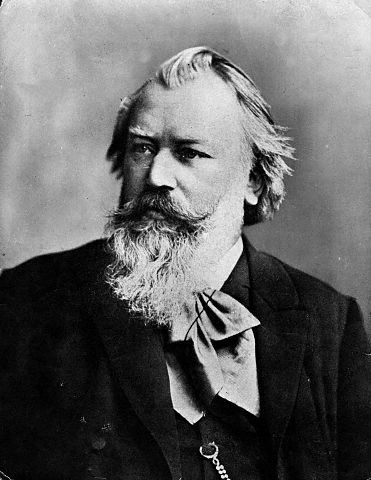
Horn Trio in E-flat Major, opus 40 – Johannes Brahms

Johannes Brahms

Johannes Brahms

__________

if I’ve been away from my perhaps too
abundant, Cornucopian indeed sometimes,
post of late, not as ubiquitous in your
hotmail, it’s because I’ve been following
not six but six and half courses at
Coursera, which have taken up a
considerable amount of my time, all of
them fruitful except for that half, which
apart from some smoke still from its
lingering ashes in the form of belated
comments on what were personally
pertinent fora, forums, I’ve committed to
the cellar of wasted money, despite its
being free, time itself being, according
to my father, hard currency

The Fiction of Relationship
Introduction to Philosophy
Revolutionary Ideas: An Introduction to Legal and Political Philosophy
Søren Kierkegaard – Subjectivity, Irony and the Crisis of Modernity
From the Repertoire: Western Music History through Performance
Philosophy and the Sciences

the half will remain unnamed for its
being, to my mind, inferior, not worth
not only recommending but even
mentioning, or, worth not only not
recommending but neither mentioning,
take your pick

but from “From the Repertoire” we were
offered this week to investigate Brahms’
Horn Trio in E-flat Major, opus 40
, entirely
worth looking into, I thought I’d pass it
along

it was composed in commemoration of
Brahms’ mother who’d died not much
earlier, a cello could replace the horn,
stipulated Brahms, even a viola for
fear of later horns being too brassy,
incommensurate with the intent of the
dedication however passionate some
of its musical argumentation, much
more abstract than that of Beethoven,
you’ll note, though still nevertheless
ever melodic

he has as well a more heraldic tone,
consequently, by extension
earthbound, rather than Beethoven’s
more transcendental ruminations
,
both remaining equal, however, ever,
in, in each his realm, their grandeur

Richard

“Six Pictures for Piano” – Arno Babajanian‏


Paul Gauguin "Poèmes barbares" (1896)

Poèmes barbares (1896)

Paul Gauguin

_______

if you thought that Arno Babajanian was
done with synesthetic investigations,
seeing sounds, hearing colours, here’s
his Six Pictures for Piano“, which he
plays, all of them, himself

can a piano paint, take pictures

you tell me

something else interesting is happening
here, the six are individual pieces despite
being part of a common whole, as the title
suggests

this is the opposite of trying to integrate
movements to a continuous and unfolding
conception, something Beethoven, for
instance, pursued, indeed ardently, in his
own sublime music

dissociation seems a context, a XXth-,
a XXlst-Century, context, in our presently
more polarized world, according to, of
course, Babajanian

what might hold us together then

maybe music

incidentally, the movements to the
Six Pictures here are

1 – Improvisation
2 – Folk Song
3 – Toccatine (a little toccata)
4 – Intermezzo
5 – Choral
6 – Sasoun Dance (don’t ask),

should you not be able to read Russian

note, none of these themes are
photographic

don’t either miss Babajanian‘s
Sonata for Violin and Piano
as played by, here again,
himself, it’s rapturous

Richard

psst: see Gauguin above paint poems