Richibi’s Weblog

Just another WordPress.com weblog

Category: Beethoven

Symphony no 7 in C major, opus 60, the “Leningrad”- Dmitri Shostakovich
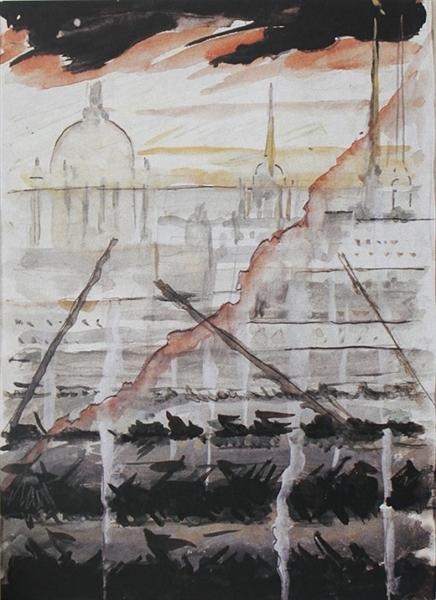
leningrad-in-blockade-sketch-on-the-theme-of-leningrad-symphony-of-d-d-shostakovich-1943.jpg!Large.jpg

Leningrad in blockade. Sketch on the theme of 
         “Leningrad Symphony” of D. D. Shostakovich. 
                                                                (c.1943) 

     Mstislav Dobuzhinsky

             __________

though I’ve been through the Seventh 
three times already, consecutively, it
doesn’t reach, for me, the heights the 
Fifth did, its first movement is
manifestly imperious, nearly even 
overwhelming, certainly unforgettable, 
I’ve been humming the ostinato in my 
sleep

but the following movements seem to 
me – not being Russian, nor having as
intimately incorporated their culture, 
where rhythms and history are 
inextricably intertwined – muddled 
about the reconstruction of its 
shattered world, melodies might be
lovely but are lost in a blur of musical
directions, there isn’t enough repetition 
of musical motifs to find solid ground, 
angry statements follow lyrical adagios
too often to get our bearings on what 
might be going on 

the first movement, however, remains a 
triumph, note the debt owed to Ravel’s 
Bolero in the rousing ostinato, the 
part where the same musical phrase 
obstinately repeats its peremptory and 
ever more vociferous mantra, its 
headlong incantation, an interesting 
blend in either symphonic work of the 
sinuous, the seductive, the beguiling,
turning into the overtly martial, all to 
do with pulse 

the Symphony no 7, the “Leningrad”,
was first presented in that very city 
during its siege by the Germans
which lasted from 1941 to 1944, 
however unbelievably, Shostakovich, 
already giant, was expected to deliver 
masterpiece by both the people and 
by the regime, imagine Bono doing a
concert for Syria 

Shostakovich doesn’t disappoint

players were culled from what remained 
of instrumentalists among the survivors
of both Stalin’s criminal purges and of 
the German siege itself left in the city, 
those who hadn’t survived the famine
there, Valery Gergiev, an exalted 
Russian conductor, describes them as
walking skeletonsmeagre from 
starvation, we’ve seen these before at 
Auschwitz

the world heard, and was moved, 
imperialism in any form was being 
vociferously condemned, going back 
to Napoleon even and his own failed 
invasion, if not also to Hannibal 
crossing the Alps, Caesar, his 
Rubicon

much of this symphony is about cultural 
resistance, the survival of a proud and 
resilient seed, any proud and resilient 
seed, hence its international standing

see Beethoven’s 9th Symphony for 
comparable fanfare, flourish, and 
circumstance, the only other work of
any such historical political importance
and, appreciably, still unsurpassed,

except for, maybe, Roger Waters
channeling Pink Floyd at the Berlin 
Wall, along with, not incidentally
thereagain Beethoven 


R ! chard

psst: the other great composer of the 
          20th Century, Messiaen, also 
          composed a commemoration of
          an awful moment in our history,
          the Holocaust, his Quartet for 
          the End of Time“, played originally
          in his very concentration camp by 
          similarly “walking skeletons”, does   
          for me everything Shostakovich’s 
          Seventh didn’t 
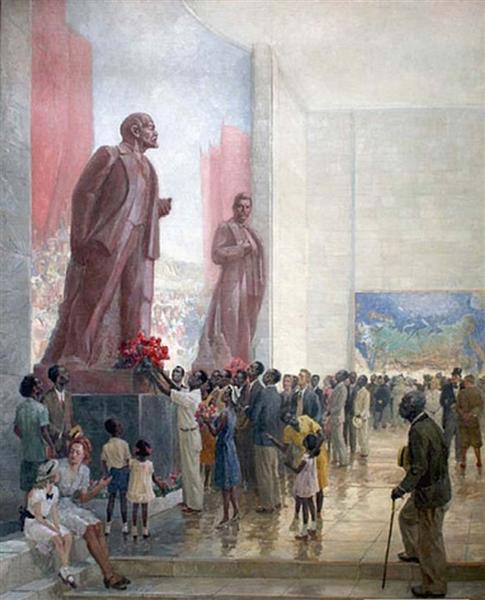
         

“Symphony no 6 in B minor, opus 54” – Dmitri Shostakovich

great-expectations-ussr-pavilion-on-1939-new-york-world-s-fair-1947.jpg!Large

Great Expectations. USSR pavilion on 1939 New York World’s Fair (1939) 

    Veniamin Kremer

       ____________

 “I hope that these few preparatory words 
can give you an insight that may permit 
you to experience this strangely 
heterogeneous work as a single entity, 
flashpoint in musical history”, says
Leonard Bernstein, somewhat, 
admittedly, grandiloquently, in an indeed
thrilling introduction to Shostakovich’s
Sixth Symphony in B minor, opus 54

that he reiterates several of the points 
that I earlier brought up does me no
disservice, coming especially from a
person of such high quality, pedigree, 
in the musical world, I’m abashed, 
bashful, indeed blushing, that my 
humble insights have been so 
eminently corroborated

but I cannot second his enthusiasm
for Shostakovich’s Sixth Symphony
a failed, to my mind, entity, a long 
introductory lament that lingered 
long after its “best before” date, 
followed by indifferent, though 
perhaps energetic, yet unrelated,
final movements, the instrumentation 
might be, admittedly, brilliant, the 
Shostakovichian precise array of 
sounds, but the sum is less than the 
parts, I think, I took home only 
confusion, as did the crowd, 
apparently, at its first presentation, 
Leningrad, November 21, 1939,
Mravinsky conducting, wow, an
even more convincing argument,
maybe, than Bernstein’s, however 
rousing, interpretation

for your information, I’ve included
Tchaikovsky’s Sixthaccording to
Bernstein intimately related, he 
explains, to Shostakovich’s Sixth

you’ll note how different, however, 
these two symphonies are compared 
to how similar in so many respects 
Beethoven’s and Shostakovich’s 
Fifths are, Tchaikovsky’s Sixth is
manifestly more Romantic than
Revolutionary 

but imagine Tchaikovsky starting and 
ending with an adagio, how audacious, 
daring, though not particularly efficient, 
I think, not especially successful, the 
adagio lamentoso seems to me 
anticlimactic after the vigorous allegro 
molto vivacewhich receives a 
thunderous applause, the last 
movement, the lamentoso, however 
lovely, doesn’t rise to the heights of a 
proper finale for this forerunner’s
contagious ebullience, sounds rather 
like an encore, melodramatic and a bit 
pretentious

or maybe I’m just getting cranky


sooner or later though, the conundrum 
of adagio bookends will be resolved, 
someone inevitably will do it, like
finding the square on the hypotenuse, 
unearthing warped space, discovering 
a way to recapture carbon dioxide and 
make it work for us, as trees would do 
if we let them, someone always exceeds, 
miraculously, our expectations, watch 
for it, dare I say, here

R ! chard

Dmitri Shostakovich – “Symphony No 5” in D minor, opus 47

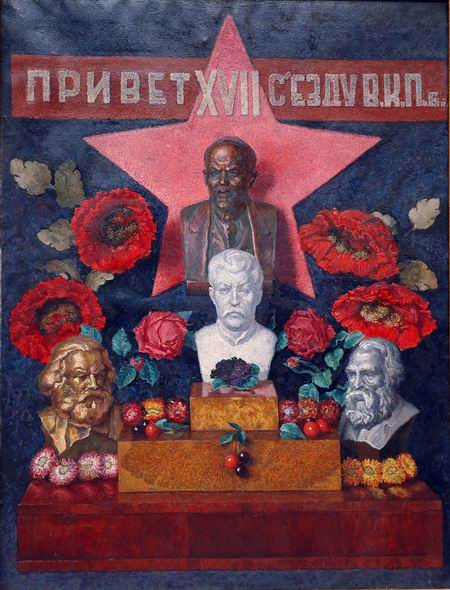
hi-xvii-congress-of-the-cpsu-b-1934

     “Hi, XVII Congress of the CPSU (B) (1934) 

              Ilya Mashkov

__________

if I thought the Fourth would knock 
your socks of, stockings, the Fifth 
ought to leave you with, dare I say, 
nothing on but your awe, it is 
extraordinary, so settle in, pour 
yourself a glass of wine, or vodka 
if you want to bethnic, for a 
mesmerizing three-quarter hour

days only before the first performance
of Shostakovich’s new symphony, an 
article showed up in a leading Moscow
paper suggesting that it would be
Soviet artist’s creative response to 
justified criticism” in reference, of 
course, to Stalin’s displeasure with 
Shostakovich’s Lady Macbeth of 
Mtsensk, which had led to the 
cancellation of his Fourth Symphony,
read all about it here

disregard for Stalin’s opinion would
have meant certain execution in an
environment where the leader could
not be contradicted, the ruler wanted
uplifting tunes, the rule was Socialist
Realism, art to celebrate the Party

a similar thing was happening at the
same time in Germany, incidentally, 
with Hitler objecting to entartete 
Kunst“, the degenerate art that 
moderns were producing, Kirchner
KleeDix, for example, who were 
only painting, as Shostakovich was 
only composing, what they heard, 
saw, for which they were all 
persecuted


a few necessary words about the 
Fifth Symphony itself, if 
Shostakovich had been moving

toward dissonance, you’ll find the
Fifth particularly notable for its 
tonal melodies, however sometimes
astringent, more larger intervals, 
sevenths, octaves, than strident 
atonal conjunctions

and since Shostakovich had been 
strictly adhering to the two other
Classical conditions, of tempo and
repetition, this symphony might as
well be a Romantic composition

listen to Beethoven’s Fifth and 
compare, they sound nearly 
identical but for a 130 years
distance, the peremptory opening, 
loud, brash, bracing, followed 
quickly by a lull in intensity, four 
movements eachhorns blare in 
either military salvos, propensity 
toward dance rhythms, short, sweet 
solo moments for several assorted 
instruments, usually contemplative, 
piercingly personal – after a 
comparison, you’ll never see 
Beethoven’s Fifth in the same light 
again

Beethoven, however, though 
forceful, indeed thunderous, is 
more centred on the actual music, 
which is jubilant, celebratory, an
exultation, while Shostakovich by 
contrast, however equally martial, 
sounds the implacability, the 
ruthlessness of the fanfare, the 
parade, you can feel the iron step 
of the guard, their advance 
inexorable, this is unquestionably 
political statement, then again 
Beethoven didn’t live in France


it’s to be noted that both works
are products of a recent revolution,
the French, the Russian, and the 
imminence of a Terror, as well of
the return of an autocratic leader,
the Emperor Napoleon in the first 
instance, in the second, of course 
Stalin

it’s helpful to view the bombastic 
portions in Shostakovich, as the 
unassailable positions of the Party, 
the more melting moments and 
single voices as those of the 
oppressed proletariat, people up 
against the stringent requirements 
of an unforgiving state growing up 
all around them 

a return to strict Classical 
conditions, by the way, which is 
to say tunes”, might’ve been 
Shostakovich’s way of placating, 
however risky still, a dictator’s 
fearful edicts regarding 
permissible taste, that’s what 
you can do when you can speak  
the language


incidentally, the symphonies are  
either composer’s Fifth, perhaps 
not incidentally


R ! chard

psst: the applause at the first 
          performance, November 21, 
          1937, lasted over half an hour,
          people were crying, they’d 
          found a prophet  


Dmitri Shostakovich – “Symphony No 4” in C minor, opus 43

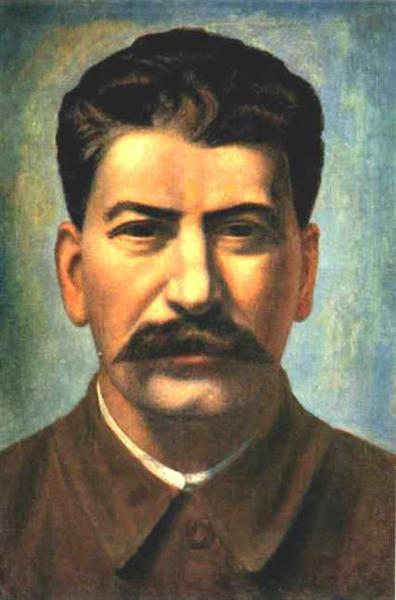
portrait-of-joseph-stalin-iosif-vissarionovich-dzhugashvili-1936.jpg!Large

   “Portrait of Joseph Stalin (Iosif Vissarionovich Dzhugashvili) (1936)

                   Pavel Filonov

                           _________

if you’ve been waiting for a Shostakovich 
to write home about among his early 
symphonies, here’s the one, his 
Symphony no 4 in C minor, opus 43 will
knock your socks off from its very 
opening gambit, have a seat, settle in, 
and get ready for an explosive hour

the Fourth was written in 1936, some 
years after the death of Lenin, and the 
instalment of Stalin as the supreme, 
and ruthless, authority, after several 
years throughout the Twenties of
maneuvering himself, cold-bloodedly,
into that position 

from Stalin, Death is the solution to 
all problems. No man – no problem.

fearing retribution after Stalin had 
criticized his recent opera, Lady 
Macbeth of Mtsensk“, Shostakovich 
cancelled the first performance of 
this new work, due to take place in 
December, ’36, others had already 
suffered internal exile or execution 
who had displeased the tyrant, a 
prelude to the infamous Great Terror

the Symphony was eventually played
in 1961, 25 years later, conducted by
no less than Kirill Kondrashin, who’d
partnered Van Cliburn a few years 
earlier in Cliburn’s conquest of Russia
but along with this time however the 
long-lived Leningrad Philharmonic 
Orchestra 

to a friend, I said, this is the biggest
thing since verily Beethoven, no one 
has so blown me away symphonically 
since then

he looked forward, he replied, to 
hearing it 

the Fourth Symphony has three distinct 
movements, to fit thus appropriately the 
definition of symphony, though the first 
and third have more than one section, 
something Shostakovich would have 
learned from already Beethoven, it gives 
the opportunity of experiencing a variety 
of emotions within one uninterrupted 
context, add several movements and 
you have a poignant, peripatetic musical 
journey, more intricate, psychologically 
complex, than many other even eminent
composers, Schubert, Chopin, 
Mendelssohn, even Brahms, for instance 

it’s helpful to think of film scores, and 
their multiple narrative incidents,
brimming with impassioned moments,   
however disparate, Shostakovich had 
already written several of them

let me point out that Shostakovich’s 
rhythms are entirely Classical, even 
folkloric in their essential aspects, 
everywhere sounds like a march, 
proud and bombastic, if not a 
veritable dance, peasants carousing,
courtiers waltzing, and repetition is
sufficiently present to not not 
recognize the essential music 
according to our most elementary
preconceptions

but the dissonances clash, as though 
somewhere the tune, despite its rigid 
rhythms, falls apart in execution, as 
though the participants had, I think,  
broken limbs, despite the indomitable 
Russian spirit

this is what Shostakovich is all about, 
you’ll hear him as we move along 
objecting, however surreptitiously,
cautiously, to the Soviet system, like 
Pasternak, like Solzhenitsyn, without 
ever, like them, leaving his country 
despite its manifest oppression, and 
despite the lure of Western accolades,
Nobel prizes, for instance, it was their 
home

and there is so much more to tell, but
first of all, listen

R ! chard 


Dmitri Shostakovich – Symphony no. 1, opus 10

portrait-of-dmitri-shostakovich-1963.jpg!Large

     “Portrait of Dmitri Shostakovich (1963) 

             Martiros Sarian

                    ______

after being transfixed, rendered aquiver, by
this mesmerizing conductor in a performance
I can only remember for his magnetism, 
expressive fingers performing arabesques of 
such exquisite sensitivity, eyes that melt, 
light up, gleam, glitter, at every ebb and flow 
of the turbulent, towering, music, eyebrows 
that, blonde, cherubic, angelic, display with 
manifest intention, the spiritual implications 
of every musical turn, a youth only, in my 
senescent estimation, taking on the conquest 
of the 21st-Century world, lately installed as 
conductor, most illustriously, of both the 
Royal Liverpool, in 2005, and the Oslo, in 
2011, Philharmonics

Vasily Petrenko led me back to Shostakovich,
after his monumental Tchaikovsky 5th,
whereupon I’ve undertaken a chronological 
review of all Shostakovich’s symphonies, 
something I did long ago with Beethoven’s 
sonatas, to my great cultural advantage, it 
was a journey that informed me not only 
intellectually but, even more significantly, 
spiritually, taught me about patience, tumult, 
and the wisdom, even glory, one acquires in 
resignation, so long as you hold onto your 
principles, your core 

you look back, I told a man once, and you 
see what you’ve come through, and you 
are proud, you recognize the hero that 
you are, or weren’t

we have only our poise and grace to lend 
to the world, or our venom and invective

but I digress

here’s Shostakovich, his First, in a line 
of Shostakovichian explorations

if you’ll join me

R ! chard

an homage to the victims of the Titanic

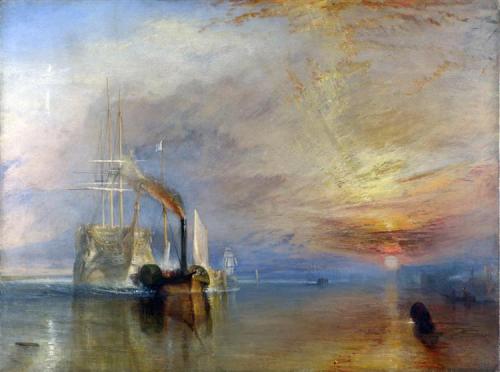
the-fighting-temeraire-tugged-to-her-last-berth-to-be-broken-up-1839.jpg!Large

  The Fighting Temeraire tugged to her last berth to be broken up (1839) 

          William Turner

                _______

while I’m on the subject of threnodies
which is to say “song[s] of lamentation
for the dead”, as I earlier statedlet me 
bring your attention to this extraordinary 
piece, an homage to the victims of the
Titanic
 
it doesn’t even have a title, much as 
Mozart and Haydn didn’t before music 
went mainstream, into public forums 
rather than merely aristocratic salons, 
and when an identifying moniker 
instead of a number became manifestly 
more practical, especially when the 
emerging Middle Classes were 
becoming the ones who were paying 
the composer’s bills, at the opera 
houses and the other sprouting 
concert venues, when some composers 
had even up to 32 sets of piano sonatas 
to remember, three and four often to 
a single set, opus number, as many as 
there are movements in a very sonata

and that’s not counting the numbered 

symphonies and string quartets of 
theirs, left to similarly calculate, 
decipher, extricate

it doesn’t have a title, I think, because
to my knowledge, it is the first of its
kind, a composition created by 
computer, for computer, an entirely 
self-contained digital work of, 
manifestly, art – I’d been waiting, 
diligently, for one – and like Beethoven, 
after the work was done, the artist(s)
just felt the title best left to the 
wordsmiths, thus – you’re welcome –  
Threnody for the Victims of the 
Titanic

sure, computers have done practical
things before, admirably, but never 
told a story, and certainly never one 
as profound as this one

these are the last moments of the 
Titanic, digitally reproduced, in real 
time, 2 hours and 40 minutes, they
are mesmerizing, you don’t want 
to miss a thing

there are no voices, apart from a 
few radio transmissions at the 
start, spotting the iceberg, calling 
out commands to beware, stop 
the engines

afterwards only silence, and the 
sound of the waves, the churning
of the engines, which have been 
restarted, sounding as rhythmic, 
incidentally, and numbing, as the 
wheels on the railroad tracks of
Steve Reich‘s Different Trains“,
another powerful threnody 

later the flash and crack of flares,
the crunch of the ship sinking  

the pervasive, however disrupted, 
silence and the inexorable passage 
of ever ticking time combine to be, 
thereafter, transfixing, meditative, 
ultimately transcendent, a fitting 
setting for a threnody 

I know of only another work to take
you to that venerable place,
Beethoven’s opus 111

and often enough Pink Floyd, for 
that matter, and the visionary 
Alan Parsons Project, of course, 
discoursing on inexorable Time 

and, now that I think of it, Elgar‘s
The Dream of Gerontius, whose 
character goes from his deathbed 
in the first act, to his afterlife in 
the second, effecting transcendence
for us by, yes, ingenious 
metaphorical proxy

but I digress

what I call Threnody for the Victims 
of the Titanic is a narrative with 
sound, not a movie, not a television
program, it has more commonality 
with a musical production than 
anything else but painting in art 
history, though its means are 
intuitively literary, ship stories go
back to The Odyssey through
Gulliver’s TravelsTreasure 
Island and to one of my very 
favourites, Ship of Fools“,
relatively recently

I could add Mutiny on the Bounty“,
Moby Dick“, “The Caine Mutiny 

in art, a precedent would’ve been set
in our collective consciousness by 
William Turner‘s celebratedThe 
Fighting Temeraire …, but I would 
mention as well Caspar David 
Friedrich‘s The Wanderer above 
the Sea of Fog for its existential
pertinence

a few literary points I’d like to stress
to back up my overt adulation, I find  
it impressive that the Classical rules
of tragedy have been maintained, 
unity of action, time, and place, 
prescriptions going back to 
Aristotle‘s Poetics in our cultural 
history, to profoundly express 
tragedy, iconic, epic, misfortune

not to mention the Classical musical
imperatives of tempo, tonality and 
repetition, none of which can be 
faulted here in this consummate 
composition

there is a no greater leveller of tempo 
than time, larghissimo here*, in the 
largest sense of that word, the 
cosmic, the inexorable pace of 
temporality in our brief heavens

a greater leveller of tonality neither  
is there than the rigorously impartial 
hum of the imperturbable Cosmos 

nor is there greater repetition than 
uniformity, however disrupted by  
however fervent ever human 
intervention, see Sisyphus, or 
Martha in “Who’s Afraid of Virginia
Woolf for iconic disrupters

R ! chard

*   Shostakovich had asked the 
     Beethoven Quartet to play the first 
     movement of his 15th String Quartet,
     “Elegy: Adagio“, so that flies 
     drop dead in mid-air, and the 
     audience start leaving the hall from 
     sheer boredom  

     well this inspired elucidation is even  
     slower than that

“First Piano Concerto” – Pyotr Ilyich Tchaikovsky

concerto-1975

      “Concerto (1975) 

               Jack Bush

                         _____

if there’s a piece that defines Classical music
for most people, encapsulates it, even for 
those who aren’t especially interested in 
Classical music, that piece would be, I think,
Tchaikovsky‘s First Piano Concerto

strictly speaking Tchaikovsky isn’t a Classical
composer, but a Romantic one, the Classical 
period in music having been transformed 
some years earlier into the Romantic period
by none other than Beethoven1770 – 1827, 
perhaps the most transformative composer 
of all time – Tchaikovsky‘s First Piano Concerto
was written in the winter of 1874 – 1875, pretty
well at the end of the Romantic Period, which 
then ceded to the Impressionists, just to get 
our periods right

what the Romantic Period added to the 
Classical Era was emotion, sentiment – note 
the use of tenuto, for instance, beats being 
drawn out, languidly, longingly, for pathos – 
what it maintained was the structure, the 
trinity of Classical conditions, rhythm, tonality, 
and repetition, which is why even the most 
uninformed listener will usually be able to 
sing along throughout the entire performance
the blueprint is in our collective blood, in the 
DNA of our culture

to remain present a piece must remain 
relevant to the promoter, an interpreter must
have reason to play it, substance surely plays 
a big part, but technical considerations play 
perhaps an even greater role towards a great
work’s longevityChopsticks“, for instance, 
is good but it won’t fill a concert hall  

unless, of course, it’s with Liberace

the “First Piano Concerto” of Tchaikovsky is 
the Everest of compositions, emotionally
complex and technically forbidding, nearly 
impossible, it would seem, were it not for 
those few who’ve mastered its treacherous 
challenges, conquered its nearly indomitable  
spirit

Van Cliburn put it on the map for my 
generation, with a ticker tape parade in 
New York to confirm it

Martha Argerich later on kept the ball rolling

and now Behzod Abduraimov, a mere youth, 
born in 1990 in UzbekistanTashkent, delivers 
by far the best performance I’ve seen since,
giving it new life for the new millenium
 
behold, be moved, be dazzled, be bewitched  

Behzod Abduraimov, watch

Richard

the wall

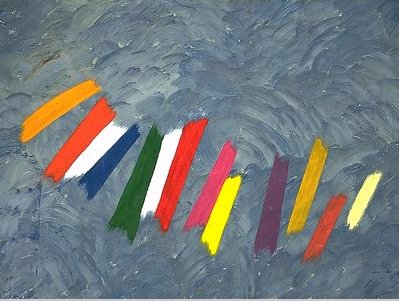
colors-for-a-large-wall-1951.jpg

   “Colors For A Large Wall (1951)

       Ellsworth Kelly

          __________

talking about walls, isn’t it only a few
years ago we were tearing one down

here is Roger Waters and several
other outstanding guest artists, in 
very Berlin, July 21, 1990, celebrating 
its demise

a little earlier, C***mas, 1989, only
moments after East Germans had 
been allowed to visit West Germany,
essentially giving way to the 
dissolution of the barrier, Leonard
Bernstein conducted Beethoven’s
Ninth Symphony, changing the 
word “joy” from the title of Schiller’s 
poem, appropriated by Beethoven 
for his great fourth choral movement, 
to “freedom”, giving new meaning, 
and new life, and new inspiration,  
to Beethoven’s always resounding 
nevertheless masterpiece

how soon we’ve forgotten

Richard

psst: let’s paint the wall

on art, its purpose

poet-with-flower-2008-jpgblog

                                Poet With Flower (2008)

                                          Stefan Caltia

                                                 _____

wherefore art, I’ve long and often wondered,
with only a wink to Juliet’s Romeo, for my
question dug deeper, why, indeed, itself art

we build our souls on the stories we’ve 
heard, the impressions we’ve received
from voices that spoke directly to our 
senses, painters with paint, musicians
with music, writers with words, poets 
with poems

it started with fairy tales, which told of
right and wrong, good and bad, courage,
kindness, responsibility, and dire 
consequences for discord

Biblical stories also took up a lot of my own
childhood, Jesus, Adam and Eve, Moses
and the Ten Commandments, this last 
reinforced by Cecil B. DeMille’s epic

but soon enough it was Oliver TwistLittle
Nell, and by an inescapable authorial leap, 
since these were all by an irresistible 
Charles Dickens for a guy my age, Sydney
Carton, who valiantly stands in for his
friend, Charles Darnay, at the guillotine, a 
quantum, even existential, leap from 
Peter Pan and Mary Poppins 

though I had the good fortune to learn to 
read and write music as a boy, play music, 
learn about Bach, Brahms and Beethoven, 
it didn’t take anyone else much more than
their enthusiasm to see what the Beatles
were similarly doing, the Rolling Stones, 
the Supremes, they were not only singing, 
but making history, shaping it, and us, we 
followed the questions they rose, their 
responses, the effects upon ourselves
for nothing is considered until it’s 
mentioned, spoken, made clear, and they
were those prophets

the same goes for art, we see as we see
cause Monet, Picasso, Warhol showed 
us how to see, what to look at

and of course poets, Shakespeare, 
RostandDanteGoethe, to inform, each,
their individual language, and culture

I have been Philip CareyScarlett O’Hara, 
Blanche DuboisGary Cooper in High
Noon“, both Martha and George in 
Who’s Afraid of Virginia Woolf“, lately 
I’ve been even Hank Williams

as Babette would say, a French doll who 
gets abducted in Raggedy Ann and Andy:
A Musical Misadventure“, an animated 
movie from the Seventies, – oo aahrr yoo 

Richard

psst: all of them have been me too,
      incidentally

” Shakespeare and Politics”- Professor Paul Cantor

on-the-waterfront-set-design-for-shakespeare-s-drama-the-merchant-of-venice(1).jpg!Large.jpg

 On The Waterfront. Set Design For Shakespeare’s Drama

   “The Merchant Of Venice” (1920)


      Alexandre Benois


                 ________


though this recommendation might seem 

erudite, esoteric, indeed eccentric, if not

even improbable, I vaunt this invaluable 

series to the stars, Professor Paul Cantor

of the University of Virginia, speaking from 

Harvard, however, here, shines such 

glorious light on the already extraordinary 

Shakespeare so as to make him the equal 

of very  Beethoven, poets of nearly 

supernatural ability 


Professor Paul Cantor views Shakespeare 

through Shakespeare’s understanding of  

politics, comparing his political settings – 

commercial Venice, imperial Rome, 

medieval and Renaissance England, 

Denmark under a Christian king – to not 

only shed light on those individual 

political systems alive at a time when 

democracy was being born, but as well 

on Shakespeare’s own unexpectedly 

probing philosophical insights in the 

matter of governance, right up there 

with John Locke and Machiavelli


who’d ‘o thunk it 


the professor is engaging throughout, his  

information entirely absorbing, you’ll come 

out a new wo/man


the lectures are not short at an hour, twenty
minutes, I break to powder my nose, get a
a glass of wine, even answer the phone to,
of course, preferred only parties, but have 
been returning addictively daily 

 it’s a heady indeed addiction


Richard