Richibi’s Weblog

Just another WordPress.com weblog

Category: Beethoven

“Mother with Children” – Gustav Klimt
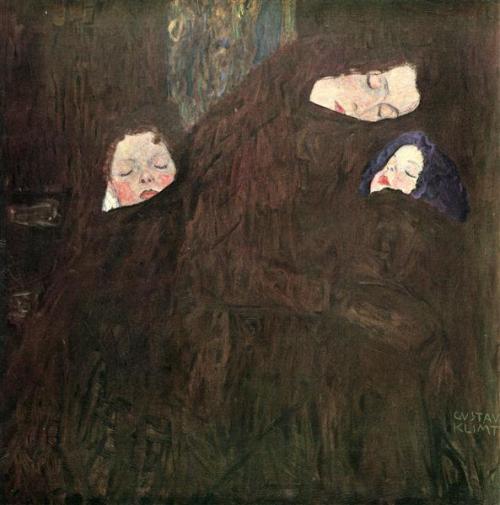
mother-with-children.jpg!Large     
     “Mother with Children (c.1909 – 1910)

             Gustav Klimt

                 _______

Gustav Klimt has long been one of 
my very favourite painters, a large 
reproduction of a detail of his 
masterpiece, Music“, hangs even 
on one of my walls

how much is that Klimt in the 
window, I’d asked the merchant 
when I saw it from the street in 
his shop’s display

later, I invited people over, to see
my Klimt, I’ve got a very large 
Klimt, I’d say – this is before 
anyone even knew of him, I was, 
I’ll admit, a bad boy

around all that, I’ve had the good 
fortune to see many of his works
during the several times I’ve been 
to Vienna, where most of his 
wonders reside, where they grace  
that immortal city, the great hall of
the Kunsthistorisches Museum,
the Art History Museum in English, 
for instance, the Beethoven Frieze 
at the Vienna Secession Building 
and, of course, at Belvedere, the 
summer palace, where among 
other paintings of his, you can 
still see the iconic The Kiss
their national treasure

but the painting above, part of a 
private, apparently, collection, is 
utterly new to me, and therefore 
striking,

note how stark the background is
here, above, compared to Klimt’s 
usually more ornamented 
constructions, how the subject is
starkly the gentleness, the 
intimation of peace, even serenity,
in the rosy cheeks of not only the 
children, but of also the mother,
the slumber and surrendermidst 
the imprecations of the 
surrounding, and portentous,
darkness, note the paradoxical, 
genetically determined even, trust 
and love, in the consonant colours, 
cherry blossoms blooming in all 
three sleeping faces, despite the 
threatening miasma of encroaching 
and engulfing primordial earth

Shostakovich also said something 
like that in his 15th String Quartet
a fundamental harmony develops, 
despite even strident distortions, 
disturbances, in otherwise 
unbearable situations, to provide 
some solace, redemption
 
listen, I urge you, if you dare

compare the crook in the mother’s 
neck, above, a nearly Baroque angle, 
to the same docile, though resilient,
bent in Klimt‘s lover in The Kiss 
for his provocative, maybe even 
enlightening, perspective on 
women


happy Mother’s Day, mothers, for all 
your invaluable attention


R ! chard

Mozart / Haydn piano sonatas

Portrait_of_Princess_Friederike_Luise_of_Prussia_(1714-1784),_Margravine_of_Brandenburg.jpg

    Princess Friederike Luise of Prussia (1714-1784), Margravine of Brandenburg

              ____________

if you had trouble distinguishing your
Schubert from your Beethoven, you’ll
probably have trouble as well telling
your Mozart from your Haydn, though
you won’t find it difficult, if you listen,  
to tell the earlier two from the latter

both the Haydn here, and the Mozart,
were written in 1789, the year of the 
French Revolution, something akin 
to our 9/11, the world changed from
one moment to the next 

the first two were still doing parties,
which is to say, salon music, stuff 
for elites, you can hear it, frivolities,
with, however magical, elaborations
– Liberace, I thought – nothing ever 
as confessional as the two later 
composers, who, with the new 
fervour around individual opinion, 
in the wake of questions even about 
the validity of God, would create the 
very Romantic Era 

Mozart and Haydn explore songs,
ditties, Beethoven and Schubert 
investigate very fundamental 
musical constructions, they’re 
down to the very essence of 
tonal possibilities, something 
that happened to the pictorial 
arts in the 1950’s, as artists 
probed the cerebral implications 
of colour, see for instance, 
Rothko

their probe itself becomes more 
powerful than their apparent 
subject, the tune, though the 
melody proves to be, ever, the 
cement that keeps the meditation 
together

what it says, what they say, is
that confronting our destiny, 
we remain the only arbiter, its
outcome will be as beautiful 
as we make it, for better or for 
worse, the creation of 
something beautiful, a work 
that can be so beautiful, much
like a life, seems to be a reply 
that can somewhat, at least, 
existentially satisfy a sense 
of purpose 

what, otherwise

  
R ! chard

psst: Mozart’s piano sonata was written 
          for Princess Friederike Luise of
          Prussia, pictured above 

what’s up in Frankfurt – Piano Sonata in F minor, “Appassionata” – Beethoven

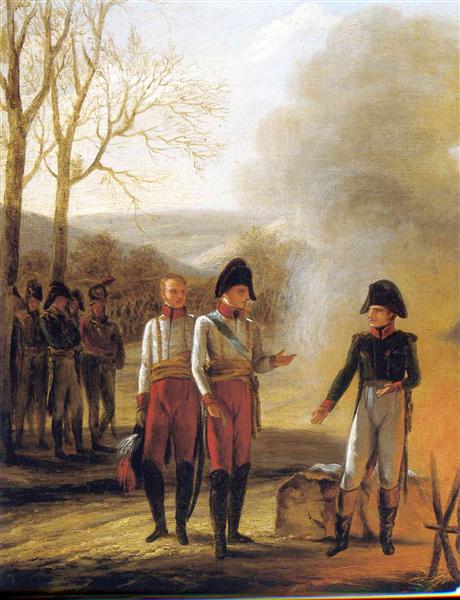
the-conversation-of-napoleon-and-francois-ii-1808.jpg!Large

  “The conversation of Napoleon and Francois II (1808) 

        Pierre-Paul Prud’hon

________

it’s 1804, Beethoven has entered his
Middle Period, left the more formal 
constraints of the Classical Period, 
Mozart and Haydn, behind, though
perhaps not essentially, the 
structure remains, hardwiredbut 
its spirit is entirely different, 
revolutionarily different, thanks to
Napoleon

and Beethoven is as opinionated 
as the revolutionaries, boisterous,
adamant, peremptory even, he is 
Zeus, and not undeservedly, at 
the top of Olympus’ musical 
mountain, where, incidentally, 
he still prevails, harmony’s very 
Homer

by his Opus 57, the Appassionata” 
– a name not of his own invention, 
but, however discriminately, ascribed 
later – he isn’t as metaphysical as 
Schubert is in that later poet’s D960
Beethoven is still writing descriptive 
texts, torrid novels, however 
masterfully illustrated, more than 
the philosophical stuff he’ll later 
undertake, even topping, when that
takes place, Schubert’s, ever, 
nevertheless, transcendental D960
if you can believe it

but Schubert remained a stripling, 
Beethoven, his elder, was given the 
grace to probe longer his humanity,
however might it have been equally 
cruelly benighted, and to stretch his 
speculative reach into previously 
unimagined dimensions, beyond 
the limited temporal scope of the 
surely shriven since Schubert 

all of whose wonders have defied 
the harsh indignities of time, and 
continue still to profoundly and
indelibly reverberate

listen, marvel


R ! chard

what’s up in Amsterdam – Piano Sonata in B flat major, D.960 – Franz Schubert

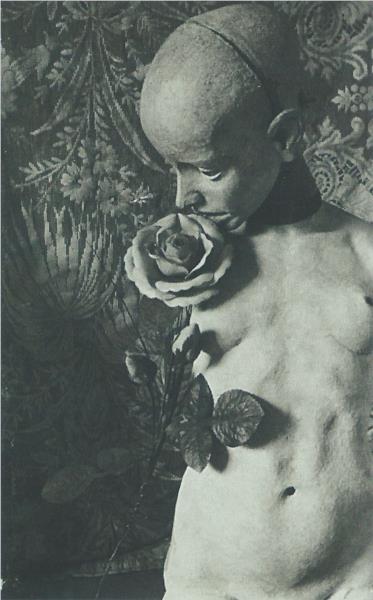
the-doll-1934-5.jpg!Large

      “The Doll / Die Puppe (1934) 

                 Hans Bellmer

                     ________

should you be concerned about telling 
your Schubert from your Beethoven,
don’t fret, I myself, though considered 
by some in this area to be omniscient, 
however manifestly, as you’ll note here, 
erroneouslyupon watching a film last 
night – the splendid Ex Machina”,  
about a robot in the form of Alicia
Vikanderviscerally commanding in 
neon blue, which is to say, incandescent, 
with stainless steel and wires for body 
parts – arms, legs, stomach – as part of 
her more human, and curvaceous, 
attributes – face, chest, and pelvis – who 
fears she might be disassembled when 
her purpose is served, and a new, and 
better robot might not only take her 
place, but also her very physical and 
metaphysical components, and concocts 
to save her life, if that’s what you’d call it, 
however convincing, sophisticated, might 
be her replication – confused the Schubert
sonata that filtered through the score for 
one of Beethoven’s, though can you 
blame me, when the sci-fi tale had been 
so otherwise gripping 

the D960, Schubert’s 23rd and last piano 
sonata, was written in 1828, shortly before 
he died, it is extraordinary, and entirely 
worthy of being compared to Beethoven,
of being held, indeed, in equal 
consideration

but you be the judge 

you’ll note again Schubert’s reserve, his 
courtesy, he is philosophical, rather than 
combative, his reply to Fate is acquiescent, 
though never subordinate, his response to 
the challenge of Life is to display the 
colours, sounds, and other, however 
humble, ephemeral, perhaps even
inconsequential, attributes of his existence, 
with the grace of a very flower, whose 
essence we still, today, have not ceased
to acknowledge, and to profoundly admire 

this is our only answer, he states, our 
ever so resplendent, however individual, 
humanity, which it is our very salvation 
to recount, to relate 

Beethoven would surely have agreed,  
and applauded

listen


R ! chard


a Beethoven / Schubert piano recital

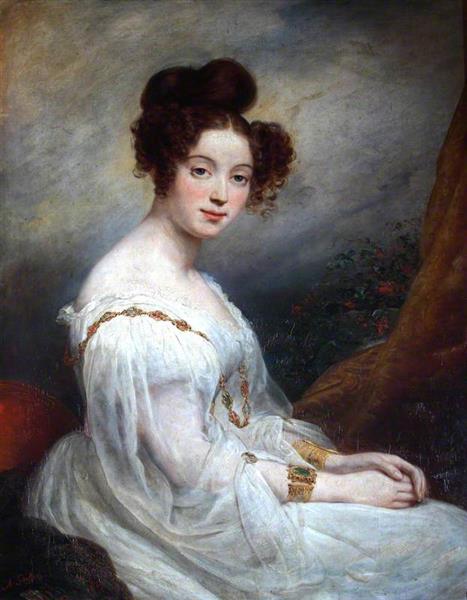
charlotte-rothsch-baroness-anselm-de-rothschild-1828.jpg!Large

 “Charlotte Rothsch, Baroness Anselm De Rothschild (1828) 

       Ary Scheffer

           _______

since Beethoven wrote nothing of any 
great consequence for four-hand piano,
I thought at first I’d head towards another 
kind of pairing, but upon listening to the 
complete recital here of the two Jussen 
brothers, where Beethoven’s “Variations 
on a Theme by Count von Waldstein”, 
1792, a trifle, and his later “Waldstein” 
Sonata, 1804, for piano solo, an infinitely 
more accomplished work of his Middle 
Period, both dedicated to the same good 
friend and patronbookend a flurry of  
enchanting Schubert compositions, 
the contrast between the two composers, 
if not starkly evident, is at least 
discernable if you listen with some 
degree of attention

the difference is in the tone, the intention, 
Beethoven is brash, assertive, Schubert 
remains ever respectful, even often 
courtly

you’ll note that after the fall of Napoleon, 
the monarchy was restored in France, 
therefore throughout the whole of 
Europe, which had resumed its more 
genteel pretensions, as had, for instance,  
even Chopin himself, you’ll remember, in 
very Paris, where he’d relocated from 
Poland because of its political unrest

I’ve often said that a distinct characteristic 
of Beethoven is that he writes against the 
beat, rather than stressing the first note 
of the air he is developing, he accentuates 
the second, or third, the next still, or the 
very last

don’t go, I wish you’d stay here, he, for 
example, beseeches, if you transpose 
his notes in the last movement of the 
Waldsteinthe one after the lugubrious 
adagio, into words, don’t go, he strikes, 
I wish you’d stay, don’t go, I wish you’d 
stay here, don’t go, wish you’d stay, 
wish you’d stay, wish you’d stay,
accent each time on the stay 

in Schubert’s Fantasie for four-hand 
piano, written a generation later, in 1828, 
and admittedly powerfully influenced by 
Beethoven, though no more derivatively 
than Mozart would’ve been of Haydn, try, 
I hear a bird sing, I hear it sing, I hear it 
sing, it sounds so lovely, to the lovely 
melody at its very beginning, one 
composer is peremptory, the other is 
more subservient, confessional

this is what I mean by intention, and the 
difference between these two towering 
geniuses, who shaped together the 
music of their era, however might they 
have been otherwise total strangers

they are both musical giants upon 
whose shoulders our Western culture  
still stands, and swoons, before such 
an utterly transcendent legacy

listen


R ! chard

String Quintet in C major, D. 956 – Franz Schubert

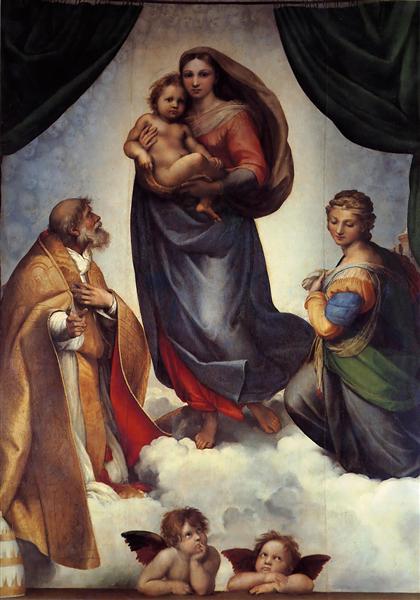
the-sistine-madonna-1513.jpg!Large

   “The Sistine Madonna (1513)
 
          Raphael


          __________ 


if you listen to only one piece of music  
this week, make it this one, Schubert’s 
a monument of Western culture, it’d be
like missing the Venus de Milo when 
you’re at the Louvre, or the Sistine 
Madonna of Dresden’s Zwinger 
the church of Saint Agnes Outside the 
Walls, transformative experiences

quartets, I couldn’t not next introduce
their very gold standard 
 
written in 1828, it was composed at 
the very height of the Romantic 
Period, just a little ahead of Chopin,
1810 – 1849, his other significant 
counterpart, apart from the ageing
Beethoven, 1770 – 1827, who still 
towered above all, despite his 
demise, and was universally 
admired 
 
but had Schubert lived longer than 
his 31 years, I suspect he might’ve 
been Beethoven’s equal, Schubert 
died even earlier than Mozart did, 
at 35, but of something that wasn’t
spoken of until much later, which 
is why we haven’t heard about the 
loss of this other musical giant
quite as grievously as we have 
about his somewhat more senior 
counterpart
 
but listen
 
it’s even hard to tell him apart from 
Beethoven, the passion, the urgency, 
the drama, even composing against 
the beat, a signature trait in 
Beethoven, like Alfred Hitchcock 
showing up in his own movies, or
Woody Allen, always introducing a 
work of art
 
a few things
 
though the frame is immaculately 
Classical, tonality, tempo, and 
recapitulation are not at all 
unobserved, the mood has changed 
from courteous, deferential, and 
respectful, to urgent, confessional, 
and private, the walls are there, but 
the furniture has changed, thanks 
of course here to Beethoven
 
and to the times
 
was writing her Sonnets from the 
Let me count the ways. – right about 
thenunfettered love poems to her 
beloved husband, Robertthe equally 
famous poet, who was remaining 
nevertheless, in his own work, more 
emotionally punctilious
 
I noted as well that the tempo in the 
second movement, one of the most 
beautiful adagios eversurely, 
lurches into an intemperate rebellion,
a second rhythm, up against the earlier 
mournful resignation of the poignant 
lament – note, in passing, that its 
stress of the dominant note is on the 
last beat not the first, like a weight 
that becomes, at every inching 
forward, intolerable, very path to a 
personal Calvary – before returning 
to that very fateful, though luminous, 
initial, stricken dirge

the next movement, the scherzo, does 
the reverse, fast, then slow, then fast 
again, to give the work in its entirety
eight rather than the four traditional 
tempi
 
the piece now has episodes, rather 
than merely a clockwork display,
drama has replaced the dance
entirely as the subtext for music
 
Schubert died two weeks after its
publication, for your info, I think 
his soul had been talking
 
 
R ! chard

psst: there’s a magical film I associate 
          with this music, The Company 
          of Strangers“, a Canadian 
          production, about several elderly
          ladies who get stuck in the 
          wilderness after their tour bus  
          breaks down in the middle of 
          nowhere
 
          you’ll never forget it


String Quintets – Mozart / Beethoven

3889-2014-2

 
           Claude Monet
 
               ________
 
 
concerned about presenting Beethoven’s 
Opus 59, the next significant string quartets 
of the early 19th Century, too early – 
Beethoven had, incidentally, at that point no 
rivals – I preferred to establish his credentials, 
rather than to enter his next phase, equivalent 
to the move from representational art to 
Impressionism in painting, a sea change,  
people would’ve balked at the very concept   
of an alternative vision, and indeed they 
were confused
 
this sea change, I should point out, challenged 
the very notions of what not only art should be, 
but also music, and literature, indeed very life 
perspectives, philosophies
 
therefore the Romantic Period, when 
expressions of personal epiphanies began 
to crowd the new democratic environment 
after the French Revolution, 1789, all of 
which would lead to, eventually, our own 
allegiance to, at least in the West, the 
concept of human rights
 
music was already, in other wordstalking,
and with Beethoven, indeed vociferously 
 
 
still adheres to Classical conditions, 
but bursts through them emotionally
 
written only 14 years earlier, one of six
of his
 
you won’t find them, perhaps, on the 
surface, to be very different, wouldn’t 
be able to even tell them apart in a
blind pinch 
 
but juxtaposing, as I always urge, 
sharpens one’s aesthetic pencil, ask
yourself, in this case, according to 
your senses, which of the compositions 
is earlier, you’ll find your senses have 
already told you
 
everything flows from that initial 
answer, when you ask yourself why  
you think that
 
 
I’d asked my mom at Belvedere, 
Vienna, whose painting hung across 
the hall we’d just entered
 
she demurred, of course, considering 
herself not up to the challenge, despite 
several visits together we’d had among 
a wonder of other European art galleries
 
I insisted
 
she tossed off, okay, Renoir, an easy 
answer, though it turned out to be a 
Degas, or the reverse, or whatever 
 
but upon reaching the painting, of 
course, Degas, she said, knowing full 
well it was himhaving lacked only the 
pluck and the confidence 
 
who’s that, I asked, turning to another
master
 
Monet, she replied, confidently
 
and was, as I’d anticipated she would 
becorrect, she can now tell her 
Rembrandtfrom her Courbets, her
Canalettos from her Vermeers also
 
we know of a lot more than we 
think we do
 
 
R ! chard

String Quartet in A Major, Opus 18, no 5 – Beethoven

adagio-1899.jpg!Large

      Adagio (1899) 
 
         Tom Roberts
 
            ________
 
 
                               for especially Kathy, who, 
                                   according to a mutual friend, 
                                       needs our prayers
 
                               please be generous 
 
 
from his Opus 18, among which there
are six, according to the Classical 
tradition, is still steeped in Classical
conditions, tonality, tempo, and 
reiteration, but is revolutionary for 
its brashness, its personal 
manifestation – hey, it says, I’m the 
Pied Piper, I’m not hiding in the 
courtly shadows any longer, my 
stage is now the concert hall, no 
more the aristocratic, however 
stately, chamber music, which has 
ceded, until now, to propriety and 
deference rather than, in a word,
genius, I’m Beethoven, Beethoven 
says, watch me
 
he doesn’t disappoint
 
written in 1801, is a very early work of
Beethoven, it’s nearly easy to confuse
him here with Haydn, with whom he’d,
incidentally, earlier studied
 
the era is still extricating itself from the 
Classical model, the Classical imperatives 
are there, tempo, tonality, and repetition 
remain rigid elements of musical 
construction in the 5th, they are nearly 
obsessive, though each movement 
imprints itself, by constant reiteration, 
on our minds, much like pop music
 
but I miss an adagio, the moral ground,
I think, of a piece of music, the place 
where your heart really takes over and 
begins to incorporate the work‘s 
humanity, I ascribe this unfortunate 
omission to Beethoven’s youthful 
exuberance, he would’ve been around 
30, and setting out, with verve and 
ambition, and he would be performing 
before general now, rather than 
aristocratic, audiences, he had a show 
to put on, not just background chamber 
music  
 
note that the second movement is a 
minuet, a sure sign of the Classical
Period, extinct in only a few further
years
 
note that the third movement, the 
andante cantabile, a leisurely walking 
pace, stepped up, rather than down, 
to a veritable clippety-clop in some 
instances, is a set of variations, to, 
incidentally, settle its theme into 
one’s very consciousness, I’ve been 
humming these movements for the 
past several days, not at all 
unprofitably
 
note also that you’ll probably soon 
be humming, too, this infectious
compositionin all its iterations, 
they are utterly captivating, after, 

still, even over two hundred years

enjoy 


R ! chard 

psst: thanks Collin, for Kathy

Cello Sonata no 2 in G minor, opus 5 – Beethoven

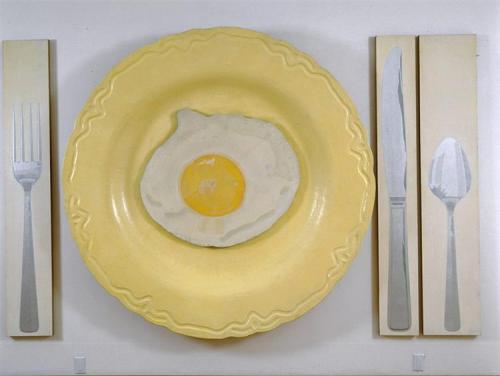
egg-on-plate-with-knife-fork-and-spoon-1964.jpg!Large

   Egg on Plate with Knife, Fork, and Spoon (1964) 

           Alex Hay

              ____

after my somewhat prolonged side trip 
into Bach country, though it is a land
of many more wonders, I’ll get back 
on track, more or less, here, with 
Beethoven’s Second Cello Sonata
the other half of his Opus 5

till then, the cello had served as 
accompaniment, essentially, for other 
more discursive, higher pitched, less 
sonorous, less stentorious  
instruments

but Beethoven puts the cello back 
into the hottest seat in the house, right 
next to the ubiquitous piano, a 
requirement in any instance following 
the neglect of the cello during the 
intervening Classical Period, despite 
Bach’s earlier luminous illustration of 
its incandescent potential

the Opus 5, no 2 starts, audaciously, 
with an adagio, not always a wise 
choice, as you’ve heard me repeat 
here before, it can be unentertaining

but Beethoven gives his adagio tension
by introducing breaks often, which,
rather than stultify, creates momentum,
therefore a narrative, a story to follow

the rhythm is no longer adjusted to 
dance essentially, such a spin as is
heard in the second and third 
movements, for instance, would 
surely sweep one off one’s feet

but the art is in the dance that 
Beethoven allows and creates between 
the piano and the cello, the first the 
filigree on the arm of the more grounded, 
more entrenched latter, the crystal, the 
silverware that adorn, symbolically, an 
however majestic oak table, the creamy
Hollandaise that makes an egg, however 
elemental, irresistible, the literary turns 
that might transform mere prose into, 
verily, poetry, icing on a cake, in a word,  
to complement, in stunning and equal 
cooperation, the inextricable 
counterpart

there is even a moral lesson transmitted
here

Beethoven can often be long-winded, 
I’ve found, but there’s always, always,
at the end of the road something 
entirely worth the extra minute, the 
even several extra minutes 

enjoy 


R ! chard

Cello Concerto no 2 in D major – Haydn

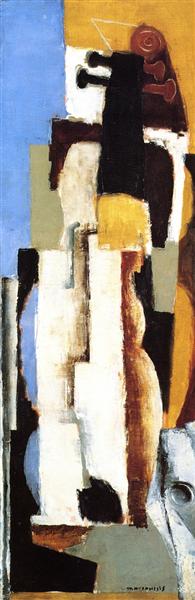
a-cello-1921.jpg!Large

         A Cello (1921)

        Louis Marcoussis

             ___________

between Bach’s transcendent Suites for
Cello and Beethoven’s reinvention of that 
instrument, two only cello works occupy
the last half of that century, both by
Haydn

his Second, however, Concerto, written 
several years later than his First, 1783, 
indeed nearly twenty years later, seems 
to me less accomplished, though ever, 
nevertheless, unimpeachably, and 
impressively, Haydn 

the first movement is long, long works 
only until you start thinking it’s long

the initial melody in the adagio, the 
second movement, struck me as artificial, 
saccharine, though Haydn weaves magic, 
not unexpectedly, still, and  
continuously, around it in its 
development, his elaboration of it

and the pace of the third movement, 
following the second, is disconcerting 
rather than surprising, rather than, 
were it effective, delightful

Mozart wrote a Cello Concerto too, 
apparently, but, if so, it is lost

otherwise we’re on to the next historical
epoch, Beethoven’s, after this inauspicious 
turn at this generation for the cello, lost 
for a while among the more assertive 
instruments of that prim, and proper,
Classical Era


R ! chard