Richibi’s Weblog

Just another WordPress.com weblog

Category: at the movies

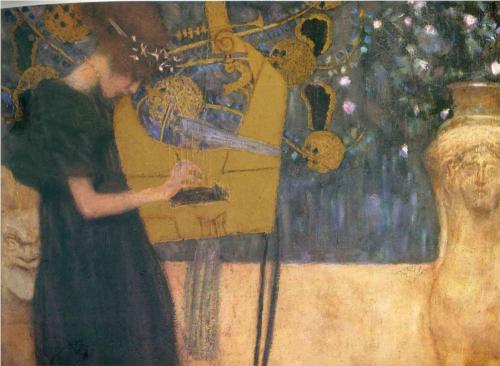
“Music”

Gustav Klimt's "Music"

Music (1895)

Gustav Klimt

______

not for lack of imagination, lately, but for,
rather, lack of confidence, the complaint
of any would-be poet, the complaint of
any proponent of oneself, one’s persona,
one’s own, however benign, however even
benevolent, ideas, I retreated into myself,
surrendering to forthright inspiration for
any, elusive enough, courage

inspiration, through its usual unsuspected
channels, and as ever categorically, gave
me, reliably, Music“, Klimt‘s ineluctable
masterpiece, not even for its iconic image,
but for its transcendental comment on
art’s interpretive counterpart, music

world’s meld

a “magical mystical miracle” happens, as
Katharine Hepburn, in her utterly
enchanting movie, Summertime“,
would have it, irrepressible as ever

I had to share

Richard

psst: note the juxtaposition of contrasting
colours, patterns, impressions, note
the Baroque presentation of Classical
imperatives, touched with Romantic
sensibilities, kicking off, not
incidentally, Modernism

“Why Do I Love You?” – from “Behind the Candelabra”

just when you thought you’d never see
Elizabeth Barrett Browning again, here
she pops up in, of all places, a movie
about Liberace, Behind the Candelabra“,
a not undistinguished representation of
the high life, the over the top life, of an
aging and flamboyant superstar with his
much younger companion, feathers fly,
Ferraris too, and so do tempers

but at one point Liberace recites this
poem, “Why do I love you?”

where have I heard that line before, I
said to myself, and needed no one, of
course, to answer, here was Elizabeth
handing over her mantle to someone
in the XXlst Century, maybe

you decide

Richard

psst: Liberace also said, “too much of a good
thing is wonderful”,
I’ll drink to that

__________________

Why do I love you?

Why do I love you?
I love you not only for what you are,
but for what I am when I’m with you.
I love you not only for
what you have made of yourself
but for what you are making of me
I love you for not ignoring
the possibilities of the fool in me,
and for accepting
the possibilities of the good in me.

Why do I love you?
I love you for
closing your eyes to the discords in me,
and for adding to the music in me
by worshipful listening.
I love you
for helping me to construct my life,
not a tavern, but a temple.
I love you because
you have done so much to make me happy.
You have done it without a word,
without a touch, without a sign.
You have done it by just being yourself.
Perhaps, after all,
that is what love means,
and that is why
I love you.

Apollo Appleseed

a friend of mine, Apollo, having
appropriated that name already
to launch a, not unpromising,
career as an artist, had never
to date considered a surname
for what I called his nom de
pinceau
, his brush name

but in a farfelu moment, French
for having lost one’s head – my
head, not his, having surrendered
immediately to his fantasy – he’d
happened upon “Appleseed” as
maybe a fitting, and to be
considered, apposition, addition,
to his presently truncated name,
I jumped on it

he later called the phenomenon,
at a loss for provenance, an
inspiration, to which I forthwith
concurred, Apollo Appleseed,
can you dig it, I told him he now
had to live up to it

inspiration is always the source
of poetry, I said, poetry is what
we all live for, to make our lives
beautiful

it involves following our inspirations,
however fanciful, however out there,
people have built lives around art,
literature, dreams, madeleines, for
goodness’ sake, fording oceans,
climbing mountains, and have
become not to be forgotten, it’s the
magic that counts, ever the aim of
inspiration

when inspiration strikes it is ever
charged with possibility, perspicacity,
delight, it is not a negative function

when inspiration strikes it is time
to stand and deliver, it knows the
ineluctable way, the one that’s in
your heart

you too can plant apple trees across
the land, of your own potentialities, if
only you dare follow even one of your
dreams

Richard

psst: you’ll have to forgive my ardour,
it’s been my Johnny Appleseed
speaking

and don’t forget to click

“Ghosts” – Henrik Ibsen

of Ibsen‘s plays, Ghostsis the only
one that I can ever really tolerate, his
others being entirely always for me 
too didactic, preachy 
 
in this brilliant production, riveting and
unforgettable, one I feared I’d never see
again, Judi Dench is again consummate,
as Mrs Alving surely definitive, and
Kenneth Branagh, as her son, nearly as
good, from way back when he still could
act
  
enjoy, marvel, be verily enlightened
 
  
Richard 
 
psst: Henrik Ibsen (1828 – 1906)


Schubert – Piano Sonata D959‏

to my utter surprise when I checked I’d never
but only once in the many months I haven’t
been able to shut up since I started spouting
my bristling endorsements, like a very rushing
river gushing with the overflowing bounty of
an inveterate spring, mentioned Schubert, an
incandescent voice from surely heaven

it was about his String Quartet in C major, the
D956, not surprisingly, it is utterly enchanting,
D for Otto Erich Deutsch still, incidentally

here’s an alternate version of it, an utterly
inspired one

but if I’ve reintroduced Schubert it’s specifically
this time to compare him with Beethoven, they’re
easily confounded, I even did it once myself, to
my crushing embarrassment, in erudite and
unflinching company, oof, I cringe to even
remember it

the D959, moments only after the 956 of course,
has all the idioms of a Beethoven, and exercises
them as expertly, the beat, however, is always
on, unlike Beethoven, whose beat is always off,
contrary, rebellious, against the prevailing
order

though this variance might seem slight, one
senses already in the younger and later
Schubert a return to form, elegance, and civility,
the First Empire had indeed taken hold during
the transformation of Napoleon from hero of
the Revolution to a different incarnation of
Emperor, Chopin as well would be beholden
to later similarly reinstated French courts

so seemingly trivial an alteration speaks
volumes when one attentively listens, one
must do this with one’s heart

such a return to aristocratic principles is not
uncommon, incidentally, we seem, indeed, to
thirst for dynasties, if you’ll note the return of
late, of the Bushes, the Clintons, and most
recently the Canadian Trudeaux

Putin is another, though arguably somewhat
less democratic, version of that principle

Beethoven is off the beat then, Schubert on, you
won’t find much else that’s different upon first
listening, you’ll note only that their music is very
much the same, rigorous beat, tonal, essentially,
harmonics, and the return eventually of the
melodies, Classical imperatives, but with the
distinction of the new Romantic,
transformational however, sensibilities

Schubert might’ve even outpaced Beethoven
had he survived, I think, but he didn’t, he died
much too young, at the most tender age of
only 31, younger even than the more
celebrated Mozart, famous for succumbing
prematurely at the still early age of 36

may they rest, may they all rest, Schubert,
Mozart, and the somewhat longer-lived
Beethoven, still early deceased at 56, in
eternal peace, for they have brought us
but wonders

Richard

psst: here’s a movie to go with the earlier
Schubert
, The Company of Strangers“,
the very best film Canada has ever had
to offer, bar none, a gaggle of old women
are stranded in the Laurentians after their
tour bus breaks down, Schubert would’ve
loved it

and been honoured

“Mrs Dalloway”‏

if you’re not afraid of Virginia Woolf
you might enjoy Mrs Dalloway“, the 
film version of one of her novels,
introspective, discreet ever, and 
only carefully and politely ever ardent,
existentially awash in civilities, with
feeble only attempts at philosophically
sounder, maybe, positions, all ultimately,
of course, inconclusive, an aristocratic
inversion of Van Gogh, but with statelier,
which is to say, more opulent, 
surroundings and, of course, corollary
attendant pretensions, all of it, incidentally, 
marvelously filmed  
 
the performances are all first rate, with
Vanessa Redgrave being, as usual,
resplendent
 
but Rupert Graves, as the shell-shocked
First-World-War veteran, turns in a
wrenching performance, one you’re not
likely to soon forget, one pointedly at
odds with the gentried airs of the rest of
the story, a terse, and damning, Woolfian
comment, who’s afraid of Virginia Woolf 
indeed, the institutionalization of
murderous insensitivities, and the
consequent blight of the blunting
of love  
 
nor did Virginia Woolf survive her own
condemnation, of course, famously
taking her own life in 1941   
 
 
all the other performances here are 
impeccable, up, admirably, each, to
the illustrious task  
 
I could’ve done without the two
time periods, however, Virginia Woolf,
the wordsmith, had it all going in her,
which is to say, Mrs Dalloway’s, 
sedentary head, leading up to her,
their, climactic party
 
 
may Septimus Warren Smith meanwhile,
and all others like him, rest ever in
ascendant, and proliferating, peace       
 
  
Richard


“Thirty Two Short Films About Glenn Gould”‏

to my mind, one of the best films Canada has
had to offer, a study of the musical giant which
is probing, perceptive, and profoundly revealing,
and the impersonator, Colm Feore, is impeccable,
superlative, rendering the mystery of flights of
inspiration vivid and comprehensible, he is,
seamlessly and completely convincingly,
Glenn Gould     
 
Glenn Gould is of course identified with his
book-end interpretations, his first release and
the interval of not quite thirty years for him to
further appraise these epic pieces, both issues
are considered monumental, defining cultural
moments, both eclipse, have eclipsed, any
other, even celebrated, performance
 
the reference in the film’s title is to these  
Goldberg Variations, of course, composed
of thirty variations on an opening “aria”,
which is repeated as a “coda”, an ending,
a musical last word, for a total of 32
segments
 
but I submit that the place of Beethoven’s own
could not possibly have been overlooked in
the movie’s title, considering especially the
inclusion of that specific number, despite,
incidentally, the missing hyphen, an infelicitous,
I think, literary licence 
 
the Thirty Two Short Films are themselves,
not incidentally, a set of 32 filmic, note, 
variations, on the subject, in this instance, 
of the player himself, Glenn Gould
 
may his star shine bright forever    
 
 
Richard


Beethoven: Sonata no. 21 in C major, op. 53 (Waldstein)‏

the “Waldstein” Sonata, no. 21 in C major, opus 53, is
one of the few compositions that Beethoven named
himself, which is to say that he dedicated it to a
friend and patron, Count Ferdinand Ernst Gabriel
von Waldstein
, if you can call that naming it

the ones with descriptive titles, the Moonlight, the
Pastorale“, The Hunt“, for instance, were mostly so
labeled by his publisher for ease of identification in
the growing market place, a more affluent merchant
class eager to take on the refinements of the nobles,
see such an instance of social mobility, however
lampooned, updated and upended, in again the
engaging and not at all unperceptive The Beverly
Hillbillies

this means that the suggestive names we’ve come
to associate with his sonatas, Moonlight”, Pastorale“,
The Hunt“, were never conceived as such by
Beethoven, his compositions were ever purely musical
inventions, or more accurately inspirations, prophetic
pronouncements of a much more oracular order,
like Prometheus Beethoven was delivering nothing
short of fire

to match music to specific visual, or even emotive,
cues, incidentally, Pictures at an Exhibition“,
The Carnival of the Animals“, for example, came
later, already a nod to Beethoven’s even indirect
propositions

that titles were given to music, rather than the more
clinical and mnemonically difficult numbers, which
is to say, not easy to remember, isn’t very different
from the evolution of popular music in the early
1960′s

the Beatles, you’ll remember, had cuts on albums
that had nothing more than their group name in
the titles, or the title of one of the album’s cuts,
“Sgt Pepper’s Lonely Hearts Club Band” came
along to change all that, we saw the birth of the
concept album, where the whole extended affair
becomes a musical metaphysics, this is no
different from the move from the music of Mozart
to that of the more expansive Beethoven, music
is no longer a ditty but an extended technical
and philosophical text, listen to Pink Floyd take
on this mantle superbly in the Seventies, the only
other body since ever to effectively challenge
Beethoven in that especially rarefied field, with
the probable exception of the sublimely expressive
Schubert perhaps, who died much too young for us
to tell, for him to have decisively dialectically proven
himself beside these erudite peers, all having,
however, found ways to have us touch beyond the
sky, the very infinite, and into the no less infinite
confines of our more private and secret selves

what they state is that creation itself, absent any
other meaning, remains potent, perhaps even
ultimately redemptive

creation as a bold and noble response to eternity,
art as affirmation

you’ll note here that the structure of this sonata
is entirely Classical, unity of tone, unity of pace,
and the eventual return of the initial melody,
essential Classical components, what has
changed is the personal bravura of the composer,
Beethoven is not playing for the aristocratic court,
but for a wider, an infinite, audience, he is
pronouncing his and, by extension, our own place
and validity in the universe, by our ability as humans
to create, to respond creatively, and even sublimely,
out of only our otherwise flailing and indeterminate
existence

it is the Romantic response to the waning belief
in God, and incidentally a profound spur to,
argument for, our present notion of inalienable
individual rights

the personal soul has taken over from the earlier
unchallenged deity, the wavering concept of God
has had a seismic fall, and all the king’s horses
and all the king’s men will never be able to put it
together undiminished again

Beethoven is showing us that future

Richard

psst: Helena Bonham Carter plays excerpts from the
Waldstein“, incidentally, in A Room with A View“,
a movie entirely worth a revisit
“Don Juan DeMarco”‏

Johnny Depp, someone whom until this movie
I didn’t pay much attention to, agreed to play
his part only if Marlon Brando would play the
psychiatrist, and Marlon Brando in response
goes on to prove again why he is 
 
Johnny Depp, however, is a veritable revelation,
holding his own, and more, to the great man, in
a role that has him take on the persona of “the
world’s greatest lover” conflated with that of
Zorro, an ingenious dramatic twist which the
writer neatly and convincingly interposes 
 
one of the writers, incidentally, is Lord Byron,
excerpts from his poem, Don Juan“, comprise
many of Don Juan DeMarco’s most rapturous
moments, you’ll easily spot them, only poets
can talk like that, or people truly in the grip of
love
 
Faye Dunaway, in a peripheral role, is never
ever a disappointment
 
and if that’s not enough, the whole thing is
presented in the thrilling accents of sensuous
and simmering Seville and the sinuous rhythms
of the smoldering tango 
 
Don Juan DeMarco” is absolutely irresistible,
you’ll laugh, you’ll cry, you’ll regain your very
youth in the incandescent spray of its 
rejuvenating formula, you’ll pause, you’ll 
ponder, you’ll find yourself reconsidering,
thoughtfully and profoundly, what it really
means to love   
 
watch 
 
 
Richard
 
psst: original song by Bryan Adams


“Wait Until Dark”‏

Wait Until Darkout-Hitchcocks Hitchcock,
this is not an unremarkable feat
 
the director, Terence Young, had already
managed the early James Bond films,
Goldfinger“, and so had already
achieved noteworthy experience,
not to mention acclaim
 
here he delivers perhaps the most satisfying
suspense film ever
 
Audrey Hepburn is again more than luminous,
she claims again, following so many impeccable
performances, her inviolable spot as a veritable
legend and immortal goddess of art, though she
loses again the Oscar, this time to the other
incandescent Hepburn   
 
she chooses all her own clothes for the movie,
incidentally, in Paris
 
 
Alan Arkin has been equalled only recently, to
my mind, as a villain, by Heath Ledger‘s Joker
in The Dark Knight“, a much less convincing,
however, movie, Richard Widmark was pretty
nasty too, come to think of it, in 1946’s Kiss
 
when quizzed on why he didn’t get a nomination,
one, one would think, he should’ve had in the
bag, he replied, “You don’t get nominated for
being mean to Audrey Hepburn!” 
 
gotcha
 
or touché, as we say in French
 
 
you’ll notice that the entire movie takes place
in one setting, a restriction imposed by the
fact of being originally a play, which must
abide such constraints, see Give ’em Hell,
Harry
 
however, having been raised in French I fully
subscribe to the Classical imperatives of unity
of time, unity of place, unity of action, which
this play delivers in spades   
 
the impositions, when masterfully maneuvered,
deliver entertainment of an even more impressive
order, see Who’s Afraid of Virginia Woolf?for
another celebrated such instance 
 
 
when Wait Until Dark” was first screened lights  
were darkened “to the legal limit” during the
climactic scene
 
even in your well-lit viewing room, even over
forty years on, think of it, you’ll still need to
hold onto your seat, pacemaker 
 
 
Henry Mancini, however unlikely here, though
not especially ineffectively, does the music  
 
in the last scene he’s heartstoppingly hot
 
 
enjoy
 
 
Richard