Richibi’s Weblog

Just another WordPress.com weblog

Category: a poem to ponder

“Bohemian Rhapsody” – Freddy Mercury‏


the poetic dramatic monologue, which finds
its popular source in Shakespeare, though
they are essentially introspective there,
philosophical rather than strictly narrative,
making them nevertheless, in a play, by
definition, dramatic, rightful claimants
still to that name, and which was
institutionalized as a poetic form by
Robert Browning later in the XlXth Century,
by upending the Shakespearean mode,
turning poems into plays instead of plays
into poems, makes its way into the XXth
Century, probably mostly unobtrusively,
no one really particularly notices, but
powerfully culturally nonetheless when
applied to, for instance, music, which is
to say poetry, of course, with notes

here’s “Bohemian Rhapsody”*, an abridged
version, as sung by Rose Osang Fostanes,
delivering a classic dramatic monologue

here’s Freddy Mercury’s complete version,
with a Greek chorus supplying oracular
even feedback

Richard

* Bohemian Rhapsody

Is this the real life?
Is this just fantasy?
Caught in a landslide,
No escape from reality.

Open your eyes,
Look up to the skies and see,
I’m just a poor boy, I need no sympathy,
Because I’m easy come, easy go,
Little high, little low,
Anyway the wind blows doesn’t really matter to me, to me.

Mama, just killed a man,
Put a gun against his head,
Pulled my trigger, now he’s dead.
Mama, life had just begun,
But now I’ve gone and thrown it all away.

Mama, ooh,
Didn’t mean to make you cry,
If I’m not back again this time tomorrow,
Carry on, carry on as if nothing really matters.

Too late, my time has come,
Sends shivers down my spine,
Body’s aching all the time.
Goodbye, everybody, I’ve got to go,
Gotta leave you all behind and face the truth.

Mama, ooh (anyway the wind blows),
I don’t wanna die,
I sometimes wish I’d never been born at all.

I see a little silhouetto of a man,
Scaramouche, Scaramouche, will you do the Fandango?
Thunderbolt and lightning,
Very, very frightening me.
(Galileo) Galileo.
(Galileo) Galileo,
Galileo Figaro
Magnifico.

I’m just a poor boy and nobody loves me.
He’s just a poor boy from a poor family,
Spare him his life from this monstrosity.

Easy come, easy go, will you let me go?
Bismillah! No, we will not let you go. (Let him go!)
Bismillah! We will not let you go. (Let him go!)
Bismillah! We will not let you go. (Let me go!)
Will not let you go. (Let me go!)
Never, never let you go
Never let me go, oh.
No, no, no, no, no, no, no.
Oh, mama mia, mama mia (Mama mia, let me go.)
Beelzebub has a devil put aside for me, for me, for me.

So you think you can stone me and spit in my eye?
So you think you can love me and leave me to die?
Oh, baby, can’t do this to me, baby,
Just gotta get out, just gotta get right outta here.

(Oh, yeah, oh yeah)

Nothing really matters,
Anyone can see,
Nothing really matters,
Nothing really matters to me.

Anyway the wind blows.
Freddy Mercury

“My City” – Christine Fichtner‏


at the end of her blog Christine Fichtner writes,

A fun Friday challenge by OM to describe any
city in less than 1 000 words.”

this is what she writes

” The endless rain of cars upon the streets lends a droning noise to the excited bustle of crowds that pace the streets in furious waves of cell phones and music players. Conversations you did not need to hear and lyrics you shouldn’t even be able to hear.

Up and down and across the buses loop with black coughs. At even intervals, as trains arrive with squeals as painful as aching joints, and the ground rumbles in a mockery of the earthquake that has been on its way for the last fifty years.

Around, buildings tower with promising winks and glassy eyes. Mirrors of desire. Coffee warms the hands of most who browse the streets.

Trees grow within their cages, trimmed and perfected. Blossoming in spring and illuminated in winter. They line the streets like ornamental filters. People flick their cigarette butts in appreciation.

An overpriced food truck. The same free newspaper you avoided two blocks back. No, you don’t have any spare change. You jaywalk a one way street. A car stops for you.

Every once in a while the sun deigns the city worthy of an appearance. But most days the skies mimic the cold cement, and cry for good measure. Ever followers, clothing of black and grey greet the eye like the dense fog that has been around all week.

Hard paths line the water, just beyond the shore. Bike bells and pounding steps followed by the scent of sweat. The occasional seal greets from afar, soon chased away by a ship’s horn. Gritty sand is cool in the shadow of the logs that line the beaches. Hills of grass and a spattering of trees give a semblance of privacy.

Every few months, fireworks cheer, costumes parade the streets. And sometimes birthday suits on two wheels flash past amongst cheering laughs.

Languages hum to each other. Every corner, a new one. Pointing fingers, flashing cameras, and large buses driving just a bit too slowly through the winding, illogical streets.

Yellow, red, black, signs lit, meters already running, slowing past bus stops and huffing when no one moves, speeding off for better luck elsewhere. Of course when you call, there are none available.

Because when night falls, the buses retreat and the alcohol pours and the police are unyielding with their sirens and dooming slips of paper. Stumbling from the bars and clubs, money scattered throughout the night, the cabs are there to collect the rest.

The scent of cuisines as you walk towards the water. Never the same one twice. Except for sushi.

Clothing sales as you move towards the pounding heart of traffic lights and beeping cars. Malls of stale air and clashing stores. Further away, niche boutiques and trendy wear eat away at your bank statement.

You avoid the east. The used needles that sleep beside someone who is not all there at the moment. The transactions that take mere seconds, switching hands as fast as they greet each other. And after dark, the knives that flash.

The buildings sigh downwards as you move north. Trees overtake the ground. Houses coexist among them, each with pet plants growing, well manicured and obedient. Here you hear the children playing, the dogs barking. Occasionally the complaint of a hungry cat.

Vehicles grunt their way up the steep roads. Colourful shoes flash as joggers and cyclists challenge the slopes. Up and up, until the forests swell, ripe with bird calls, dainty hooves, and snuffling snouts.

And the mountains overlook with the fondness as the city spreads like competing children. At the buildings that covet the watery view and the bright colours of the sun’s extremes.

As light fades, the clouds, in a rare moment of kindness, may choose to reveal the sky’s solemn sentries that dot the darkness in a slow, rotating guard. The city lights glimmer like a dying fire’s embers. It’s warm, and if you could, you would reach out and touch it. ”

______________

“I decided to describe my city, Vancouver.”,
she later explains, though by that time I’d
entirely, of course, got it, it should, I think,
be Vancouver’s official poem, right up there
with Chicago’s Chicago

bravo Christine

Richard

“Reciprocity” – Wislawa Szymborska

Wislawa Szymborska won the Nobel prize
in Literature in 1996, here is one of her
poems, translated from the Polish by
Clare Cavanagh

Richard

_______________

from the New Yorker, February 3, 2014

Reciprocity

There are catalogues of catalogues.
There are poems about poems.
There are plays about actors played by actors.
Letters due to letters.
Words used to clarify words.
Brains occupied with studying brains.
There are griefs as infectious as laughter.
Papers emerging from waste papers.
Seen glances.
Conditions conditioned by the conditional.
Large rivers with major contributions from small ones.
Forests grown over and above by forests.
Machines designed to make machines.
Dreams that wake us suddenly from dreams.
Health needed for regaining health.
Stairs leading as much up as down.
Glasses for finding glasses.
Inspiration born of expiration.
And even if only from time to time
hatred of hatred.
All in all,
ignorance of ignorance
and hands employed to wash hands.

Wislawa Szymborska

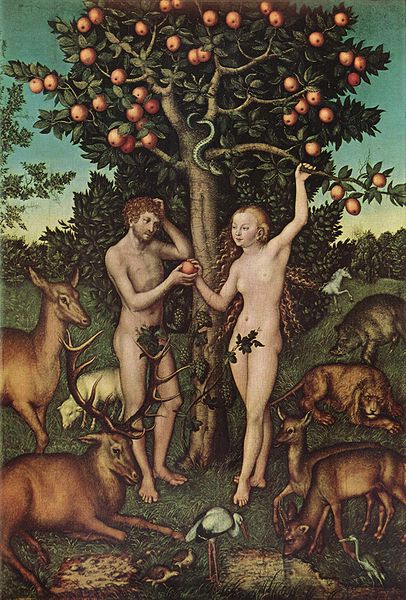
“Adam and Eve” – Lucas Cranach the Elder

Cranach Adam Eve

Adam and Eve (1596)

Lucas Cranach the Elder

____________

from The New Yorker, January 27, 2014

Adam and Eve” by Lucas Cranach the Elder, 1526

She seems a mere girl really,
small-breasted and slim,
her body luminescent
next to Adam, who scratches
his head in mild perplexity,
So many baubles hang
from the tree
it didn’t hurt to pick one.
The snake is a quicksilver curve
on a branch she is almost
young enough to swing from.

The garden bores her anyway:
no weedy chaos among
the flowers and vegetables;
the animals so tame
you can hardly tell the lamb
from the lion, the doe from the stag
whose antlers outline Adam’s modesty.
She is like that teen-age girl
who wandered from the mall last week
not to be seen again, the world before her
glittering and perilous.

Linda Pastan

______________

yesterday on a mission to buy socks,
finally – I had only a pair left and one
of those with a hole in it – I wondered
about clothes, why hadn’t we evolved
fur or feathers or, heaven forbid,
scales, like all other creatures,
without exception

cherry trees were in blossom, birds
sang along my path, despite an
inoffensive drizzle as I went along

perhaps, I thought, by standing erect
our private parts were too much in
evidence for even indiscriminate
Nature to bear, though apes in all
their varieties walk on two legs and
seem to cavort happily, indeed
lasciviously, though ever
unsheathed, I objected, everywhere

the only difference I could muster
between us and them was that we’d
eaten from the Tree of Knowledge,
the fruit, apparently, of our
apocalyptic decadence, while they’d
never had ever an Eve, nor, for that
matter, an, equally complicit, note,
Adam, no matter what the, mostly
male, elders might say

therefore apes gambol in their
Garden of Eden still, as you can
see in the Cranach above, serenely
uncontrite, while we buy socks in
the jungle next door, and berate,
burdened, our bedevilled lubricities,
what’s under those strategically
positioned, and obliterating, leaves

Tree of Knowledge indeed

Richard

psst: from the Courtauld Gallery in
London, more on Cranach’s
painting
, just click

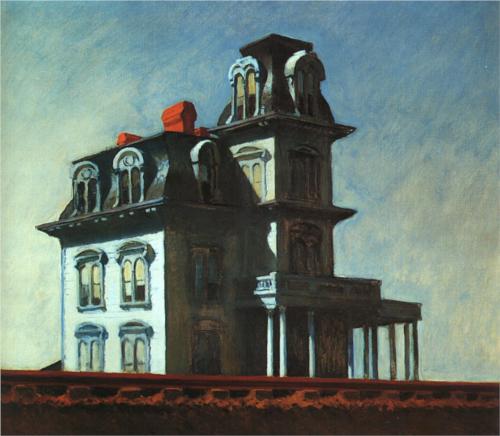
“Edward Hopper and the House by the Railroad” (1925) – Edward Hirsch‏

"House by the Railroad" (1925) - Edward Hopper

House by the Railroad (1925)

Edward Hopper

______

Edward Hopper and the House by the Railroad (1925)

Out here in the exact middle of the day,
This strange, gawky house has the expression
Of someone being stared at, someone holding
His breath underwater, hushed and expectant;

This house is ashamed of itself, ashamed
Of its fantastic mansard rooftop
And its pseudo-Gothic porch, ashamed
of its shoulders and large, awkward hands.

But the man behind the easel is relentless.
He is as brutal as sunlight, and believes
The house must have done something horrible
To the people who once lived here

Because now it is so desperately empty,
It must have done something to the sky
Because the sky, too, is utterly vacant
And devoid of meaning. There are no

Trees or shrubs anywhere–the house
Must have done something against the earth.
All that is present is a single pair of tracks
Straightening into the distance. No trains pass.

Now the stranger returns to this place daily
Until the house begins to suspect
That the man, too, is desolate, desolate
And even ashamed. Soon the house starts

To stare frankly at the man. And somehow
The empty white canvas slowly takes on
The expression of someone who is unnerved,
Someone holding his breath underwater.

And then one day the man simply disappears.
He is a last afternoon shadow moving
Across the tracks, making its way
Through the vast, darkening fields.

This man will paint other abandoned mansions,
And faded cafeteria windows, and poorly lettered
Storefronts on the edges of small towns.
Always they will have this same expression,

The utterly naked look of someone
Being stared at, someone American and gawky.
Someone who is about to be left alone
Again, and can no longer stand it.

Edward Hirsch

___________

Edward Hopper seems to have had
a profound influence on American
poets, this is the third poem around
one of his paintings I’ve encountered,
one by Joyce Carol Oates, a great lady
of not only poetry but of letters, having
been prolific in all literary forms, in each
nothing short of exemplary, another by
Brice Maiurro
, a budding poet of the
greatest, to my mind, merit, of whom
we will surely hear more if there is any
poetic justice

you can read about both of them right
here
in my blog, or just click their
individual names above

Edward Hirsch, by the way, stands
no less tall here, I submit, than the
other two in this coveted company

Richard

beyond Alice

                                       for Yolande

 
we had been talking, a friend and I, about
ashes – after, of course, my tale of Hawaii,
and my sacred purpose there with my
friend Greg around the memory of his
nephew and parents – the preparations
necessary to effect a smooth
transmission from one’s demise to final
disposition, a somber thought for many, 
but quite irreversible however, and better
sooner than too late, when bureaucratic
considerations inexorably and
inappropriately apply 
 
to do so had been for her a last-minute
thing, earlier too stark, invisible,
unconsidered, but a comfort, she said,
ultimately, for the process had thus  
itself become invisible, seamless, upon
a call the service duly submitted to her
particular wishes, of allowing her to sit by
the body till just before dawn, to avoid the
crush of the suddenly bristling morning,
and the probable indiscretions against
the solemnity of the night 
 
she remembered how she had herself
reverently cast her own husband’s
ashes, told me she had kept some
should she find somewhere else
another garden than the one she
tended now should she ever want
to wander
 
I spoke of my own ashes, others’ ashes  
 
 
she had with her husband cast those
of a sole remaining aunt of an afternoon,
from a rock on the seashore as the tide
moved in and out, feasting on sandwiches
and wine, I had seen dolphins dance out
on the ocean when I’d done something
similar myself around other ashes
 
a boy, a gay guy, she said came walking
before them on the same beach later,
earlier, I can’t remember
 
what do you mean gay, how did you
know that, I defensively countered
 
he was walking between two elderly
ladies, she answered without a beat
as though I hadn’t interrupted, holding
a tea service, complete with silverware,
china and napkins
 
I was glad I’d asked, I thought her 
conclusion incontrovertible
 
her husband thought they’d entered 
Alice’s wondrous rabbit hole, I thought
he couldn’t’ve been far off  
 
they asked 
 
the two ladies were his aunts, he replied, 
come over from England to commemorate
their sister, his mom  
 
this wasn’t at all a rabbit hole, I thought,
but somewhere immeasurably finer, holier,
transcendent, they would be offering her 
remains piecemeal to the rose garden,
there by the water in the sunlight on the
lawn, shaping sweetly their own ideas of 
what lay beyond
 
I’d heard utterly, of course, and ineluctably
there a poem 
 
my friend replenished our wine
 
we recalled our own departed spirits    
  
 
Richard  


“our best conversations are in our sleep” – the great power

on intimacy


          i was having a dream he said
          you and i were walking in a city where we had never been
          it’s still there somewhere
          i’m going back to find it
          then he pulled my whole body closer
          as much of my skin as his could touch
          and slipped away

                                        the great power 

Richard


this is a love poem

from the lip of Diamond Head we’d be able
to see right down to Jevon’s pier, Greg said,
in a moment that seemed to him inspired
when he grasped it right out of the corner
of the room right in front of me, as I sat 
there on the bed pondering options
 
a trip around Oahu, our first and only other
choice, would’ve been expensive, even
excessive, and I’d already been around the
island before, which rendered moot the idea
that he’d offered with great gallantry, that for
me it would be a novelty, something I’d never
done, to add texture to our mission
 
instead of Rome at the last minute that trip
had seemed too impracticable, presenting
too many daunting obstacles  
 
I’d asked for an alternative, and right there,
again like an inspiration, he said Hawaii,
this time across from me on my sofa
 
 
Hawaii had seemed completely improbable
to me, and somewhat disrespectful at first,
but then Greg spoke of Jevon’s pier, Jevon,
his nephew, had died ten years earlier,
tragically, and way too young, and his
parents had scattered his ashes there,
a place Jevon loved, and to which his
folks returned every fall to winter
 
the death of Jevon had been Greg’s first
experience of death, its impact had not
receded, like love the experience of
death is indelible, and, of course,
transformative
 
 
Jevon’s mother had demurred at the
idea of superimposing even her own
parents’ ashes, when Greg inquired,
needing a form of absolution for what
he would have be a solemn act, over
the place where she’d thrust to heaven
her only son’s
 
her husband seems to have borne the
burden much more stoically, eschewing,
apparently, the need for metaphor
and rituals 
 
to Greg and I, the would-be pilgrims, her
wishes, their wishes, would be paramount
 
and any consecration cannot be blurred
by imprecision, or slight 
 
 
the first day we went to Jevon’s pier, at the
far end of Waikiki, beneath Diamond Head,
where the beach front becomes more
residential, Greg found the very spot where
he’d sat, cried, remembered with his sister
 
and the two of us facing east dipped our
feet in the ocean that spread to the distant
blue horizon, and beyond there to what we
could no longer imagine 
 
but we imagined nevertheless, and believed, 
that Jevon was there 
 
Greg had brought a couple of white
symbolic feathers, one for each of us,
to cast upon the waves in commemoration,
we read poems, we watched the feathers
drift to where we could no longer spot
them, the froth of lazy waves lapped at
our toes like kisses, I thought, from, of
course, God
    
 
Diamond Head might seem ovious now,
but there it wasn’t, though the elements
might’ve seemed to be all crying out for 
it 
 
Greg heard
 
I thought the idea resplendent
 
from Diamond Head these ashes, his
grandparents’, would look upon Jevon’s 
pier, like elders forever watching over
their child, Jevon would play, swim,
cavort, under their watchful gaze
forever and ever      


Diamond Head is apparently the remains
of an extinct volcano that created the
island of at least Oahu, other volcanos, I
suppose, created the several surrounding
others, the mouth of the crater is now a
tourist attraction, the front lip, the one
facing Honolulu and its beach, Waikiki,
is the highest part of the mountain, we
would be climbing there, reaching the
base by bus, then walking all the way
back
 
I am not wont to climb mountains, though
Greg averred that when he lived there he’d
climbed it several times, though we were
both much younger then
 
 
he sprang up the rocks like a billy goat, I
puffed, paused a lot, and panted, but would
not have not continued the trek though my
life depended on it, there are some things I
will not not
 
 
some showers softened our journey up,
like kisses again, I thought, a respite from
the teeming sun, and here and there a
playful and welcome and soothing breeze 
 
the tip was astounding, with a view of the
entire island, and the entire blue Pacific
lying before us 
 
 
any place of consecration must be sacred,
unhurried, private if not unpeopled, and
reasonably quiet, though thunder and
lightning, natural occurrences, don’t
count    
 
there’d been showers, nothing at all
threatening, and Greg had needed time
to unseal both urns, small decorative
pots that had sat patient on his mantel,
lit by candlelight, until this journey
 
I’d staked out a position at the very
edge of the mountain, a railing kept
us from straying dangerously too far 
 
I poured his mother’s ashes into his
cupped hands when he asked, held
on to the warm still, though empty
now, urn, he closed his hands upon 
this dust with the trust that this was
indeed his mother 
 
noises about, people too close for
undisturbed comfort, held his palms
shut, savouring, I thought, opportunely,
her remaining parts, but discreetly, for
it had to be done, letting drift some of
their powder through fingers that
sensed surely their embedded
memories   
 
then all was gone  
 
 
he’d had to smash his father’s urn to
get it open, it cracked into two parts
like a broken egg, some ash had fallen
to the ground, he dusted it up, picked
some up that could be returned to the
broken vessel  
 
I thought, it is all dust, it will all go
nevertheless to the earth
 
I held the broken bits while Greg prepared
his father’s ashes
 
 
but I couldn’t any longer properly see, the
shower had become no longer kisses but
drops that confounded my glasses, a mist
clouding further what I could see, God was
speaking to Moses on the mountain 
 
Greg cast his fist in the direction of the gust,
opened his palm, and let the rush of charged
particles furl into a darker knot, like swallows
during murmuration, then dispel like a vision 
into the indiscriminate other
    
 
later he cast the urns to a similar fate, and
a little plaster angel with a picture of his
mom on the back, the date, and probably
something endearing 
 
 
as we scuttled down the mountain jauntily,
cleansed, a mission faithfully and reverently
accomplished, the sun returned
 
on the way back I even looked for shade
 
 
Richard
 
psst: you might’ve wondered, how was I there,
        I am a friend, he’d asked 


“A Dog Was Crying in Wicklow Also” – Seamus Heaney‏

the death of a poet is not a happy occasion,
and yet their voices become clearer, it seems,
after their demise, as though the connection
had been stripped of any temporal, or even
corporal, merely, considerations, I talk to my
father, for instance, more directly, and indeed
intimately, than ever I did when he was alive
 
Seamus Heaney, 1939 – 2013, a poet, even
laureate, died August 30th, but left us with
this beautiful poem he’d written, on the
death of a friend
 
 
Richard
 
                     _______________
 
 
A Dog Was Crying in Wicklow Also
 
When human beings found out about death
They sent the dog to Chukwu with a message:
They wanted to be let back to the house of life.
They didn’t want to end up lost forever
Like burnt wood disappearing into smoke
Or ashes that get blown away to nothing.
Instead, they saw their souls in a flock at twilight
Cawing and headed back for the same old roosts
And the same bright airs and wing-stretchings each morning.
Death would be like a night spent in the wood:
At first light they’d be back in the house of life.
(The dog was meant to tell all this to Chukwu).
But death and human beings took second place
When he trotted off the path and started barking
At another dog in broad daylight just barking
Back at him from the far bank of a river.
And that is how the toad reached Chukwu first,
The toad who’d overheard in the beginning
What the dog was meant to tell. “Human beings,” he said
(And here the toad was trusted absolutely),
“Human beings want death to last forever.”
Then Chukwu saw the people’s souls in birds
Coming towards him like black spots off the sunset
To a place where there would be neither roosts nor trees
Nor any way back to the house of life.
And his mind reddened and darkened all at once
And nothing that the dog would tell him later
Could change that vision. Great chiefs and great loves
In obliterated light, the toad in mud,
The dog crying out all night behind the corpse house.
 

                                       Seamus Heaney, 1995


“Requiem” – Andrew Lloyd Webber‏

 
a friend sent me a video of an unlikely
international trio wowing the judges
on “America’s Got Talent”, of all
places, with as unlikely a musical
choice, something called Pie Jesu“,
not at all, I thought, prime time
 
but I was also wowed
 
 
the Pie Jesu“, I learned, is one of the
chants in, of all people, Andrew Lloyd
Webber’s Requiem“, to my mind now
his undisputed masterpiece, despite
his other more notable but less
convincing, I thinksuccesses
 
it consists of a series of chants, much
as movements in music, incidentally,
which is probably where music itself
would originally have copied that
more formal, and decidedly potent, 
pattern
 
the Pie Jesuis the last chant in this
from its stunning, Oscar-ready,
conductrix to its other soaring
musical heights 
 
but it seems to me that the last part 
as written,the Libera me“, for some
reason or other was not included,
though you’ll find the rest here will
already, and quite triumphantly,
indeed indisputablyperfectly do  
 
wow, indeed


psst: note the white triangles of the
        hymnals, the music books, like
        origami angels, Miro abstracts,
        or artful representations of,
        indeed, the very Christian
        Trinity
 
        also, thanks Norm