Richibi’s Weblog

Just another WordPress.com weblog

Category: a poem to ponder

“Essay on Wood” – James Richardson


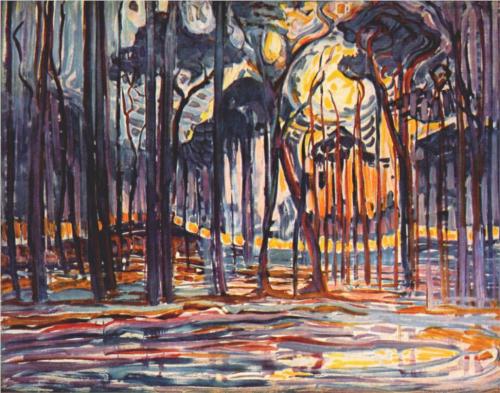
Piet Mondrian - "Woods Near Oele" (1908)

Woods Near Oele (1908)

Piet Mondrian

______

if my last entry was about an Étude
in the Form of a Waltz
“,
an unlikely
combination, here’s an essay in the
form of a poem, kind of like my
own stuff

Richard

______________

Essay on Wood

At dawn when rowboats drum on the dock
and every door in the breathing house bumps softly
as if someone were leaving quietly, I wonder
if something in us is made of wood,
maybe not quite the heart, knocking softly,
or maybe not made of it, but made for its call.

Of all the elements, it is happiest in our houses.
It will sit with us, eat with us, lie down
and hold our books (themselves a rustling woods),
bearing our floors and roofs without weariness,
for unlike us it does not resent its faithfulness
or question why, for what, how long?

Its branchings have slowed the invisible feelings of light
into vortices smooth for our hands,
so that every fine-grained handle and page and beam
is a wood-word, a standing wave:
years that never pass, vastness never empty,
speed so great it cannot be told from peace.

James Richardson

“Monet Refuses the Operation” – Lisel Mueller‏

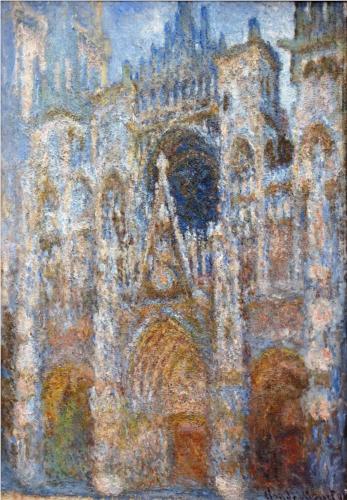
Claude Monet - "Rouen Cathedral, Magic in Blue"

Rouen Cathedral, Magic in Blue (1894)

Claude Monet

______

up until now I’ve presented dramatic
monologues
, but only to music, on my
blog
, referring to Robert Browning as
their originator, but not ever producing
any representative spoken work, never
mind any of, themselves, the poet’s
seminal masterpieces, My Last
Duchess
“, “Fra Lippo Lippi“, “How
They Brought the Good News from
Ghent to Aix
“,
for instance, which,
granted, can be daunting now in their
breadth and erudition, the Romantics
didn’t have television, they had to
entertain themselves

here’s a poem for our time, written
in 1996, only two decades ago, gasp,
Lisel Mueller imagines herself Claude
Monet
, an easier concept, after all,
who’s been to Ghent or Aix, why
would anyone want to run there,
whereas Monet‘s another story, who
doesn’t today know Monet

Monet was blind at the end of his life,
one learns from the website where I
got this
, a blog with plenty of breadth
and already considerable erudition, he
received corrective surgery to be able
to continue with his work

there was, however, a limit

Monet Refuses the Operation

Doctor, you say there are no haloes
around the streetlights in Paris
and what I see is an aberration
caused by old age, an affliction.
I tell you it has taken me all my life
to arrive at the vision of gas lamps as angels,
to soften and blur and finally banish
the edges you regret I don’t see,
to learn that the line I called the horizon
does not exist and sky and water,
so long apart, are the same state of being.
Fifty-four years before I could see
Rouen cathedral is built
of parallel shafts of sun,
and now you want to restore
my youthful errors: fixed
notions of top and bottom,
the illusion of three-dimensional space,
wisteria separate
from the bridge it covers.
What can I say to convince you
the Houses of Parliament dissolve
night after night to become
the fluid dream of the Thames?
I will not return to a universe
of objects that don’t know each other,
as if islands were not the lost children
of one great continent. The world
is flux, and light becomes what it touches,
becomes water, lilies on water,
above and below water,
becomes lilac and mauve and yellow
and white and cerulean lamps,
small fists passing sunlight
so quickly to one another
that it would take long, streaming hair
inside my brush to catch it.
To paint the speed of light!
Our weighted shapes, these verticals,
burn to mix with air
and change our bones, skin, clothes
to gases. Doctor,
if only you could see
how heaven pulls earth into its arms
and how infinitely the heart expands
to claim this world, blue vapor without end.

Lisel Mueller

Richard

psst: thanks Brain for this beautiful poem
“The Unwritten” – W.S. Merwin

Mickail Vrubel - "Pencils' (1905)

Pencils (1905)

Mickail Vrubel

_______

below is a poem wherein the poet,
W.S. Merwin, confronts his pencil,
any pencil, which each contains
all the words which will never be
written, it is a great spur to the
creative imagination, an evocation
of the infinities of possibilities
available to any artist, any
person, indeed, who dreams

but in the 21st Century, will
anyone soon wonder what’s
a pencil, when was the last
time, ask yourself, you even
used one

Richard

___________

The Unwritten

Inside this pencil
crouch words that have never been written
never been spoken
never been taught

they’re hiding

they’re awake in there
dark in the dark
hearing us
but they won’t come out
not for love not for time not for fire

even when the dark has worn away
they’ll still be there
hiding in the air
multitudes in days to come may walk through them
breathe them
be none the wiser

what script can it be
that they won’t unroll
in what language
would I recognize it
would I be able to follow it
to make out the real names
of everything

maybe there aren’t
many
it could be that there’s only one word
and it’s all we need
it’s here in this pencil

every pencil in the world
is like this

W.S. Merwin

the Eagles, and the dramatic monologue‏


to get your summer groove on,
you’ll surely want to listen to this,
just click

then again, you just might find
that “you may never leave”

Richard

psst: Hotel California“, another, wonderful, dramatic monologue

On a dark desert highway, cool wind in my hair
Warm smell of colitas, rising up through the air
Up ahead in the distance, I saw a shimmering light
My head grew heavy and my sight grew dim
I had to stop for the night
There she stood in the doorway;
I heard the mission bell
And I was thinking to myself,
“This could be Heaven or this could be Hell”
Then she lit up a candle and she showed me the way
There were voices down the corridor,
I thought I heard them say…

Welcome to the Hotel California
Such a lovely place (Such a lovely place)
Such a lovely face
Plenty of room at the Hotel California
Any time of year (Any time of year)
You can find it here

Her mind is Tiffany-twisted, she got the Mercedes bends
She got a lot of pretty, pretty boys she calls friends
How they dance in the courtyard, sweet summer sweat.
Some dance to remember, some dance to forget

So I called up the Captain,
“Please bring me my wine”
He said, “We haven’t had that spirit here since nineteen sixty nine”
And still those voices are calling from far away,
Wake you up in the middle of the night
Just to hear them say…

Welcome to the Hotel California
Such a lovely place (Such a lovely place)
Such a lovely face
They livin’ it up at the Hotel California
What a nice surprise (what a nice surprise)
Bring your alibis

Mirrors on the ceiling,
The pink champagne on ice
And she said “We are all just prisoners here, of our own device”
And in the master’s chambers,
They gathered for the feast
They stab it with their steely knives,
But they just can’t kill the beast

Last thing I remember, I was
Running for the door
I had to find the passage back
To the place I was before
“Relax, ” said the night man,
“We are programmed to receive.
You can check-out any time you like,
But you can never leave! “

life lessons from Ethel Merman and Donald O’Connor


just click

is this a dramatic monologue, I asked

it depends on who you think she’s
talking to, I answered

cheers

Richard

“Chiquitita”, revisited‏

Dear Richard:

The lyrics don’t make sense to me from a Mexican perspective. They do from a Spanish Republican perspective, particularly as they were written by a European from a country which decidedly was on the Republican side in the Spanish Civil War, at a time in recent history when Spanish Republican veterans could finally come out into the open (i.e. after Franco died and a constitutional democracy was established in Spain).

It would be interesting to find out for sure.

_________________

do you think this might help, Jim, just click

Richard

psst: a great read on the consequences
of the Spanish Civil War, by Javier
Cercas
, The Anatomy of a Moment

“Chiquitita” – Abba

here’s a new entry to confuse everything
if you’ve been following the discussion
about the setting for Fernando at
“Fernando”, revisited‘ on my blog,
Abba’s “Chiquitita”, again a dramatic
monologue
, note

Chiquitita, tell me what’s wrong
You’re enchained by your own sorrow
In your eyes there is no hope for tomorrow
How I hate to see you like this
There is no way you can deny it
I can see that you’re oh so sad, so quiet

Chiquitita, tell me the truth
I’m a shoulder you can cry on
Your best friend, I’m the one you must rely on
You were always sure of yourself
Now I see you’ve broken a feather
I hope we can patch it up together

Chiquitita, you and I know
How the heartaches come and they go
And the scars they’re leaving
You’ll be dancing once again and the pain will end
You will have no time for grieving

Chiquitita, you and I cry
But the sun is still in the sky and shining above you
Let me hear you sing once more like you did before
Sing a new song, Chiquitita
Try once more like you did before
Sing a new song, Chiquitita

So the walls came tumbling down
And your love’s a blown out candle
All is gone and it seems too hard to handle
Chiquitita, tell me the truth
There is no way you can deny it
I see that you’re oh so sad, so quiet

Chiquitita, you and I know
How the heartaches come and they go
And the scars they’re leaving
You’ll be dancing once again and the pain will end
You will have no time for grieving

Chiquitita, you and I cry

But the sun is still in the sky and shining above you
Let me hear you sing once more like you did before
Sing a new song, Chiquitita
Try once more like you did before
Sing a new song, Chiquitita

Try once more like you did before
Sing a new song, Chiquitita

which could be even Argentinian

is there a Rio Grande in Argentina, Jim

cheers

Richard

psst: hats off once again to Robert Browning,
lest we forget

“Fernando”, revisited‏


despite still so profound an emotional
impact I haven’t been the only one to
wonder about Fernando‘s specifics

what’s happening, apart from the
throbbing melancholy, glory

it turns out that there are a couple of
people here, two men, or maybe a man
and a woman, reviewing a long gone
night when they crossed the Rio Grande

so Mexico, rather than Spain, must’ve
been the setting, I conjectured

the Mexican-American War, 1846 –
1847, established the border between
the victorious Americans and Mexico

these two must’ve been remembering
a particular private night, but I suspect
a more momentous night, conquering
territory, however ultimately it may
have been, however ignobly, lost

Wes Carr, an Australian Idol contestant,
does an impressive interpretation of a
song that is too iconic
to much ever
overtake, not to mention overwhelm

but what do you think

Richard

“Miss Otis Regrets” (1934) – Cole Porter‏

while we’re on the subject of dramatic
monologue
s, here’s one, performed by
Fred Astaire, which splendidly illustrates
the intention

here’s Bette Midler doing it

and here’s more Bette, irrepressible, and
utterly irresistible, if you can stand it

or, as she would have it, the Divine,
and indeed, Miss M

just click

enjoy

Richard

psst: “Miss Otis Regrets”

Miss Otis regrets, she’s unable to lunch today, madam,
Miss Otis regrets, she’s unable to lunch today.
She is sorry to be delayed,
but last evening down in Lover’s Lane she strayed, madam,
Miss Otis regrets, she’s unable to lunch today.
When she woke up and found that her dream of love was gone, madam,
She ran to the man who had led her so far astray,
And from under her velvet gown,
She drew a gun and shot her love down, madam,
Miss Otis regrets, she’s unable to lunch today.
When the mob came and got her and dragged her from the jail, madam,
They strung her upon the old willow across the way,
And the moment before she died,
She lifted up her lovely head and cried, madam
Miss Otis regrets, she’s unable to lunch today

“Why Do I Love You?” – from “Behind the Candelabra”

just when you thought you’d never see
Elizabeth Barrett Browning again, here
she pops up in, of all places, a movie
about Liberace, Behind the Candelabra“,
a not undistinguished representation of
the high life, the over the top life, of an
aging and flamboyant superstar with his
much younger companion, feathers fly,
Ferraris too, and so do tempers

but at one point Liberace recites this
poem, “Why do I love you?”

where have I heard that line before, I
said to myself, and needed no one, of
course, to answer, here was Elizabeth
handing over her mantle to someone
in the XXlst Century, maybe

you decide

Richard

psst: Liberace also said, “too much of a good
thing is wonderful”,
I’ll drink to that

__________________

Why do I love you?

Why do I love you?
I love you not only for what you are,
but for what I am when I’m with you.
I love you not only for
what you have made of yourself
but for what you are making of me
I love you for not ignoring
the possibilities of the fool in me,
and for accepting
the possibilities of the good in me.

Why do I love you?
I love you for
closing your eyes to the discords in me,
and for adding to the music in me
by worshipful listening.
I love you
for helping me to construct my life,
not a tavern, but a temple.
I love you because
you have done so much to make me happy.
You have done it without a word,
without a touch, without a sign.
You have done it by just being yourself.
Perhaps, after all,
that is what love means,
and that is why
I love you.