Richibi’s Weblog

Just another WordPress.com weblog

Category: a poem to ponder

“The Poet’s Calendar” (February) – Henry Wadsworth Longfellow‏

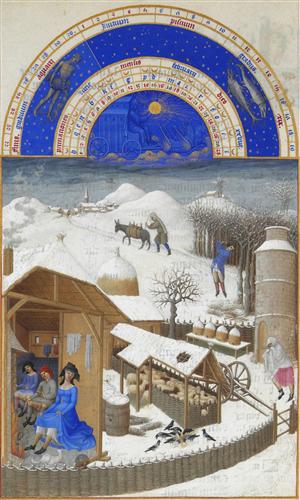
 "Facsimile of February: Farmyard Scene with Peasants" -  Limbourg brothers

Facsimile of February:
Farmyard Scene with Peasants

the Limbourg brothers

___________

if there are paintings about February,
there must be poems about February,
I thought, hence the following entry,
though preceded by a belated January,
or Janus, as it turns out, held back by
nothing other, surely, than the “fields
with snow”, the “frosts”, and the
fowl-filled “frozen fen”

both are from a very calendar of
poems by Henry Wadsworth
Longfellow
, whom I’ve always
imagined tall, however
inappropriate, kind of like thinking
that because my name is Richard
I’m rich

it’s called, appropriately enough,
The Poet’s Calendar, just click

January

Janus am I; oldest of potentates;
Forward I look, and backward, and below
I count, as god of avenues and gates,
The years that through my portals come and go.
I block the roads, and drift the fields with snow;
I chase the wild-fowl from the frozen fen;
My frosts congeal the rivers in their flow,
My fires light up the hearths and hearts of men.

February

I am lustration, and the sea is mine!
I wash the sands and headlands with my tide;
My brow is crowned with branches of the pine;
Before my chariot-wheels the fishes glide.
By me all things unclean are purified,
By me the souls of men washed white again;
E’en the unlovely tombs of those who died
Without a dirge, I cleanse from every stain.

Henry Wadsworth Longfellow

March will have to wait

Richard

psst: lustration is a purification, Janus, the
god with two faces, who can see
backwards and forwards, fen,
marshland

walking in beauty – January 11, 2015 (for Terry)

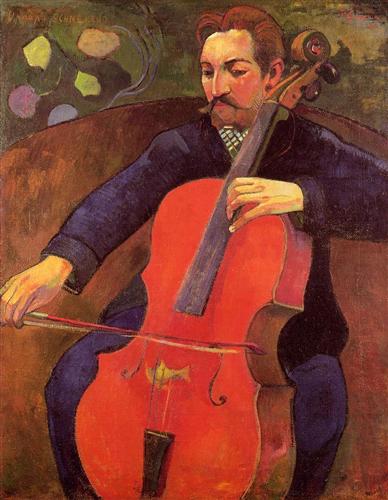
Paul Gauguin - "The Cellist (Portrait of Upaupa Scheklud)"

The Cellist (Portrait of Upaupa Scheklud) (1894)

Paul Gauguin

_______

what are you reading, Terry asked,
I’d been riffling through the pages
of a book I’d just finished, trying to
find a particular bit I wanted for
firm ground later in conversations

a man in Sarajevo during the siege,
July 5, 1992 to February 29, 1996,
the bit I’d been looking for, had seen
neighbours, 22 of them, killed when
a mortar from the surrounding hills
had, as they waited in line for a much
depleted market, a consequence of
the siege, obliterated them, arms,
feet everywhere, as well as the
wounded

the man, a cellist with a Sarajevo
symphony, probably its finest, had
resolved, in honour of the victims,
to come out to play each day, at
the very time, in the very place of
the atrocity, for 22 days, one for
each of the victims, despite being
each time in the very eye of a
sniper’s bullet, Albinoni’s haunting
Adagio
, listen

he made it out eventually to Ireland,
it is later indicated

The Cellist of Sarajevo“, I replied,
I’m taking it back to the library, I
needed to check some dates, I
write, I want to talk about it

I’ve been talking about walking in
beauty, I said, incorporating it into
one’s life, this man overcame his
fear of death so profoundly as to
deliver a very dirge, an act of
prodigious, even transcendental
meditation, to sit and play midst
the rubble and ashes of his friends
this tribute, how sound must’ve
been his conviction

walking in beauty, I said, it’s a
Navajo prayer

Wordsworth has a poem like that he
said, and recited it word for word

“She walks in beauty, like the night
Of cloudless climes and starry skies;
And all that’s best of dark and bright
Meet in her aspect and her eyes;
Thus mellowed to that tender light
Which heaven to gaudy day denies.

One shade the more, one ray the less,
Had half impaired the nameless grace
Which waves in every raven tress,
Or softly lightens o’er her face;
Where thoughts serenely sweet express,
How pure, how dear their dwelling-place.

And on that cheek, and o’er that brow,
So soft, so calm, yet eloquent,
The smiles that win, the tints that glow,
But tell of days in goodness spent,
A mind at peace with all below,
A heart whose love is innocent!”, he said

I was flabbergasted, I had only my
few lines of Shakespeare to compare

I’m Richard, I said

Terry, he retorted

I can’t talk now, I’m off, if you can
believe it, to read Shakespeare with
a friend, we’ll meet again, you’re easy
to spot, you’ve got no shoes, you’re
barefoot, my mom has talked about
you, you always say hello, she says,
she thinks you’re a nice man

Terry had his sandals in his hand,
he stood under his umbrella, I
hadn’t opened mine, he was trying
to shield me also from, for me, the
merely mist, not rain, despite a
rod stretched unhooked from his
otherwise sufficient cover from
the wet

can you remember my e-mail, he
offered, it’s easy

I wrote it on the battered flyleaf
of my Shakespeare

that’s a relic, he said

my International Collector’s Library,
I answered, that’s where I got my
literature when I was a boy, in my
little town of Timmins, an outpost,
I’d get a classic every month, each
bound distinctively, their gimmick

you could get money for that, he
suggested

not, like this, I said, it’s in tatters

I’ll tell my mom I talked to you, I said,
she’ll be delighted

Tony, right

Terry, he corrected

Richard, I said

Richard

later he thought I’d been Michael

Richard

psst: it turns out the poem is by Byron,
not Wordsworth, not surprising,from
this distance all the Romantic poets
sound alike, except for, of course,
the Brownings, an inconsequential
gaffe
“Riposte to Ode” – Michael Homolka‏

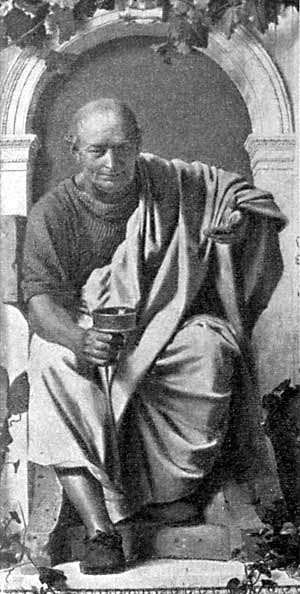
Anton von Werner - "Horace"

Horace

Anton von Werner

______

Riposte to Ode

It isn’t like that Horace Life stresses us out
However many hundreds of decades later we’re told
to welcome anxiety is beneficial
and to quote honor our imperfections

You’ve got the Adriatic Sea We’ve got what
the Finger Lakes? Not quite as conducive
to worrying the infinite question so we worry
about other things equities statistics

I’m not really a wine man either
not in the unmixed sense where Alcibiades
might barge in any moment and out-naked us all
I’m an American so I prefer pig iron

Wildflowers abound somewhere I’m sure
I don’t know anything about flowers though
Few of us in the cities follow them
the way you seem to as if tracking currencies

But to speak to your point about an actual
battlefront approaching Main Street who knows?
Maybe we would resort to hookers and crack
per your suggestion I can’t say Horace I wish I could

Michael Homolka

______________

which “Ode” remains a mystery, so
one should suppose Michael Homolka
is “ripost[ing]” to Horace’s entire body
of odes, he wrote four books of them,
23 – 11 B.C.E., during the time of
Augustus

I found the Odes too steeped in
Roman and mythological arcana to
follow their uneasy referents, too
esoteric, I thought, to even look
them up, seems Michael Homolka
thought the same

but his Ars Poetica“, if you’ll pardon
the expression, spoke directly to my
heart, On style“, “On metre“, on
How to be a good poet“, for
instance, topics I find irresistible

you’ll note that whereas I’ve used
commas ever to indicate pauses
in what I write, Homolka uses
spaces, if you’ll allow me that,
perhaps immodest, conjunction,
you’ll find these in his original
copy
, WordPress won’t allow me
that, click here for that original
copy

he also allows himself question
marks, something I never do

go figure

you’ll also note his dramatic
monologue, my favourite, if
you haven’t already done so

Richard

psst: “None knows the reason why this curse
Was sent on him, this love of making verse.” – Ars Poetica“, line 470

“How I Didn’t Get Myself to a Nunnery” – Suzanne Lummis‏

"Ophelia" - Arthur Hughes

Ophelia (1852)

Arthur Hughes

_________

according to Suzanne Lummis Ophelia
“g[o]t outta town”

Suzanne Lummis is Ophelia here, this
is a dramatic monologue, I can’t tell you
how much I find that exciting

you’ll want to run to the source, of course,
to find pertinent references, so I’ve linked
a few for you from the text below to their
counterparts in Hamlet“, if it’s coloured,
just click, otherwise a couple of asterisks
explain two probably too obvious items,
in which case you’ll forgive me my
infelicitous impertinence, my unintended
and hapless presumption

thanks

How I Didn’t Get Myself to a Nunnery

That girl they found ensconced in mud and loam,
she wasn’t me. Small wonder, though, they jumped.
To a conclusion. Water puffs you up,
and we pale Slavic girls looked much alike—
back then. Deprivation smooths you out.
Yes, that was the season of self-drowned maids,
heart-to-hearts with skulls, great minds overthrown.
And minds that could be great if they could just
come up for air. Not in that town. Something stank. *

But me, I drifted on. I like rivers.
And I’m all right with flowers. I floated
on a bed of roses—well, O.K., rue
and columbine
. It bore me up not down.
That night I made a circle with my thumb
and finger, like a lens, and peered through it
at the moon—mine, all mine. My kissed-white moon.
“Moon River wider than a . . .” Mancini/
Mercer wrote that, sure, but I wrote it first.

You wonder where I’m going with all this?
Where water goes. It empties into sea.
Sold! I’d take it—the sea or a fresh life.
Some other life. A good man—good enough,
fair—fished me out. He’d come to quench his thirst.
No sun-god prince,* of course, like him I’d loved,
still loved. (Some loves don’t die; not even murder
kills them.) I married his thatched hut, hatched chicks—
kids running underfoot. Don’t cry for me,

Denmark. I’d learned the art of compromise
back there, in the black castle—then came blood,
ghosts. Something in me burst. If not lover,
father, king, ** then whom can you trust? Alone,
I took up some playing cards. I played them
into skinny air. A voice said, Swim or drown.
It said: Your house caught fire, flood, caught fear—
it’s coming down. No one loves you now, here.
By land or water, girl, get outta town.

Suzanne Lummis

* i.e. Hamlet, of course, prince of Denmark
** Hamlet, Polonius, Claudius

our debt to Shakespeare in literature
is enormous, after even 400 years –
“Hamlet” was written in 1602 – his
literary form, his countless neologisms,
his stories, his blueprints, transformed
into ballets, paintings as above, operas,
have become our myths, our moral and
philosophical standard, our modern
Olympus, the measure of our time,
our epoch, Shakespeare is our Iliad

only Beethoven in music has ever
matched this, in the visual arts, no
one

you’ll notice that the poem itself is a
monologue, in answer, in homage, to
Shakespeare, it’s in iambic pentameter,
also his wont

mine too, incidentally

Richard


Vox Balaenae (Voice of the Whale) – George Crumb‏

whales

whales

____

we say that birds sing, despite the
fact that it is their ordinary language,
whales, upon our hearing them, seem
also to be singing

when we sing we alter our voices to
fit pitches and volume and rhythms
intentionally, otherwise we’re talking

what, then, is music, is bird song
music, whale song, is Vox Balaenae“,
a composition by George Crumb, from
1971

if so, what do we mean by music, which
used to be, a long time ago it appears
now, melodic, recurrent and rhythmic

in Vox Balaenae“, where is the music
we used to think of as music, though
harmonious it has the elements rather
of language, communication, instead
of the ordered outlay of composition

it is, however, indeed Classically laid,
with movements and everything, even
a set of variations, though interestingly
attended on either side, these, by, as it
were, book ends, a prologue and an
epilogue, literary terms, to reinforce
the idea of narration, there are three
movements

Prologue: Vocalise (…for the beginning of time)

Variations on Sea-Time [Sea Theme]
Archeozoic
Proterozoic
Paleozoic
Mesozoic
Cenozoic

Epilogue: Sea-Nocturne (…for the end of time)

a blue light in the performance suggests
a marine environment, masks dehumanize,
render everything “[a]rcheozoic”, extended
technique, unusual use of the instruments,
are instructions stated in the score

for a while I’ve been saying that prose is
just bad poetry, for a while I’ve been trying
to make poetry out of prose

how are we doing

Richard

“The Belle of Amherst”‏

Emily Dickinson

Emily Dickinson

_______

a couple of my Internet interests intersected
recently to bring me this theatrical gem, this
outright treasure

there’d been a few poems of Emily Dickinson
I’d read in my poetry class, none particularly
affecting, while at the Tonys on another site
Julie Harris was winning the ’77 award for
best actress for her role as that very poet, in
a superb evocation, The Belle of Amherst“,
of Dickinson’s life, available, I, to my delight,
indeed erudition, discovered, elsewhere still
on the Internet, straight from the original
Broadway stage

Julie Harris was the very stuff of Tonys, so
was the production

watch, don’t not watch

you’ll want to run back to your Emily
Dickinsons afterwards, even

here’s one

If I can stop one heart from breaking,
I shall not live in vain;
If I can ease one life the aching,
Or cool one pain,
Or help one fainting robin
Unto his nest again,
I shall not live in vain.

Emily Dickinson

Richard

“Nude Descending a Staircase” – Duchamp / Kennedy‏

Marcel Duchamp "Nude Descending a Staircase, No.2" (1912)

Nude Descending a Staircase, No.2 (1912)

Marcel Duchamp

________

Nude Descending a Staircase

Toe upon toe, a snowing flesh,
A gold of lemon, root and rind,
She sifts in sunlight down the stairs
With nothing on. Nor on her mind.

We spy beneath the banister
A constant thresh of thigh on thigh—
Her lips imprint the swinging air
That parts to let her parts go by.

One woman waterfall, she wears
Her slow descent like a long cape
And pausing, on the final stair,
Collects her motions into shape.

X.J. Kennedy

_________

in my class on Modern Poetry on the
Internet they complained that both
Duchamp and Kennedy were
objectifying women

maybe I too am

read my response

“I thought the poem was hot, and I’m not even a heterosexual, it renders voluptuous the female body, as the female body should be rendered, and, again, I’m not even a heterosexual, how can a heterosexual man not tremble at the “snowing flesh, / a gold of lemon, root and rind,”, the “constant thresh of thigh on thigh”, the very “swinging air / that parts to let her parts go by.”, by the time she gets to the “final stair” you’re jelly

women have their own pornography, have you seen The Bridges of Madison County

I also love Duchamp’s painting, all shimmering gold and glittering, all panels of incandescent light, his “Nude” could descend my staircase any day, despite my counterintuitive position, for which information you can again read above

cheers, Richard”

cheers, Richard

psst: poets are supposed to defy conventions,
watch me, poets know we’ve got nothing
to lose

a gift from Brain

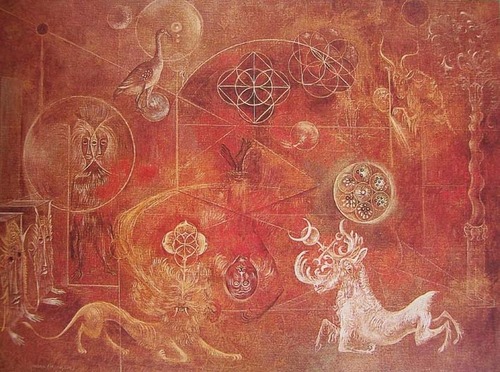
Leonora Carrington - "The Burning of Giordano Bruno" (1964)

“The Burning of Giordano Bruno (1964)

Leonora Carrington

_______

the last entry at The Other Side of the Brain
was the following poem, which delivers such
thunder that I couldn’t help appropriating it
for my own purposes

forgive me, Brain, but with this one you’ve
been too much of an inspiration

thanks

________________

What He Thought

for Fabbio Doplicher

We were supposed to do a job in Italy
and, full of our feeling for
ourselves (our sense of being
Poets from America) we went
from Rome to Fano, met
the mayor, mulled
a couple matters over (what’s
a cheap date, they asked us; what’s
flat drink). Among Italian literati
we could recognize our counterparts:
the academic, the apologist,
the arrogant, the amorous,
the brazen and the glib—and there was one
administrator (the conservative), in suit
of regulation gray, who like a good tour guide
with measured pace and uninflected tone narrated
sights and histories the hired van hauled us past.
Of all, he was the most politic and least poetic,
so it seemed. Our last few days in Rome
(when all but three of the New World Bards had flown)
I found a book of poems this
unprepossessing one had written: it was there
in the pensione room (a room he’d recommended)
where it must have been abandoned by
the German visitor (was there a bus of them?)
to whom he had inscribed and dated it a month before.
I couldn’t read Italian, either, so I put the book
back into the wardrobe’s dark. We last Americans
were due to leave tomorrow. For our parting evening then
our host chose something in a family restaurant, and there
we sat and chatted, sat and chewed,
till, sensible it was our last
big chance to be poetic, make
our mark, one of us asked
“What’s poetry?
Is it the fruits and vegetables and
marketplace of Campo dei Fiori, or
the statue there?” Because I was
the glib one, I identified the answer
instantly, I didn’t have to think— “The truth
is both, it’s both!”, I blurted out. But that
was easy. That was easiest to say. What followed
taught me something about difficulty,
for our underestimated host spoke out,
all of a sudden, with a rising passion, and he said:
The statue represents Giordano Bruno,
brought to be burned in the public square
because of his offense against
authority, which is to say
the Church. His crime was his belief
the universe does not revolve around
the human being: God is no
fixed point or central government, but rather is
poured in waves through all things. All things
move. “If God is not the soul itself, He is
the soul of the soul of the world.” Such was
his heresy. The day they brought him
forth to die, they feared he might
incite the crowd (the man was famous
for his eloquence). And so his captors
placed upon his face
an iron mask, in which
he could not speak. That’s
how they burned him. That is how
he died: without a word, in front
of everyone.
And poetry—
(we’d all
put down our forks by now, to listen to
the man in gray; he went on
softly)—
poetry is what

he thought, but did not say.

Heather McHugh

______________

this made me think that God is an
adjective not a noun, an attribute,
not a commandment, “God is no
fixed point or central government,
but rather is poured in waves
through all things”

cheers, Richard

psst: I’ve made the choice to leave out
the poem’s purported paragraphs
for their being indiscriminate in
every Internet reproduction

“A Repentance” – richibi‏

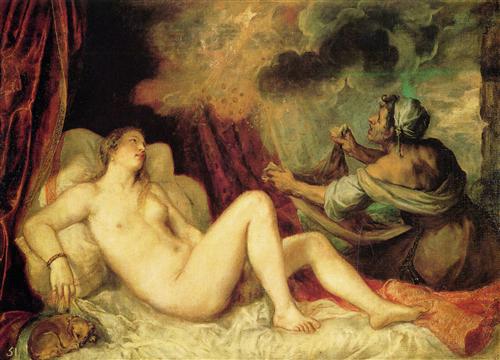
Titian "Danaë" (1554)

Danaë (1554)

Titian

________

nor can I not report a poem that I offered
as an apology for an affront I’d caused,
utterly unwittingly, to one of my course’s
gracious participants

she had objected to slights against the
very perception of sex crimes, which I’d
egregiously equated, she said, with
soul-destroying profanities

_________

A Repentance

(wherein I “bite my thumb”
at the Petrarchan sonnet, I think)

Stand certain, Anonymous, that
I am completely in your corner,
No even passing account of sexual
Crimes against women should

Ever overlook their horror,
Regardless of the context,
Erudite or otherwise, therefore
Let me here sincerely apologize

Your reprimand is not lightly
Stamped upon my conscience,
Only understand that for me a

Rape of the soul is also a
Repulsive matter, greatly also deplorable
Yours truly, Richard

____________

you’ll note the acrostic interpolation,
“SINCERELY SORRY”, at the head of
each verse of my text, meant to
counter the mode of the offending
matter, John Peale Bishop’s vicious
A Recollection

Richard

psst: the painting above is the subject
of Bishop’s, completely
objectionable, stunt

Jackson Pollock / Tristan Tzara

 Jackson Pollock -  "Blue Poles (Number 11)"

Blue Poles (Number 11) (1952)

Jackson Pollock

_____

How to Make a Dadaist Poem

To make a Dadaist poem:

Take a newspaper.
Take a pair of scissors.
Choose an article as long as you are planning to make your poem.
Cut out the article.
Then cut out each of the words that make up this article and put them in a bag.
Shake it gently.
Then take out the scraps one after the other in the order in which they left the bag.
Copy conscientiously.
The poem will be like you.
And here are you a writer, infinitely original and endowed with a sensibility that is charming though beyond the understanding of the vulgar.

Tristan Tzara

_________________

though the idea at first seems fanciful,
outrageous, think of Jackson Pollock,
and his “action paintings”, great art
produced by the instinctual wisdom of
musculature, its preconscious impulses

Tristan Tzara, 1896 – 1963, was one of
the originators of Dada, an influential
art movement of the early Twentieth
Century that rejected all traditional
forms of art for having led to the
havoc of World War l

Richard