Richibi’s Weblog

Just another WordPress.com weblog

Category: a poem to ponder

“The Raven” – Edgar Allan Poe
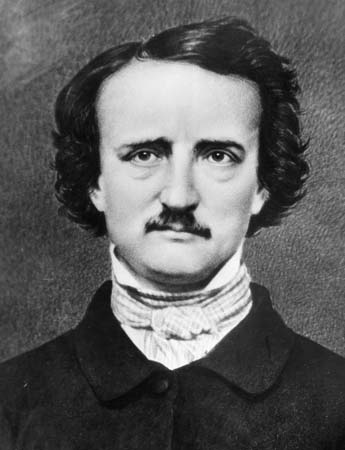
Edgar Allan Poe

Edgar Allan Poe

_________

only a few days ago, of an otherwise
uneventful afternoon, “there came a
tapping, as if someone gently rapping,
rapping at my”
[laptop] door”

“Tis some visitor”, I muttered, “tapping
at my [laptop] door – Only this and
nothing more.”

but to my surprise, to my delight, to my,
lo, roused and rustled up excitement,
for I hadn’t read this poem in countless
years, “in there stepped”, serendipitously,
uninvited, [the] stately Raven of the
saintly days of yore”

thanks, David

Edgar Allan Poe’s The Raven“, after
several perhaps of Shakespeare’s, is the
most famous of dramatic monologues,
certainly the most haunting

though it is set in “bleak December”,
there is no more apt poem to herald,
I think, the feast of Hallowe’en

here Vincent Price channels the epochal
work
, magisterially, unforgettably

watch

Richard

psst:

The Raven

Once upon a midnight dreary, while I pondered, weak and weary,
Over many a quaint and curious volume of forgotten lore—
While I nodded, nearly napping, suddenly there came a tapping,
As of some one gently rapping, rapping at my chamber door.
“’Tis some visitor,” I muttered, “tapping at my chamber door—
Only this and nothing more.”

Ah, distinctly I remember it was in the bleak December;
And each separate dying ember wrought its ghost upon the floor.
Eagerly I wished the morrow;—vainly I had sought to borrow
From my books surcease of sorrow—sorrow for the lost Lenore—
For the rare and radiant maiden whom the angels name Lenore—
Nameless here for evermore.

And the silken, sad, uncertain rustling of each purple curtain
Thrilled me—filled me with fantastic terrors never felt before;
So that now, to still the beating of my heart, I stood repeating
“’Tis some visitor entreating entrance at my chamber door—
Some late visitor entreating entrance at my chamber door;—
This it is and nothing more.”

Presently my soul grew stronger; hesitating then no longer,
“Sir,” said I, “or Madam, truly your forgiveness I implore;
But the fact is I was napping, and so gently you came rapping,
And so faintly you came tapping, tapping at my chamber door,
That I scarce was sure I heard you”—here I opened wide the door;—
Darkness there and nothing more.

Deep into that darkness peering, long I stood there wondering, fearing,
Doubting, dreaming dreams no mortal ever dared to dream before;
But the silence was unbroken, and the stillness gave no token,
And the only word there spoken was the whispered word, “Lenore?”
This I whispered, and an echo murmured back the word, “Lenore!”—
Merely this and nothing more.

Back into the chamber turning, all my soul within me burning,
Soon again I heard a tapping somewhat louder than before.
“Surely,” said I, “surely that is something at my window lattice;
Let me see, then, what thereat is, and this mystery explore—
Let my heart be still a moment and this mystery explore;—
’Tis the wind and nothing more!”

Open here I flung the shutter, when, with many a flirt and flutter,
In there stepped a stately Raven of the saintly days of yore;
Not the least obeisance made he; not a minute stopped or stayed he;
But, with mien of lord or lady, perched above my chamber door—
Perched upon a bust of Pallas * just above my chamber door—
Perched, and sat, and nothing more.

Then this ebony bird beguiling my sad fancy into smiling,
By the grave and stern decorum of the countenance it wore,
“Though thy crest be shorn and shaven, thou,” I said, “art sure no craven,
Ghastly grim and ancient Raven wandering from the Nightly shore—
Tell me what thy lordly name is on the Night’s Plutonian ** shore!”
Quoth the Raven “Nevermore.”

Much I marvelled this ungainly fowl to hear discourse so plainly,
Though its answer little meaning—little relevancy bore;
For we cannot help agreeing that no living human being
Ever yet was blessed with seeing bird above his chamber door—
Bird or beast upon the sculptured bust above his chamber door,
With such name as “Nevermore.”

But the Raven, sitting lonely on the placid bust, spoke only
That one word, as if his soul in that one word he did outpour.
Nothing farther then he uttered—not a feather then he fluttered—
Till I scarcely more than muttered “Other friends have flown before—
On the morrow he will leave me, as my Hopes have flown before.”
Then the bird said “Nevermore.”

Startled at the stillness broken by reply so aptly spoken,
“Doubtless,” said I, “what it utters is its only stock and store
Caught from some unhappy master whom unmerciful Disaster
Followed fast and followed faster till his songs one burden bore—
Till the dirges of his Hope that melancholy burden bore
Of ‘Never—nevermore’.”

But the Raven still beguiling all my fancy into smiling,
Straight I wheeled a cushioned seat in front of bird, and bust and door;
Then, upon the velvet sinking, I betook myself to linking
Fancy unto fancy, thinking what this ominous bird of yore—
What this grim, ungainly, ghastly, gaunt, and ominous bird of yore
Meant in croaking “Nevermore.”

This I sat engaged in guessing, but no syllable expressing
To the fowl whose fiery eyes now burned into my bosom’s core;
This and more I sat divining, with my head at ease reclining
On the cushion’s velvet lining that the lamp-light gloated o’er,
But whose velvet-violet lining with the lamp-light gloating o’er,
She shall press, ah, nevermore!

Then, methought, the air grew denser, perfumed from an unseen censer ***
Swung by Seraphim whose foot-falls tinkled on the tufted floor.
“Wretch,” I cried, “thy God hath lent thee—by these angels he hath sent thee
Respite—respite and nepenthe **** from thy memories of Lenore;
Quaff, oh quaff this kind nepenthe **** and forget this lost Lenore!”
Quoth the Raven “Nevermore.”

“Prophet!” said I, “thing of evil!—prophet still, if bird or devil!—
Whether Tempter sent, or whether tempest tossed thee here ashore,
Desolate yet all undaunted, on this desert land enchanted—
On this home by Horror haunted—tell me truly, I implore—
Is there—is there balm in Gilead? ***** —tell me—tell me, I implore!”
Quoth the Raven “Nevermore.”

“Prophet!” said I, “thing of evil!—prophet still, if bird or devil!
By that Heaven that bends above us—by that God we both adore—
Tell this soul with sorrow laden if, within the distant Aidenn, ******
It shall clasp a sainted maiden whom the angels name Lenore—
Clasp a rare and radiant maiden whom the angels name Lenore.”
Quoth the Raven “Nevermore.”

“Be that word our sign of parting, bird or fiend!” I shrieked, upstarting—
“Get thee back into the tempest and the Night’s Plutonian ** shore!
Leave no black plume as a token of that lie thy soul hath spoken!
Leave my loneliness unbroken!—quit the bust above my door!
Take thy beak from out my heart, and take thy form from off my door!”
Quoth the Raven “Nevermore.”

And the Raven, never flitting, still is sitting, still is sitting
On the pallid bust of Pallas * just above my chamber door;
And his eyes have all the seeming of a demon’s that is dreaming,
And the lamp-light o’er him streaming throws his shadow on the floor;
And my soul from out that shadow that lies floating on the floor
Shall be lifted—nevermore!

Edgar Allan Poe

* Pallas Athene, Greek goddess of wisdom,
courage, justice, the arts, patroness of
Athens

** Pluto, Greek god of the Underworld

*** censer, a vessel for burning incense

**** nepenthe, a drug which induces
forgetfulness

***** balm of Gilead, a rare perfume of Gilead,
a region east of the River Jordan, reputed to
have been a universal cure

****** Aidenn, paradise
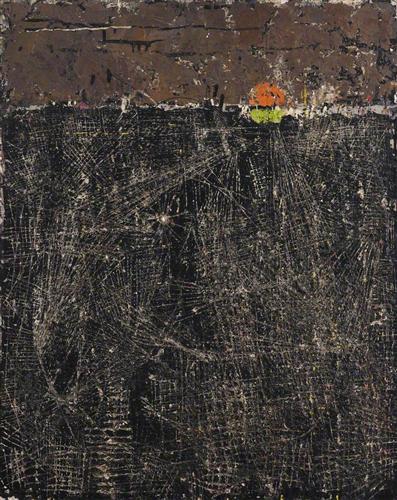
“Coming into New York” – John Updike‏

 "The Black City l (New York)" - William Congdon

The Black City l (New York) (1949)

William Congdon

________

at he other end of the continent from
Vancouver there’s New York, perhaps
not [t]he most liveable city on the
planet
but at one point the very
centre of the world, I know, I was
there, Liverpool, with even the
Beatles, had nothing on New York
City then

but that’s before Reaganomics and
Margaret Thatcher, since, Milan,
Tokyo, other cities have gotten into
the act, dulling some of New York’s
resplendence, glamour, magic

from the airport, rather than Updike‘s
Providence, the city buzzes with an
energy for me that’s electric, the
horizon sizzles already with a current
I feel in my skin, like watching bacon
fry, it commands your attention, all
grey, of course, with the washed out
colours of commercial advertisements
the size of buildings lining intermittently
the road in

New York seems a furnace, and it is,
whipping up Dante’s Inferno in all of
its myriad avenues and cells, but also
giving you flashes of Paradiso just
around any corner, the work of
inspiration, imagination, serendipity
and good will, the other side of the
infinitely variable human condition

here’s John Updike‘s equally idiosyncratic
picture of his coming home, however
more apocalyptic

Richard

_________________

Coming into New York

After Providence, Connecticut—
the green defiant landscape, unrelieved
except by ordered cities, smart and smug,
in spirit villages, too full of life
to be so called, too small to seem sincere.
And then like Death it comes upon us:
the plain of steaming trash, the tinge of brown
that colors now the trees and grass as though
exposed to rays sent from the core of heat—
these are the signs we see in retrospect.
But we look up amazed and wonder that
the green is gone out of our window, that
horizon on all sides is segmented
into so many tiny lines that we
mistake it for the profile of a wooded
hill against the sky, or that as far
as mind can go are buildings, paving, streets.
The tall ones rise into the mist like gods
serene and watchful, yet we fear, for we
have witnessed from this train the struggle to
complexity: the leaf has turned to stone.

John Updike


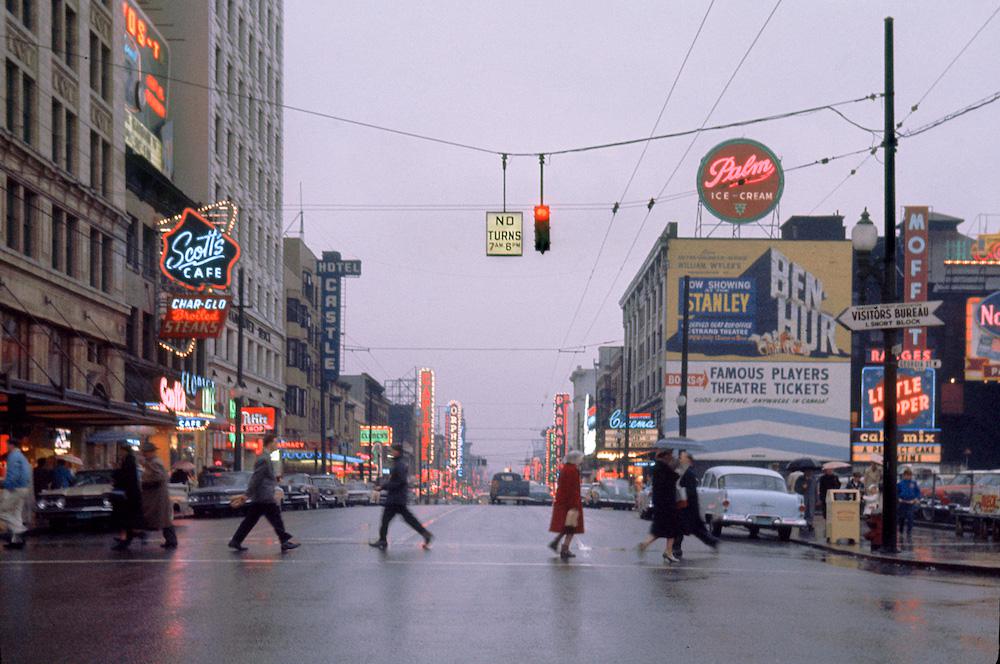
“Vancouver” – Philip Resnick

"Crosswalk" - Fred Herzog

Crosswalk (1960)

Fred Herzog

_______

not many poems exalt a city, the first
for me was Sandburg’s Chicago, a
far cry from Shelley, Byron, Keats,
and finally something that I could
sink my teeth into – though pretty,
the earlier, Romantic, poems had
been prissy, effete, skylarks,
Grecian urns, the irrelevant fall of
Babylon to the Assyrians
to me

– a lot of festooned air, I thought,
signifying nearly nothing, despite,
afterwards, its often very clever,
indeed truly inspiring, aphorisms

“Beauty is truth, truth beauty, — that is all
Ye know on earth, and all ye need to know.”

for instance

but I was young then, have gotten through
Romanticism’s idiosyncratic pretensions
to its noble universal heart, maybe ‘ve
even picked up a few of its literary
excesses since, what do you think

here’s one, right up there with Chicago“,
about Vancouver this time, my city

and it’s a dandy, I think

come visit

Richard

_______________

Vancouver

The most liveable city on the planet, they say,
which seems true enough on a mid-August afternoon,
sailboats dotting the bay,
picknickers at crowded beaches
competing for summer heat
and precious square centimetres of sand.
Sunlight casts its spell,
and hearing over and over again
how wonderful you are
has a hypnotic ring to it,
much like lovers gently rocking
to rhythms of the midnight hour
or first sight of running water to the parched.
We who grow old here
have like Cavafy‘s Alexandrians
learned to treat such messages with suspicion.
Those bereft of love
find little compassion betwixt concrete condo towers,
those with few means dwell in the same Inferno’s circles
as the bereft of other cities,
and those in hawk to the god of greed
are no less addicted for living in the suburbs of insatiability.

Philip Resnick

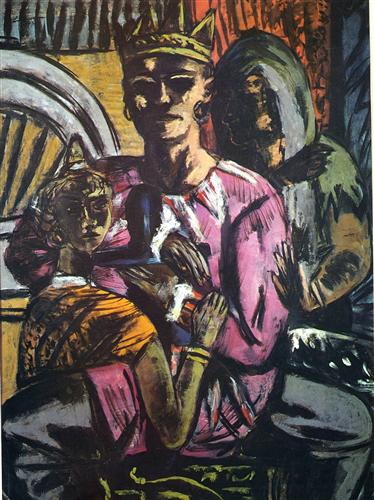
“King John” – Shakespeare‏

"The King" - Max Beckmann

The King ( 1934 – 1937)

Max Beckmann

_________

King John, 1166 to 1216, was the brother
of Richard the First, “the Lionheart”, and
of Geoffrey, both sons, as well as John,
of Eleanor of Aquitaine and Henry the
Second

you might remember them all from the
classic The Lion in Winter from the
Sixties

in Shakespeare’s story, John has become
king, both Geoffrey and Richard have
already perished, but Geoffrey has left an
heir, Arthur, Constance’s son, and since
Geoffrey had been the eldest, his own son,
it is contested, should be the rightful heir
to the English throne

John is not in agreement, nor is Eleanor,
his mom, but Constance is backed by the
Duke of Austria and the King of France,
who will go to war to unseat John

meanwhile Arthur is too young to be
anything but ineffectual, innocent

they all meet before Angiers, a town
now in France, but ruled then by
England, where a delightful
confrontation occurs at its gates,
the town representative will let in
the King of England but only when
he knows who, of either, He is

war is however averted when a
marriage is suggested between the
two courts, a niece of John, Blanche
of Castille, will marry the Dauphin,
Louis, son of Philip of France,
joining, however improbably, the
two sparring factions

but thereby Arthur’s claim is lost,
and Constance is fully aware of
the inevitable, and treacherous,
consequences

a legate from the Pope, Cardinal
Pandolf, also steps into the fray,
to stir the political pot, pompously,
predictably, punctiliously and
perniciously, not to mention,
perfidiously, in the end, of course

the language is Shakespeare’s, to
be sure, therefore unavoidably
wrought, but with garlands of
irrepressible poetry that is ever
utterly, and irresistibly, enchanting

“I am not mad:”, says Constance to
Pandolf, who’s accused her of being
in such a state

“Lady, you utter madness, and not sorrow.”

Constance replies

“I am not mad: this hair I pull is mine
My name is Constance; I was Geoffrey’s wife;
Young Arthur is my son, and he is lost:
I am not mad: I would to heaven I were!
For then, ’tis like I should forget myself:
O, if I could, what grief should I forget!
Preach some philosophy to make me mad,
And thou shalt be canonized, cardinal;
For being not mad but sensible of grief,
My reasonable part produces reason
How I may be deliver’d of these woes,
And teaches me to kill or hang myself:
If I were mad, I should forget my son,
Or madly think a babe of clouts were he:
I am not mad; too well, too well I feel
The different plague of each calamity.”

act lll, scene lV

has there ever been such a telling
evocation of agony

Stratford’s version is superb, extraordinary,
unforgettable, don’t miss it, just click

Richard

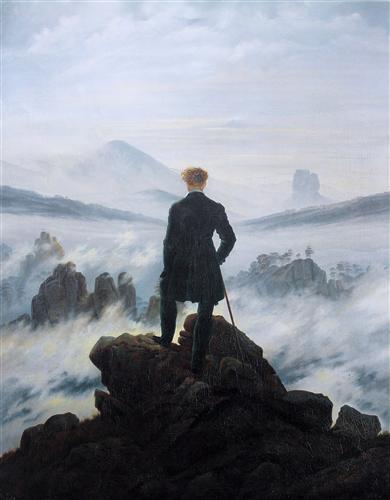
Fantasie in C Major, D. 760 (“Wanderer”) – Franz Schubert‏

 "The Wanderer above the Sea of Fog" - Caspar David Friedrich

The Wanderer above the Sea of Fog (1818)

Caspar David Friedrich

____________

a great way of learning to speak music,
approfondir, we say in French, to plumb
the intellectual depths of, is to count the
tenuti, as I quasi-humorously suggested
in my last piece one should, a tenuto, of
course, holds, caresses, one note, or one
chord, only, before proceeding any
further

music is a language, like French, English,
indeed I even include it as a language I
speak as professional qualification, people
find it amusing who don’t speak it

but you need to start somewhere, and
tenuti are as good a place as any, they’re
like an exclamation mark, denote intensified
intention, these give direction, and structure
to the statement, separating the units of
what’s being said

pauses between words, when you’re learning
a language, for learners is a godsend, and
thank goodness for them at least at the end
of sentences

tenuti do the same, count the tenuti, you’ll
discover an enchanted world of music,
right there between the lines

surprisingly you’ll find, rubati, tenuti,
rallentandi, accelerandi
don’t occur much
in Romantic music, where you’d expect
the grand passions to swoop and sway
and swoon, but gripped still by the
rigours of Classicism, and its own roots
in the harpsichord, its beats were rigid
still, mostly, right through to Schubert,
Chopin, whereupon more lachrymose
composers began to use these devices
nearly indiscriminately

count the tenuti in this wonderful
Fantasie in C Major, D. 760 of Schubert,
his Wanderer” Fantasy, you won’t find
that many, nor rubati, rallentandi,
accelerandi,
for that matter, and that’s like
someone not crying on your shoulder,
Schubert gives it to you straight, whether
emphatic, earning empathy, or making
magic

Richard

psst:

the Wanderer” Fantasy, incidentally,
is, again, programmatic music, it is
based on Schubert‘s own lied, song,
to Georg Philipp Schmidt von
Lûbeck
‘s The Wanderer

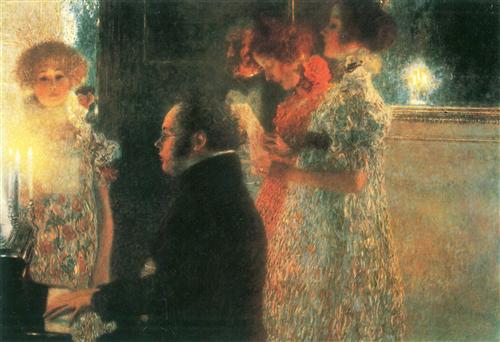
“Schubert at dinner” – me‏

"Schubert at the Piano, ll" -  Gustav Klimt

“Schubert at the Piano, ll” – Klimt (1899)

Gustav Klimt

_______

June has been too hot for words
here, therefore my hiatus, along
with other physical and emotional
tribulations

but someone sent me something
today that made me think I should
return to my literary preoccupations

I’ve been fussing about my kitchen
rather, making soups, biscuits,
muffins, learning about basic, and
trying out unusual, taste
considerations

coconut rice with lime, for instance,
perfect for seafood and summer
presentations

pan-roasted pork tenderloin in a
whisky, mustard preparation, for
one’s incontrovertible delectation

you need to sear the tenderloin in
oil first, salt and pepper of course,
turning to brown all indentations

then smear with a whipped up
mustard and butter blend, lower
heat, cover, listen to this Schubert,
meanwhile, revelation

one of several transcendental
sonatas he wrote before he died,
a too early death, considering his
sublime cultural donations

he was 30, too young to die, to
produce what would’ve surely
been otherworldly musical
creations

when the meat’s cooked, set it
aside, keep warm, loosely
covered, increase heat, add
diced shallots, soften for
several fragrant inhalations

add as much whisky as you
want, though too much, I
found, will defeat your taste
expectations, though not, of
course, your degree of
inebriation

bring to a boil, reduce to a glaze,
lower heat, add cream to the
mustard, butter, shallot, whisky
agglomeration

gently cook sauce till it clings
to a spoon, I add the pork then
to the pan to return it to my own
doneness specifications

with coconut rice, you’ll serve
an unadulterated celebration

with Schubert’s D894, whether
cooking or dining with it, an
utterly existential affirmation

have fun

Richard

psst: serve with wine

“fried bread” – me

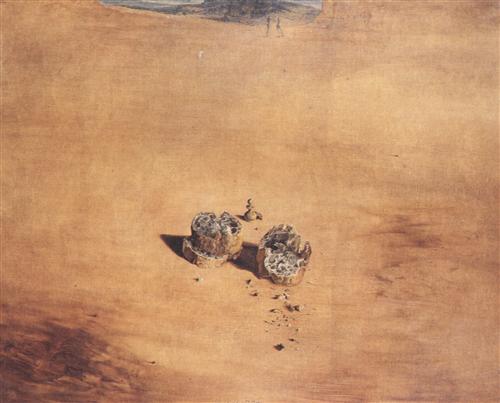
  "Two Pieces of Bread Expressing the Sentiment of Love" - Salvador Dali

Two Pieces of Bread Expressing the Sentiment of Love (1940)

Salvador Dali

_____

for my mom, who wanted the recipe

fried bread

to

1 1/2 cups of flour, pick a flour, any
flour

add

1/2 tsp salt, and
1 1/2 tsp of baking powder

I would think that eliminating salt
would give you merely a blander
bread, therefore salt is not
essential

and not adding baking powder
would simply produce a flatter
fry, therefore, theoretically, also
optional, but I’ve yet to test
these suppositions

though the recipe calls for 1 cup of
warm water, I’ve found that so much
water added to 1 and 1/2 cups of
flour makes the dough too limp and
unmanageable, so I recommend

1/2 cup of warm water

though water density, hard, soft,
probably depends on where you live

knead in more water by degrees if
your dough remains too dry

I also added

1/4 cup of grated Romano cheese, and
1 ample tbsp of fresh thyme

to the mix last night, though I’d
considered fresh basil, let it rise 20
minutes in a warm spot under a dry
cloth while I watched Sweden win
Eurovision 2015 from Vienna, rolled
out circles between two sides of a
piece of sealing wrap, folded over,
with extra flour between if needed,
the wrap helps to not make a mess
of your counter, made three large
rounds of dough out of my mix for
hearty slices, though less robust
portions would be, I’m sure, just
fine

fried each patty in up to

1/4 cup of oil, avocado had been
recommended, also coconut or
grape seed since, but I introduced
it only as needed not to overwhelm
either myself or the pan

flipped the cake once when the
top was becoming plump and
seemed to be breathing, when
the underside had become
golden brown

let the other side fry till equally
crusty and golden

had some last night with
Kaiserschinken, Kaiser’s ham,
and a firm Italian cheese,
Parrano Robusto

also a glass of cheap white wine

delicious

Richard

“a gull” – me


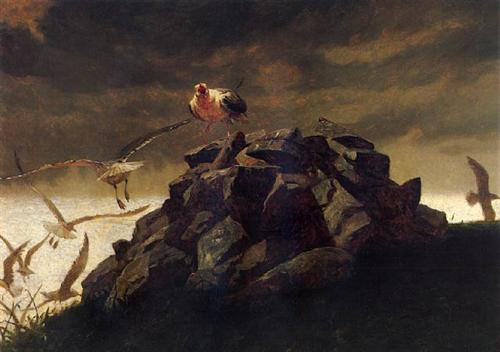
"The Rookery" -  Jamie Wyeth

The Rookery (1977)

Jamie Wyeth

_______

a gull

facing west into the imminent sunset,
a gull has been standing erect, of stone
nearly, atop the building across the
street from my high-rise window, little
by little in the darkening sky it’s
becoming its own silhouette, turning
from white to black against the
encroaching, still opalescent, evening

at one point it will disappear into the
night just standing there, black on
irrepressible black, ultimately
losing any distinction

should I listen

Richard

May, 2015

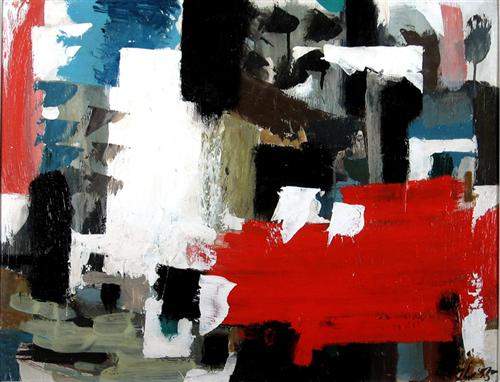
 "May" -  Jack Bush

May (1955)

Jack Bush

______

though the following poem might not be
a May poem in the traditional sense, the
play on words made it nevertheless to
my mind irresistible

May, not in the sense of what May is,
but May in its sense of what might be

Forever Young

May God bless and keep you always
May your wishes all come true
May you always do for others
And let others do for you
May you build a ladder to the stars
And climb on every rung
May you stay forever young
Forever young

May you grow up to be righteous
May you grow up to be true
May you always know the truth
And see the light surrounding you
May you always be courageous
Stand upright and be strong
May you stay forever young
Forever young

May your hands always be busy
May your feet always be swift
May you have a strong foundation
When the winds of changes shift
May your heart always be joyful
May your song always be sung
May you stay forever young
Forever young, forever young
May you stay forever young

Bob Dylan

____________

may your May be either way all of
those things

Richard

on odes

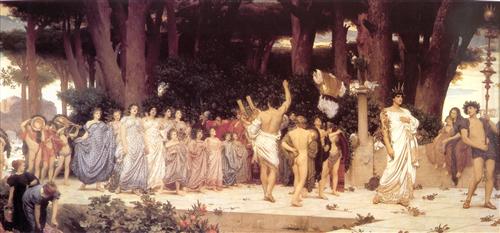
                          "The Daphnephoria" - Frederic Leighton

The Daphnephoria (c. 1875)

Frederic Leighton

________________

odes, with their suggestion of music
– despite a history of merely words
spoken in the intervening interim,
counting on meaning and rhythm
without music’s attendant tonality –
go back to the Greeks, the Seventh
Century, BCE, Sappho, for instance,
one of history’s most honoured
women poets, surely quite an
achievement for her in an age of
predominant, indeed
disenfranchising, masculinity

the ode was meant to accompany
tributes to people, events, things,
thereby acquiring an element of
acclamation and praise within its
dimensions, Pindar, ca 552 – 442
BCE, wrote odes for heroes of the
original Greek Olympics, for
instance

by the time of Horace, 65 – 8 BCE,
odes had become stylized,
independent of music, here’s one,
not inappropriately in this season’s
vernal context, to spring

odes remained spoken throughout
their resurrection in the wake of the
rediscovery of the Ancient World
during the Renaissance, onwards
through some famous Romantic
ones, Shelley, for instance, Keats,
up to even this one, by Stanislaw
Barańczak
, which I found in the
New Yorker
, April 20th, a gem, I
think, and in the very spirit of our
Age of Irony

Plywood

O plywood, second best to the real stuff,
believe me, one day I will say “Enough”

to my stooping shoulders, my slouched spine;
my sloped shape and your stiff boards will align,

and you’ll see how my backbone will unbend
and I’ll be standing straight until the end

of my makeshift but rectilinear
prayer, one stiff-backed as a chest of drawers

when we shove heavy furniture around;
I will rise from the dead, though on what ground

and which I, I don’t know; I’ll stand erect,
though my vertebrae’s hierarchic sect

won’t outlive plywood, no, it just can’t win
against that vertical eternity, so thin

and yet so sturdy in its ersatz pride;
as if the moon had shown me its dark side,

I lean, my ear glued to a cupboard’s back,
and I can hear its hollow and exact

hymn to its own cheap immortality;
no, wait, I still can straighten, still can be

square with this upright world (you knew I could),
just as plumb as four planks of real wood.

Stanisław Barańczak

(Translated, from the Polish,
by Clare Cavanagh and the author.)

__________

though you mightn’t’ve caught an “Ode”
in the title, the clue to its essence is in
the initial “O”, an acclamation

and yes, “O, Canada” is therefore also
an ode, as would be most anthems

incidentally Beethoven put the music
back into the form with his incendiary
use of Schiller’s poem for his vocal
triumph in his ninth Symphony, An
die Freude
“,
the Ode to Joy,
incomparable in this rendering for
an improbable 10,000
, yes 10,000, just
click

Richard