Just another WordPress.com weblog
November / Month of the Sonata – 13
by richibi
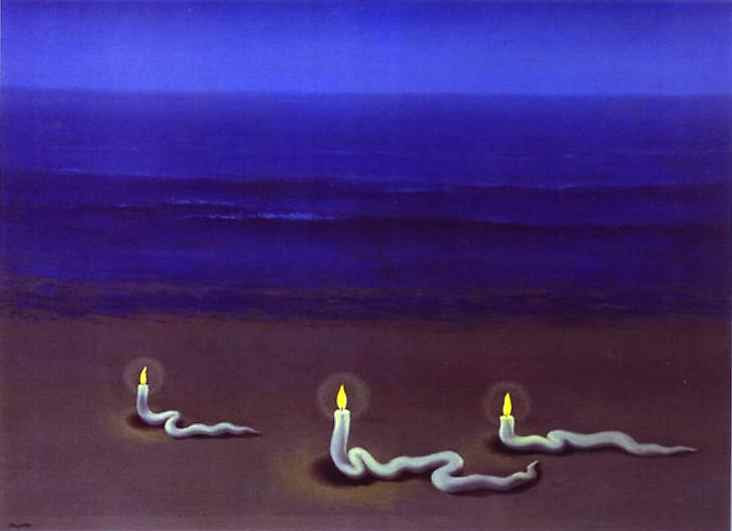.jpg "Meditation, 1936 - Rene Magritte")
_______
a story
while I volunteered at the palliative care
unit of our downtown hospital, a family
asked if I could monitor their mother
while they took time off for lunch
of course, I agreed
their mother lay unsettled on her hospital
bed, jittery, shaking, distressed, incoherent,
out of touch, in her own nether, dissociated
world, while the family, about ten of them,
had been chatting, seemingly oblivious to,
or unconcerned with, their mother’s flailing
they left
I sat by her side, placed a palm tenderly on
her quivering arm, to impart what calm I
could, to bring her warmth, care, attention,
and began to sing a mantra I’d learned at
an ashram I had been attending, weekly,
for months, after the death of my beloved,
in order to find solace, consolation, Om
Namah Shivaya, I chanted, gently, quietly,
over and over again
little by little, she settled, was becoming
calm
then, in a whisper, she began to join in,
Row, row, row your boat, she sang,
over and over again, along with my
own mantra, a duet of communication,
despite even the incongruity of the
tunes, we were meeting at an even
deeper, primordial level
something stirred behind me, I turned,
the family was standing in the doorway,
all held their breath, watching, as though
they were witnessing grace
I think they were
a mantra is a distillation of the three
pillars of Western music, tempo,
tonality, and repetition, what we sing
to children to lull them to sleep, that’s
what a mantra is
Row, row, row your boat indeed
the history of music in the West is
the disintegration of those norms,
for better or for worse
Bach, no accompaniment, no piano,
tail end of the Renaissance, when art
was directed by the Christian Church,
Bach was in fact cantor, music director,
of several churches in Leipzig
it took Mozart to kickstart the Classical
Era in the West, the purview, now, of
the aristocracy, a process that started
that he commissioned for Versailles,
leaving the Church behind in a
secularizing world
with Bach, tempo, tonality and repetition,
set the uncorrupted standard for the
ensuing ages, Bach is the next best
thing, to my mind, to meditation
R ! chard
 Richibi's Weblog