Richibi’s Weblog
About
Just another WordPress.com weblog
Piano Concerto no 4, Opus 58 – Beethoven
by
richibi
“
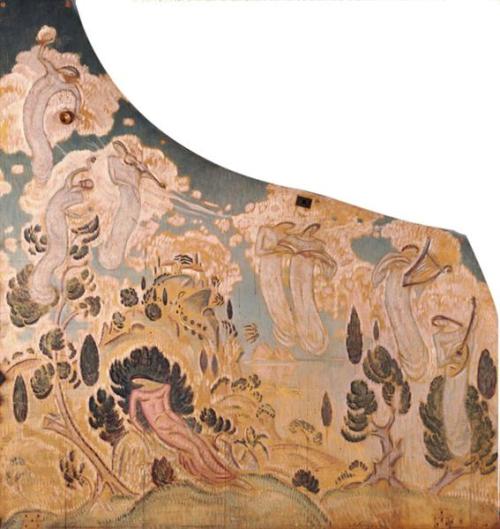
Music (Painting and Decoration of a Piano)
“
(1915-1920)
Konstantinos Parthenis
__________
like with Shakespeare, some of Beethoven’s
work doesn’t reach the heights I find in their
utter masterpieces, his
Fourth Piano Concerto
is, to my mind, such a piece,
though it’s not at
all not impressive
my complaint is that the musical motive, the
original theme, the cluster, merely, of notes
that make up the matter of the
ensuing
harmonic explorations, in all of
the three
movements of the
Fourth
, is
lost
in
his
excessive elaborations
,
one
is
distracted by
the
soloist’s
dazzling
showmanship
rather
than by the
work’s
metaphysical
magic, as
is conversely the case rather
in
Beethoven’s
sister
concertos, his
One
,
Two
,
Three
, and
Five
most notably, the
Fourth
‘s slow movement,
the
andante con moto,
slow, but not unduly,
passes by in an instant, nearly imperceptibly,
but for the conspicuousness of its plodding
rhythm, you wonder what just happened,
what did I miss
the first movement, the
allegro moderato,
or slightly slower than allegro, begins highly
unconventionally with the soloist at the helm,
setting up the conversation, as it were, the
subject of the matter
that an individual, a commoner, would’ve
dared to initiate a dialogue of purported
significance in a culture where subjects
would have known their place, like later,
for instance, a woman asserting her
position in a patriarchal society, would’ve
been shocking, and highly controversial
but Beethoven raps out a rhythm, four
quick notes followed by four quick notes
followed by the same four notes again,
ra ta ta tat, ra ta ta tat, ra ta ta tat, like
someone knocking at a door, however
plaintively, requiring
attention, before the
orchestra
responds, determinedly and
categorically,
though
the soloist will ever
remain the
prime,
and
manifest, mover
this is not a tune, this is a statement
this is also the 18th Century’s introduction
to the Romantic Period, where individual
voices were stating their answer to the
question of the disintegration of the
aristocratic as well as the religious
ideals which had prevailed throughout
the earlier Christian centuries, when
their controlling dogmas, however still
entrenched, were being questioned,
and rejected, as evidenced by both the
constitutional dictates of the American ,
and the French Revolutions
, which
were
installing,
codifying for
their
progeny,
their individual continents,
and
for
very
history,
the idea of Human,
as
opposed
to the traditionally assumed
Divine,
Rights
secular voices would consequently
sprout in myriad profusion
throughout the ensuing 19th Century
in order to people
with personalities,
as distinct
from
omnipotent, whether
secular or ecclesiastical,
established
figures,
to
shape the
ideologies
of the
impending future,
for better
or for
worse
but I digress, exponentially
the third movement of the
Fourth Piano
Concerto
reminds me, in all its urgency,
of the
finale of Rossini’s
William Tell
Overture
, of which I suspect it might
have been an inspiration, the work
better known to many of my generation
as the
theme to
The Lone Ranger
Lone Ranger indeed, Beethoven was
already leaving his indelible, not to
mention generative, mark on our
present, 21st Century, culture
enjoy
R ! chard
Share this:
Share on Facebook (Opens in new window)
Facebook
Share on LinkedIn (Opens in new window)
LinkedIn
Like
Loading...
Related
Published:
October 22, 2019
Filed Under:
Beethoven
,
concerts to ponder
,
in search of beauty
,
in search of God/dess
,
in search of truth
,
music to ponder
,
paintings to ponder
,
people to ponder
,
up my idiosyncrasies
,
walking in beauty
Tags:
"Music (Painting and Decoration of a Piano)" - Konstantinos Parthenis
:
American Revolution
:
Divine Rights
:
French Revolution
:
human rights
:
Piano Concerto no 1 / opus 15 - Beethoven
:
Piano concerto no 3 / Opus 37 - Beethoven :
:
Piano Concerto no 4 / Opus 58 - Beethoven
:
Piano Concerto no 5 / Opus 73 - Beethoven
:
Piano Concerto no. 2 / opus 19 - Beethoven
:
the Romantic Period
:
the Lone Ranger
:
William Tell Overture - Rossini
Leave a comment
Cancel reply
Δ
« Previous Post
Next Post »
Comment
Reblog
Subscribe
Subscribed
Richibi's Weblog
Join 144 other subscribers
Sign me up
Already have a WordPress.com account?
Log in now.
Richibi's Weblog
Subscribe
Subscribed
Sign up
Log in
Copy shortlink
Report this content
View post in Reader
Manage subscriptions
Collapse this bar
Loading Comments...
Write a Comment...
Email (Required)
Name (Required)
Website
%d
 Richibi's Weblog