Richibi’s Weblog

Just another WordPress.com weblog

Month: March, 2018

String Quartet, opus 77, no 1 – Joseph Haydn
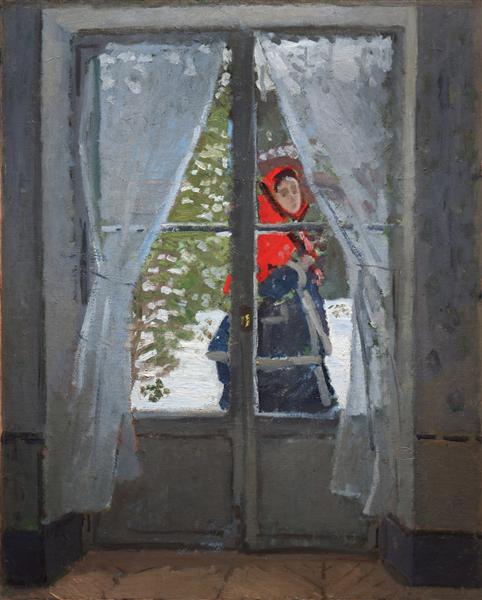
the-red-cape-madame-monet.jpg!Large.jpg

      The Red Cape (Madame Monet) (c.1870) 

              Claude Monet

                    _______

                                              for my mom

that’s a lot of Haydn, I said to my mom, 
when I saw the list of my transmittals in
her hotmail, hm, I wondered, maybe it’s 
too much

then I said, but it’s like when we’ve 
toured, for instance, our European 
art galleries, me propounding on 
the paintings, as I am wont, however 
incorrigibly, to do, but now, note, you 
can tell the difference between your 
Monets and your Klimts, however 
similar their perspectives

or like your tour guide taking you
recently through Argentina, 
highlighting spots, in the space of 
a month only, the same amount of 
time I’ve spent for the music of 
Haydn

pronounced, incidentally, I specified, 
like “hidin'” in English, not “maiden”, 
just sayin’

I gathered that she’d ‘ve sensed by 
now, if she’d been listening, which she 
said she had, mornings over her 
coffee, what a string quartet is, four
movements, different tempos, fast
at first, a joyful introduction, 
followed by a lament, then a spirited 
third movement, for countereffect, 
then a big fourth movement finish

also, the internal structure of each 
movement would’ve been internalized,
theme, a counter theme, a 
recapitulation of both, or either, all of 
it, probably unconsciously, which is 
how art fundamentally works till you
meticulously deconstruct it

the string quartet is the work of Haydn, 
the house that Haydn built, from 
peripheral aristocratic entertainment, 
like modern day artists sporting their 
wares in noisy restaurants, to the 
glamour of taking on, in concert halls, 
Europe, Brunelleschi did a similar, 
sleight-of-hand thing with his dome 
in Florence for its oracular Cathedral

remember that the string quartet lives 
on as a form, where no longer does 
the minuet, for instance, nor the 
polonaise, nor even the waltz, not to 
mention that concertos, and  
symphonies have become now  
significantly subservient to movies, 
secondary players


watch the instrumentalists here live 
out, in Haydn’s Opus 77, no 1, their 
appropriately Romantic ardour,
something not at all promoted in 
Haydn’s earlier Esterházy phase, to 
raise their bow in triumph, as they 
do at the end of most movements
is already an indicationnot at all 
appropriate for the earlier princely 
salons, that times have changed

Haydn was a prophet, but also an
elder, with an instrument to connect 
the oncoming, and turbulent, century 
to the impregnable bond of his 
period’s systems, the legitimacy of 
the autocratic, clockwork, world, 
Classicism, the Age of Reason, the 
Enlightenment, for better or for 
worse

we are left with its, however ever 
ebullient, consequences

enjoy


R ! chard

String Quartet in C major, opus 76, no 3, “Emperor” – Joseph Haydn

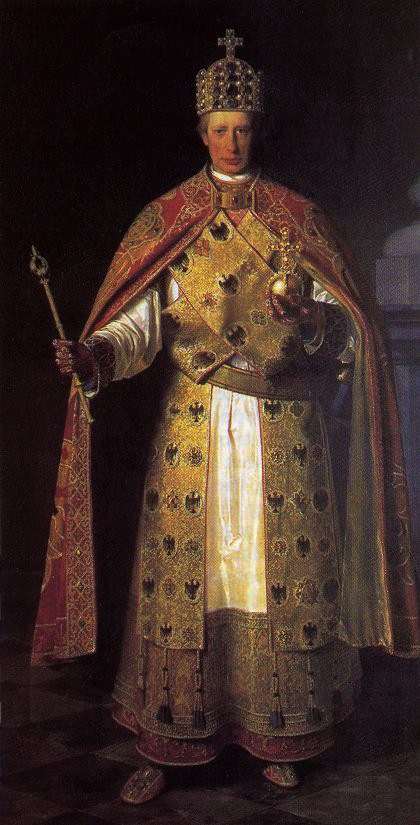
Ludwig_Streitenfeld_001.jpg

    Francis II as Holy Roman Emperor (1874)

          Ludwig Streitenfeld

               _____________

Haydn’s String Quartet, opus 76, no 3
is nicknamed the Emperor cause the 
second movement, the poco adagio;
cantabile, is a recapitulation of an 
anthem Haydn had earlier written for 
Francis ll, the Holy Roman Emperor
– not, incidentally, for Napoleon, the 
Emperor of the moment, who was to 
defeat Francis lleventually, at the 
Battle of Austerlitz, December 2, 1805, 
thereby dissolving that Holy Roman 
Empire, which had been established 
by Leo, the very Pope, lll when, on 
December 25th, 800, which is to say 
preceding Austerlitz by a thousand 
years, he crowned Charlemagne its 
Emperor 

Haydn must’ve been a monarchist


you’ll recognize that second movement
as the present day anthem of Germany

but listen to how Haydn makes it glisten, 
explicitly, with articulations and filigree 
that render it utterly irresistible

the adagio is usually the moment that
remains immutable, if the composer
is doing hir stuff, it’s the one you walk 
home singing, the faster movements,
however histrionic, are nearly a dime 
a dozen, though ever nevertheless 
often dazzling 

this adagio is utterly Romantic, though
I’m sure Haydn didn’t know what he 
was doing, cause despite their push
against the democratic surge, even 
monarchists, princes, dukes, dutiful 
composers, were finding, and voicing, 
their personal, and individual, which 
is to say, their democratic, opinions, 
however aristocratic their pedigree

artists had done a similar thing when 
their personalities began to single 
themselves out as especially gifted 
when the Renaissance was 
happening, it was now music’s hour, 
individual voices were staking their 
claim, Haydn’s manifestly superior 
based on talent and, after widespread 
economic affluence, audience appeal, 
Haydn’s commercial boots were made 
for walking, and he filled them both
magnificently and incontrovertibly

the poco adagio; cantabile is not 
courtly music, it reaches for not
merely elegance, but the heart,
we’ve entered another 
transformational generation, 
something like the revolution 
that triggered change in the 
cultural upheaval of the1960s 

our first step then was the Beatles, 
theirs was Haydn, or rather Elvis
Presley shoring up the Beatles, 
Beethoven was more aptly John,
Paul, George and Ringo 


but watch the rapture on the players’ 
faces, Francis ll would’ve been 
appalled, much like parents in my 
generation facing the pill, drugs, 
unorthodox sexual couplings, and, 
of course, raucous and unruly rock 

music

today, under the spell of the 
Romantic Period, and encouraged
by that very Sexual Revolution, the
Calidore String Quartet’s Elysium
their evident blissemotionally 
manifest, and utterly arresting, sells 
tickets, for better orhopefully not, 
for worse

but you call the shots, to decorum or 
not to decorum, that is the question

watch, wonder, listen 


R ! chard